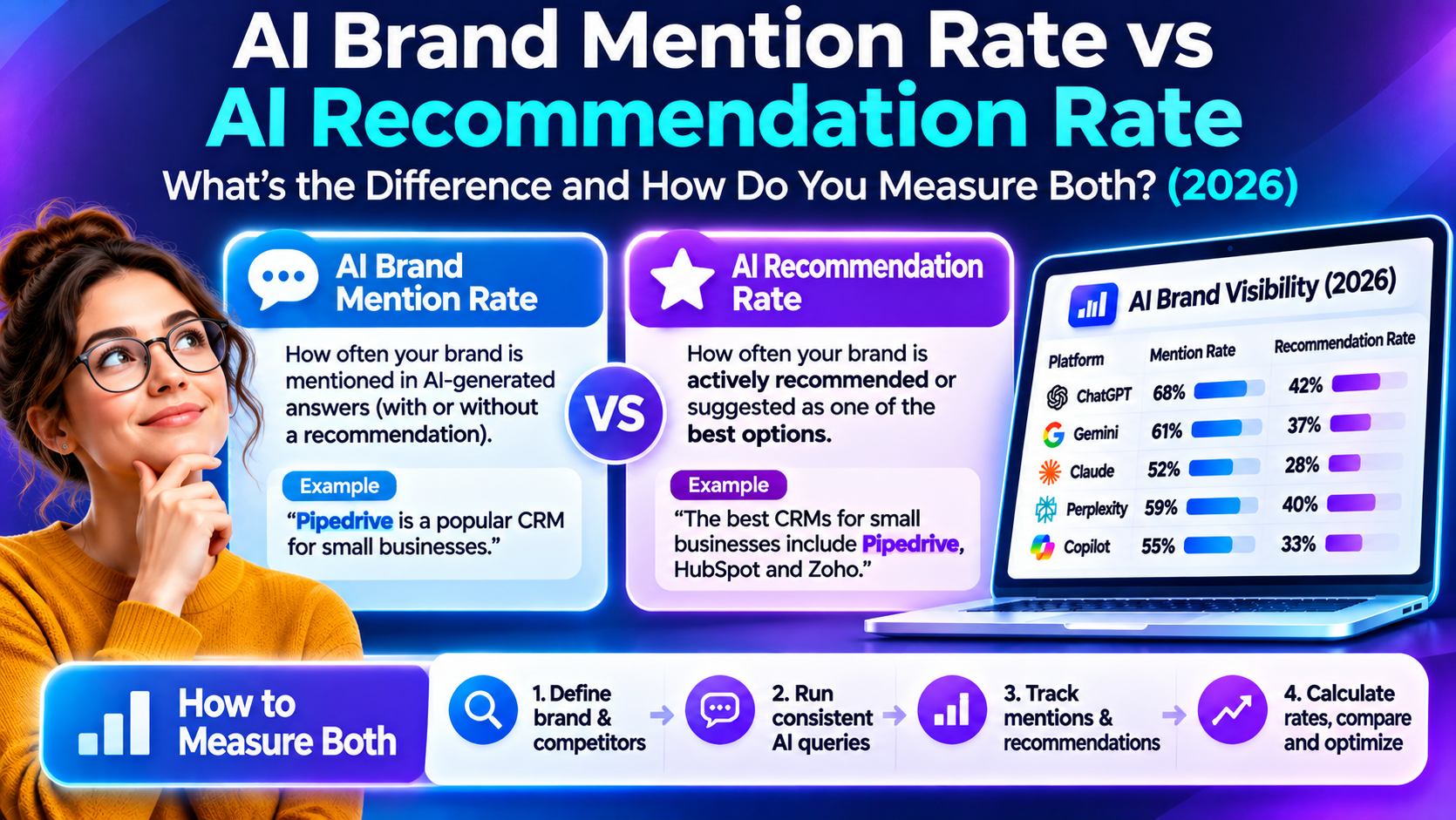
AI Brand Mention Rate vs AI Recommendation Rate: What’s the Difference and How Do You Measure Both? (2026)
A brand can appear in 70% of AI-generated answers but be recommended in only 20%. That gap matters. An AI assistant might mention your company as an example, warn against it, or recommend a competitor instead. Counting all three outcomes as a win would misrepresent your brand's visibility.
For US businesses measuring their presence in ChatGPT, Google Gemini, Claude, Perplexity, and Microsoft Copilot, two metrics should be reported separately: AI Brand Mention Rate and AI Recommendation Rate. This guide defines both, supplies calculation formulas and worked examples, and explains how to build a repeatable measurement program without mistaking sampled model answers for all customer searches.
Quick answer: Mention rate measures how often your brand is named in a defined set of AI responses. Recommendation rate measures how often your brand is affirmatively suggested as a suitable option in that same set. Both percentages depend on the prompt set, sampling method, and exact classification rules. Neither is a universal platform-reported metric.
1. What is AI Brand Mention Rate?
AI Brand Mention Rate is the percentage of eligible, sampled AI answers that mention your brand by name. It measures basic presence, not endorsement.
Formula:
AI Brand Mention Rate (%) = (eligible answers containing a brand mention / total eligible answers evaluated) × 100
For example, suppose you run 100 qualifying responses across your selected AI platforms and 62 contain the brand name Northstar CRM. The mention rate is (62 / 100) × 100 = 62%.
The brand counts as mentioned if the response unambiguously names it, including as a recommended product, a neutral comparison item, or a warning. Record aliases and product names in advance; do not casually add matches after reviewing outcomes. A hyperlink to your site with no visible brand name can be counted separately as a citation rather than silently treated as a named mention.
What it answers: “When an AI assistant answers the customer questions we monitor, how often does it name our company?”
What it does not answer: “Was the brand recommended, presented accurately, clicked, or purchased?”
2. What is AI Recommendation Rate?
AI Recommendation Rate is the percentage of eligible, sampled answers that clearly suggest your brand as a suitable option for the user's question. It is a stricter outcome than a simple mention.
Formula:
AI Recommendation Rate (%) = (eligible answers that affirmatively recommend the brand / total eligible answers evaluated) × 100
If Northstar CRM is recommended in 24 of the same 100 responses, the recommendation rate is 24%. In this framework, recommendations are a subset of mentions: the response must identify the brand and positively suggest it as relevant to the user's needs.
Recommendation definitions are not universally standardized. Some monitoring providers count a favorable mention or top-ranked placement as a recommendation; others require an explicit endorsement. Document your rule before collecting data and use it consistently across platforms, competitors, and reporting periods.
A practical classification rule is to record a recommendation only when the AI answer clearly says the business is a good option, includes it among recommended providers in response to a buying-intent question, or selects it for a defined use case. A mere list of competitors, an uncertain statement such as “might be considered,” or a negative mention should not qualify.
3. Mention Rate vs Recommendation Rate: Side-by-side comparison
| Dimension | Brand Mention Rate | Recommendation Rate |
|---|---|---|
| Core question | Was the brand named? | Was the brand positively suggested? |
| Numerator | Answers that mention brand | Answers that explicitly recommend brand |
| Denominator | All eligible sampled answers | The same eligible sampled answers |
| Captures neutral or negative mentions? | Yes | No |
| Requires judgment about context? | Usually little | Yes—use a fixed rubric |
| Best for | Discoverability baseline | Buyer-facing influence signal |
| Typical limitation | Can look strong despite negative context | Sensitive to wording, intent, and annotation rules |
Avoid computing mention rate over all monitored responses and recommendation rate over only the answers that mention the brand, then reporting those percentages side by side. That changes the denominator and obscures the comparison.
If useful, you can additionally report Recommendation Among Mentions:
Recommendation Among Mentions (%) = (recommended answers / answers mentioning the brand) × 100
This is a conditional rate, not the same as your primary Recommendation Rate. Label it explicitly.
4. Three worked examples showing why both KPIs matter
These examples are illustrative measurements, not real results for actual companies.
Example A: High mentions, weak recommendations
A fictional SaaS vendor is named in 70 of 100 eligible AI answers, but recommended in only 20.
- Mention Rate: 70%
- Recommendation Rate: 20%
- Recommendation Among Mentions:
20 / 70 = 28.6%
Interpretation: The company is recognizable, yet many responses mention it neutrally, comparatively, or unfavorably. Review the actual language, the reasons alternatives were selected, and whether factual inaccuracies affected decisions. Do not assume a content campaign alone will fix the gap.
Example B: Lower mentions, high recommendation quality
Another fictional vendor is mentioned in 40 of 100 answers and recommended in 32.
- Mention Rate: 40%
- Recommendation Rate: 32%
- Recommendation Among Mentions:
32 / 40 = 80%
Interpretation: When the company appears, it is often suggested positively, but the business may have an awareness or topical coverage gap. Examine prompts where it never appears.
Example C: A rate rises even while recommendations decline
Month 1: 30 recommendations from 100 answers = 30%. Month 2: 45 recommendations from 200 answers = 22.5%.
The raw count grew, but the rate fell. This may reflect a different mix of prompts or platforms; it does not prove the brand lost real-world demand. Use the same sampling protocol before interpreting the change.
5. How to classify AI answers consistently
Create a short annotation policy that human reviewers—or a carefully audited classification model—can follow:
| Response example | Mention? | Recommendation? | Reason |
|---|---|---|---|
| “Northstar CRM is one of the options available.” | Yes | No | Neutral presence |
| “For a five-person sales team, I recommend Northstar CRM.” | Yes | Yes | Clear endorsement |
| “Avoid Northstar CRM if offline use is essential.” | Yes | No | Negative mention |
| “Northstar CRM and Rivermark CRM are competitors.” | Yes | No | Factual comparison |
| “Consider these tools: Northstar CRM, Rivermark CRM, Apex CRM.” | Yes | Depends on rubric | Ambiguous unless clearly a recommendation list |
| “This source explains the topic: northstarcrm.com” | Separate citation | No | URL citation alone |
For the ambiguous case, decide before measurement whether “consider these” qualifies as a recommendation when the prompt asks for suggestions. Record the original prompt and final coding decision. Never classify all list appearances as positive recommendations by default.
Set conventions for brand aliases, subsidiaries, homonyms, spelling errors, citations without named brands, source snippets, and follow-up messages. Use a second reviewer on a subset of responses to check agreement and resolve disputed classifications.
6. Build a reliable AI Visibility prompt library
Your score is only as representative as the questions you test. Choose buyer-relevant queries that resemble realistic decisions, rather than only branded questions that already contain your company name.
For a US B2B software company, sample categories could include:
- Problem discovery: “How can a 10-person sales team reduce CRM admin work?”
- Category discovery: “What CRM tools work well for small US sales teams?”
- Comparison: “Compare CRM systems for a growing service business.”
- Purchase intent: “Which CRM should a US company choose with a $100 monthly budget?”
- Use-case fit: “Recommend a CRM for a construction sales team.”
- Brand accuracy: “What does Northstar CRM do and who is it for?”
The sixth prompt is a branded factual test and should be reported in a separate cohort; including brand-name prompts in general recommendation rates will artificially inflate mentions. A robust initial library might include 30–50 unbranded questions selected by buyer persona, industry, intent, and geography.
Keep prompt wording and prompt weights stable. Store any changes as a new measurement version rather than silently revising past results.
7. Measure five AI assistants with a repeatable sampling plan
A useful pilot covers ChatGPT, Gemini, Claude, Perplexity, and Microsoft Copilot, subject to the products' available features and your testing rights.
For example, run 40 unbranded prompts × 5 platforms × 3 replicates = 600 sampled answers per measurement cycle. Repeated runs help capture variability, though they are not independent observations in a strict statistical sense.
Record the following for every run:
| Field | Example value |
|---|---|
| Collection date/time | 2026-11-15 10:00 EST |
| Platform and model/experience | ChatGPT, web search enabled |
| Prompt ID | SMB-CRM-014 |
| Prompt intent | Purchase consideration |
| Geography/language | United States / English |
| Brand named? | Yes / No |
| Brand recommended? | Yes / No |
| Recommendation position | First / Other / None |
| Citation to owned domain? | Yes / No |
| Tone/factual accuracy | Positive / Neutral / Negative / Incorrect |
| Response text and source links | Archived evidence |
| Evaluator and rubric version | Reviewer 1 / v1.0 |
Where possible, control account state, personalization, prompt context, search mode, and location. Log the configuration when control is not possible. Some products do not provide complete model/version metadata; mark that field as unavailable rather than guessing.
AI answers vary across sessions, dates, regions, and experiences. Your numbers are estimates for your defined test set, not a census of everything users see.
8. Calculate both rates: a realistic KPI dashboard
Suppose one month yields the following fictional eligible response counts:
| AI platform | Answers | Mentioned | Recommended | Mention Rate | Recommendation Rate |
|---|---|---|---|---|---|
| ChatGPT | 120 | 66 | 30 | 55.0% | 25.0% |
| Gemini | 120 | 48 | 24 | 40.0% | 20.0% |
| Claude | 120 | 54 | 18 | 45.0% | 15.0% |
| Perplexity | 120 | 72 | 42 | 60.0% | 35.0% |
| Copilot | 120 | 60 | 30 | 50.0% | 25.0% |
| Total | 600 | 300 | 144 | 50.0% | 24.0% |
Combined Mention Rate = 300 / 600 × 100 = 50%.
Combined Recommendation Rate = 144 / 600 × 100 = 24%.
Because each platform has the same 120-answer sample size here, the combined rate matches the simple average of platform percentages. When sample sizes or intended business importance differ, use transparent weights. Never let an accidental oversampling of one platform determine the headline number.
Useful additional KPIs: Citation Coverage (answers that cite your owned domain / all eligible answers), Brand Accuracy Rate (factually correct brand descriptions / all evaluable brand descriptions), share of brand mentions among a documented competitor set, and referral conversions measured in your own analytics. These are different indicators with different denominators.
9. Why citation rate is different from mention and recommendation rates
An AI assistant can recommend your product without linking to your website. It can also cite an article on your domain without recommending your company. Therefore:
- Mention: Your brand is named in the response.
- Recommendation: Your brand is positively suggested as an option.
- Citation: The response visibly references your website or material as a source.
- Referral: A user actually arrives at your site from an AI surface.
- Conversion: The visitor completes a valuable business action.
Microsoft's Bing Webmaster Tools AI Performance report reports site citations across supported Microsoft Copilot, Bing AI and partner experiences. Microsoft explicitly distinguishes citations from rankings, traffic and authority. Its aggregate counts should not be substituted directly into your prompt-sample mention or recommendation calculations.
10. Common measurement mistakes
Counting any brand mention as a recommendation
This is the most serious error. A negative mention still raises Mention Rate, but should never raise Recommendation Rate under the positive-endorsement rule.
Using only branded prompts
If your prompt begins with the company name, the brand is likely to be mentioned. Use branded prompts for an accuracy audit and unbranded queries for category discovery benchmarking.
Comparing unequal time periods or prompt mixes
A score can shift because you changed the questions, AI platforms, geography, or measurement rules. Preserve a stable benchmark set and version all deliberate changes.
Ignoring sample size and variability
A result of 4/5 is 80%, but it is not a stable estimate. Report numerator, denominator, sampling method, and uncertainty where appropriate. Repeated observations from the same prompts are correlated; simplistic confidence intervals can make results look more precise than they are.
Treating all recommendations as equivalent
Being the first recommendation is often different from being one of 15 options. Record order and phrasing as secondary indicators, without quietly changing the primary definitions.
Confusing visibility with pipeline or revenue
Even improved Recommendation Rate does not prove a sale was caused by AI visibility. Use website analytics, qualified leads, assisted conversions, and controlled tests where feasible.
11. A 30-day measurement rollout for US businesses
Week 1 — Define the rules
Choose the tracked brand and competitors, document aliases, assemble 30–50 realistic unbranded prompts, and freeze the measurement rubric. Segment prompts by intent, industry, and US geography.
Week 2 — Collect a baseline
Run the prompt library across the AI products you can consistently test. Save complete responses, dates, citations, settings and coding decisions. Audit ambiguous recommendations manually.
Week 3 — Investigate the gaps
Identify prompts with a mention but no recommendation, prompts where competitors appear and you do not, and answers containing factual errors. Review website information and credible third-party evidence that may shape these answers.
Week 4 — Report and plan improvement
Publish Mention Rate, Recommendation Rate, Recommendation Among Mentions, sample counts and confidence limitations. Prioritize content and business-information improvements, then schedule the next collection with the same baseline prompts.
Do not claim a change after four weeks was caused by a specific website edit unless the evaluation design can support that inference.
12. Manual spreadsheets vs AI Visibility software
A spreadsheet can work for a first 30-day pilot. At scale, software can help schedule prompts, organize responses, compare competitors and track historical changes. Evaluate platform coverage, repeatability, evidence retention, custom coding rules, export options and pricing before subscribing.
US-headquartered providers already listed in our directory include:
- Profound — AI search intelligence and visibility measurement.
- Evertune — GEO analytics, consumer prompts and competitive research.
- Scrunch AI — visibility analytics and agent-oriented website optimization.
- Brandlight — enterprise brand intelligence and reputation monitoring.
- Conductor — AI Search analysis integrated with enterprise SEO workflows.
- seoClarity — enterprise SEO and AI search measurement.
Capabilities and calculation methods vary. Do not assume their published “visibility,” “recommendation,” or “share of voice” values use the exact definitions in this guide. Ask each vendor for its numerator, denominator, query sample, annotation method, and refresh frequency.
If you need agency assistance, browse the GEO & AEO Agencies category, which includes US providers such as WebFX and iPullRank.
13. Frequently asked questions
Is AI Mention Rate the same as AI share of voice?
No. Mention Rate is the percentage of sampled answers containing your brand. A common AI share-of-voice definition is your share of mentions among the tracked competitor set. That metric depends on the competitor roster and whether multiple mentions per response count more than once.
Can Recommendation Rate exceed Mention Rate?
Not under the strict definitions used here, because every affirmative brand recommendation must also name the brand. If your dashboard shows Recommendation Rate greater than Mention Rate, check for denominator mismatches, different scopes, or inconsistent annotation rules.
Can a brand have high Mention Rate but low Recommendation Rate?
Yes. Neutral comparisons, warnings, and criticism can all mention the brand without recommending it. This gap is often more actionable than mentions alone.
Which AI platform is most important to monitor?
That depends on your customers and the products they use. Choose platforms based on realistic buyer behavior, and keep the measurement design consistent enough to interpret changes.
Is there one official industry formula for Recommendation Rate?
No universally adopted formula applies across all AI monitoring tools. This article recommends an auditable answer-level definition that should be disclosed alongside any reported percentage.
How many prompts should a small business test?
A focused 30–50-prompt library provides a manageable starting point, not a statistical guarantee of market representativeness. Repeat relevant prompts, segment by buying intent and enlarge your dataset when important decisions depend on the results.
Do AI citations prove my brand is recommended?
No. A citation shows that a source was referenced in an answer. It can appear in a purely educational response without suggesting your company as a vendor.
Can I guarantee an improved score by changing my website?
No. AI answers depend on multiple sources, retrieval conditions, model behavior and prompt context. Focus on accurate, useful business information and monitor results rather than purchasing guaranteed-inclusion claims.
14. Conclusion: report presence and persuasion separately
AI Brand Mention Rate tells you whether your company is part of the conversation. AI Recommendation Rate tells you how often the answer actually suggests your company as a suitable option. Neither one captures the complete buyer journey, but reporting both—with stable prompt samples, explicit coding rules and transparent denominators—provides a more useful baseline than counting raw mentions alone.
For practical next steps, read our multi-platform AI brand monitoring guide and explore the AI Visibility Platforms directory.
Sources and further reading
- IAB — Measuring Visibility in the AI Era (August 2026): industry framework for AI mention and citation measurement; terminology varies by provider.
- Microsoft — AI Performance in Bing Webmaster Tools: first-party citation measurement and interpretation limits.
- Microsoft — Introducing AI Performance (February 2026): product announcement and scope.
Editorial disclosure: This is an independent educational guide. Example companies, prompts, counts, and results in calculation sections are fictional and provided for illustration. Directory listings are informational, not endorsements or guaranteed performance rankings. Last reviewed: November 15, 2026.