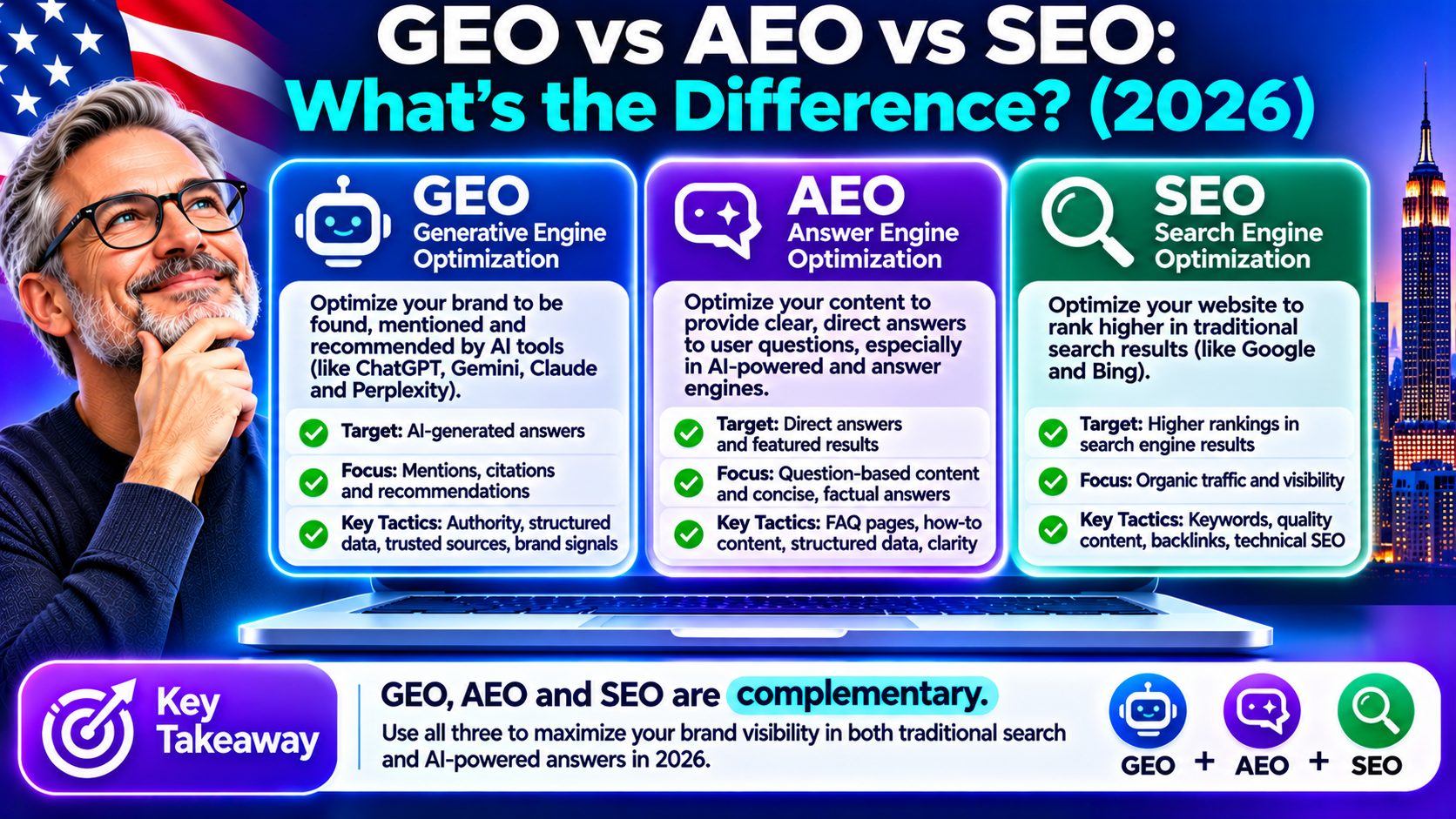
GEO vs AEO vs SEO: What's the Difference? (2026)
Businesses are encountering three overlapping terms in search marketing: Search Engine Optimization (SEO), Answer Engine Optimization (AEO), and Generative Engine Optimization (GEO). If your customers now ask ChatGPT for vendor recommendations, read Google's AI Overviews, or use Perplexity to research products, which approach should you invest in?
The practical answer is not to choose one and abandon the others. SEO establishes a discoverable, credible website; AEO emphasizes clear answers to questions; and GEO focuses on how a brand or source is represented in generative AI responses. These are useful planning labels, but their boundaries are not standardized, and their methods often overlap.
This 2026 guide explains the distinctions, shows how to measure results, provides a realistic action plan, and connects you to US-based providers in the AI Visibility Directory.
GEO vs AEO vs SEO: Quick Comparison
| Dimension | SEO | AEO | GEO |
|---|---|---|---|
| Full name | Search Engine Optimization | Answer Engine Optimization | Generative Engine Optimization |
| Primary question | Can people find our pages in search results? | Can an answer system clearly use our information to answer a question? | Does our brand or content appear accurately and usefully in generative AI answers? |
| Typical surfaces | Organic search results | Featured snippets, answer interfaces, conversational search | ChatGPT with search, Perplexity, Gemini, AI Overviews, AI Mode and similar experiences |
| Core work | Technical accessibility, helpful content, site structure, links | Direct explanations, question-oriented content, clear facts | AI visibility baselines, source and citation analysis, factual consistency, content and authority improvements |
| Common metrics | Search impressions, clicks, organic conversions | Answer appearances, relevant citations, question coverage | Brand mention rate, citation coverage, recommendation inclusion, accuracy, AI referrals |
| What it cannot guarantee | A first-place Google ranking | That an engine will choose your answer | A citation, recommendation, or endorsement by an AI model |
Important: AEO is also used by some practitioners to refer primarily to classic answer boxes and voice search; others use it more broadly for modern AI answers. GEO and AEO are often used interchangeably by vendors. Ask prospective providers what they actually deliver rather than relying only on the label.
1. What Is SEO?
Search Engine Optimization is the practice of improving the technical accessibility, clarity, usefulness, and reputation of website content so search engines can discover it and users can find it through search results.
An effective SEO program usually covers several connected areas:
- Technical SEO: crawlability, indexability, redirects, canonical URLs, mobile usability, performance and website architecture.
- Content strategy: pages that address real buyer questions, compare alternatives accurately and provide first-hand expertise.
- On-page SEO: descriptive titles, headings, links, accessible text and useful page summaries.
- Authority and reputation: independently earned references, editorial coverage and genuine business credibility.
- Measurement: organic visibility, qualified traffic, leads and sales rather than rankings alone.
For example, a cybersecurity consultancy might create a detailed page explaining its penetration-testing service, pricing approach, qualifications, deliverables and typical engagement process. Conventional SEO helps relevant buyers discover this page through search.
SEO remains relevant to generative search. Google says that its AI search experiences rely on core search systems and recommends established SEO fundamentals, including making important content accessible as text and keeping structured data consistent with what visitors can see. Source: Google Search Central — AI features and your website.
When SEO matters most
If your website is difficult to crawl, offers thin or outdated information, or fails to answer buyers' basic questions, begin with SEO fundamentals. An AI-focused content campaign cannot reliably compensate for an inaccessible or untrustworthy website.
2. What Is AEO?
Answer Engine Optimization describes efforts to make information useful for systems that respond directly to questions. These may include search answer panels, voice interfaces and AI-powered search products.
AEO does not mean writing every heading as a question or stuffing pages with FAQs. It means giving users direct, correct, sufficiently contextual answers that are easy to locate and understand.
What an AEO-friendly page looks like
Suppose a software company publishes a guide answering, “Does SOC 2 certification mean a product is secure?” A useful section might:
- Explain concisely that SOC 2 is an assurance reporting framework, not a blanket security guarantee.
- Distinguish SOC 2 Type I and Type II accurately.
- Describe what a prospective buyer should review in a report.
- Cite authoritative supporting material.
- State limits and update the information when standards change.
This structure serves human readers first. It also provides a clear, attributable explanation that answer systems may use when retrieving relevant information.
Practical AEO activities
- Research genuine customer questions, especially high-intent pre-purchase questions.
- Write straightforward answers followed by details, examples and qualifications.
- Keep product specifications, eligibility requirements and pricing statements consistent.
- Use clear sections, tables and definitions where they genuinely improve comprehension.
- Maintain relevant internal links to product pages, research and supporting evidence.
- Use appropriate structured data when applicable, without assuming markup guarantees a featured answer.
What AEO cannot promise
No consultant can guarantee that ChatGPT, Google or another answer engine will reproduce a particular sentence or display a specific page. The system's responses can differ by query wording, context, time, retrieval source and model version.
3. What Is GEO?
Generative Engine Optimization focuses on improving a brand's or source's visibility and representation within answers generated by AI systems.
Instead of only asking “Does our page rank?”, GEO adds questions such as:
- Is our company mentioned when users ask for providers in our category?
- Does the system recommend competitors but omit us?
- Are our products described accurately?
- Which outside websites are cited in relevant answers?
- When our website is cited, is the link appropriate and useful?
- Do AI referrals contribute meaningful business outcomes?
GEO became a research and commercial topic as systems began synthesizing answers from multiple sources rather than presenting only ranked links. Academic work introduced evaluation approaches for measuring visibility inside generated responses. However, research results are context-dependent; they do not demonstrate a universal trick that guarantees higher citations across models. Research: GEO: Generative Engine Optimization.
Practical GEO activities
Establish an AI visibility baseline. Define a repeatable set of prompts reflecting your audience's research and buying journey. Record whether your brand is mentioned, recommended or cited, and verify factual accuracy.
Study source coverage. Investigate which websites, product directories, expert publications and original research sources repeatedly appear in relevant answers. Prioritize legitimate, editorially earned visibility over manufactured citations or paid references disguised as independent evidence.
Improve your owned information. Publish clear, factual pages about your products, services, capabilities and limitations. Resolve contradictions across product pages, documentation and company profiles.
Strengthen useful third-party information. Correct inaccurate business profiles, contribute expert research and maintain legitimate industry relationships. Do not buy artificial mentions or create misleading reviews.
Test and learn. Repeat measurements across platforms and over time. Analyze results in aggregate rather than treating a single chatbot answer as a permanent ranking.
What current search engines say
Google's official guidance describes GEO and AEO as terms used in the market for AI search visibility work, but says that, for Google Search, optimization for generative AI features is still part of SEO. It explicitly warns against chasing special “AEO/GEO hacks” rather than investing in valuable original content and solid technical foundations. Source: Google Search Central — optimizing for generative AI features.
Microsoft similarly states that SEO principles underpin visibility across Bing and AI-powered experiences, while GEO cannot guarantee grounding or citations. Source: Bing Webmaster Guidelines.
4. One Business Example: A US B2B Software Company
Imagine a US-based inventory-management SaaS company trying to attract operations managers.
SEO scenario: A prospective buyer searches Google for “inventory software for multi-location retailers.” Strong SEO helps an accurate, useful comparison or product page become discoverable in conventional results.
AEO scenario: The buyer asks, “What features should multi-location inventory software include?” A clear, comprehensive guide explaining stock synchronization, permissions, integrations, reporting and security can help answer that question.
GEO scenario: The buyer asks ChatGPT or Perplexity, “Which inventory platforms should a 30-store retailer evaluate?” The company wants to understand whether its brand appears, whether the recommendation is accurate, what sources inform the answer and where competitors have stronger evidence.
These are three views of the same buyer journey, not three disconnected marketing channels. A single well-maintained product knowledge base, backed by authoritative information and effective technical SEO, can support all three.
5. What Should a Business Measure?
The biggest strategic mistake is treating “AI visibility” as one number without explaining what it measures. A useful measurement program distinguishes discovery, representation, citations and business outcomes.
| Metric | What it measures | Key caution |
|---|---|---|
| Organic search impressions | How often a page appears in tracked search results | Visibility does not equal a website visit |
| Organic clicks and conversions | Search visits and resulting business outcomes | Attribution is imperfect |
| Brand mention rate | Share of sampled AI answers that mention your brand | Depends heavily on which prompts are sampled |
| Recommendation rate | Share of relevant sampled answers explicitly recommending the brand | Mentioning is not necessarily recommending |
| Citation coverage | Share of sampled answers or prompts linking to your sources | A citation is not always positive or commercially valuable |
| Brand accuracy | Whether generated claims about your company are correct | Requires human review against authoritative facts |
| Competitive share of voice | Your relative presence compared with named competitors | Competitive sets and measurement methods must be stable |
| AI referral traffic | Visits arriving from attributable AI services | Some AI-assisted conversions may not be directly attributable |
| Qualified enquiries | Leads, demos or sales influenced by AI discovery | Ask how causality and attribution are being estimated |
Microsoft's Bing Webmaster Tools AI Performance report measures citation activity across supported AI experiences and provides page-level insights. Microsoft explicitly notes that citation totals do not themselves measure authority, rank or impact.
A repeatable baseline exercise
Build a test set of 30–50 prompts across three groups: informational questions, comparison questions and purchase-intent questions. Use the same query set, geography, observation window and competitor definitions each time.
For each response, record: engine, date, exact prompt, whether the brand appears, whether it is recommended, citations, factual errors and any relevant competitor mentions. If possible, run multiple observations to account for variability.
Review changes monthly. Do not claim that a content change caused a visibility increase without controlling for other plausible explanations, such as model updates, prompt variation or source changes.
6. Seven Steps to Improve SEO, AEO and GEO Together
Step 1 — Confirm indexing and technical accessibility
Check whether your important pages are crawlable, indexable and internally linked. Review server responses, redirects, canonical tags, robots directives and content rendered by JavaScript. Fix substantive accessibility problems before expanding content production.
Step 2 — Map the buyer journey
Collect real questions asked by customers, sales teams and support teams. Group them into awareness, evaluation, vendor comparison and decision stages. Prioritize the questions that matter commercially.
Step 3 — Build accurate, original content
Publish meaningful product information, firsthand examples, evidence, limitations and demonstrations. Avoid dozens of nearly identical articles that simply rearrange common definitions.
Step 4 — Make answers easy to verify
Include clear facts, dates, authorship where useful, references, comparisons and transparent assumptions. Update material when products, specifications, laws or pricing change.
Step 5 — Earn legitimate external references
Develop original research, credible partnerships and useful commentary that industry publishers may independently reference. Keep company profiles and authoritative business information consistent.
Step 6 — Measure across multiple AI experiences
Track a stable set of relevant prompts on the platforms your buyers use. Compare visibility and accuracy, but avoid overreacting to individual runs.
Step 7 — Connect visibility to outcomes
Monitor organic traffic, AI referrals, assisted conversions, demo requests and qualified enquiries. Continue investing in work that supports customers, not only dashboard scores.
7. Should You Hire an SEO, AEO or GEO Specialist?
The answer depends on where your bottleneck sits.
| Situation | Sensible starting point |
|---|---|
| Site has indexing problems or weak content architecture | Technical SEO specialist |
| Buyers ask questions your website does not answer clearly | Content strategist with AEO capabilities |
| Brand is consistently omitted or misrepresented in AI answers | GEO/AI Visibility audit plus content and source analysis |
| Large enterprise needs monitoring across products and markets | AI Visibility analytics platform |
| Team lacks capacity to implement technical and editorial work | Managed SEO/GEO agency |
A good vendor should describe the work, evidence and measurement plan in concrete terms. Beware of absolute guarantees of top AI recommendations, guaranteed citation positions, or instant results without a baseline.
US-based agencies in our directory
Our independent directory includes these providers as examples of different service approaches—not as a ranking or endorsement:
- WebFX — managed SEO, GEO and AI search marketing.
- Omniscient Digital — B2B organic growth, content and AEO.
- iPullRank — technical SEO, Relevance Engineering and AI search strategy.
- First Page Sage — SEO, thought leadership and GEO services.
Explore the GEO & AEO Agencies category to compare providers.
US-based AI Visibility software providers
- Profound — AI search visibility and citation intelligence.
- Evertune — GEO and AI marketing research workflows.
- Scrunch AI — AI visibility and agent experience tools.
- Brandlight — enterprise AI brand intelligence and reputation analysis.
- Conductor — enterprise search and AEO workflows.
- seoClarity — enterprise SEO and AI search analytics.
Read our AI Visibility software selection guide and GEO agency comparison for more help evaluating vendors.
8. Common SEO, AEO and GEO Mistakes
Mistake 1: Treating all three disciplines as unrelated. Most improvements to site accessibility, authoritative content and accurate business information can benefit more than one channel.
Mistake 2: Assuming a citation equals a recommendation. An AI model can cite a website for a factual claim while recommending another vendor—or no vendor at all.
Mistake 3: Confusing prompt samples with market share. A tool's share-of-voice metric reflects its sampled queries and methodology; it should not automatically be interpreted as the share of all users' AI answers.
Mistake 4: Purchasing promises of guaranteed citations. An outside agency cannot control the output of independent AI systems.
Mistake 5: Publishing shallow content at scale. Hundreds of repetitive articles are not a substitute for expertise, original evidence or useful product details.
Mistake 6: Ignoring actual revenue outcomes. Visibility metrics are useful, but qualified demand and customer satisfaction ultimately matter more.
9. Frequently Asked Questions
Is GEO replacing SEO?
No. GEO adds a focus on visibility in generative answers, but foundational SEO remains important. Google specifically recommends established search best practices for its generative AI experiences.
Are GEO and AEO the same thing?
Not exactly, but they overlap. AEO typically emphasizes answering questions directly, while GEO emphasizes visibility and representation within generative AI responses. Providers may use the terms interchangeably, so evaluate actual service deliverables.
Does FAQ schema guarantee an AI citation?
No. Structured data can help search systems interpret eligible content when used correctly, but it is not a guaranteed citation mechanism. Google says no special AI schema is required for inclusion in its AI search features.
Can businesses optimize for ChatGPT or Perplexity?
Businesses can improve their information quality, technical accessibility and presence in credible sources, then measure how they appear in relevant answers. They cannot dictate a particular answer or secure guaranteed recommendation positions.
How long does GEO take to work?
There is no universal timetable. Results depend on existing visibility, competitive conditions, technical issues, source updates, retrieval behavior and platform changes. Agree on a baseline and a review cadence instead of accepting fixed-result promises.
Which is more important for a small business?
Start with an accurate, functional website, strong business information, useful service pages and relevant SEO basics. Add AEO-style content clarity and GEO measurement where customers demonstrably use AI systems to research providers.
Should a company buy AI Visibility software immediately?
Not necessarily. First determine the questions customers ask and what business decision the software would improve. A small organization can begin with manual sampling, while larger teams may benefit from systematic monitoring and reporting.
10. A Practical 30-Day Plan
Week 1: Audit indexability, site structure and core product information. Interview sales and support staff about common buyer questions.
Week 2: Improve five high-value pages with direct, accurate answers, original examples and transparent supporting evidence.
Week 3: Create a 30–50 prompt monitoring set. Record mentions, citations, accuracy, competitors and AI referrals where measurable.
Week 4: Review findings, identify missing information and select two or three prioritized improvements. Decide whether specialist support or a dedicated monitoring platform is warranted.
Conclusion: One Discoverability Strategy, Three Useful Lenses
SEO helps search engines find and understand your content. AEO emphasizes clear, reliable answers. GEO adds measurement and optimization for your brand's representation in generative AI responses. These perspectives complement one another; they do not create three independent guarantees of visibility.
For most US businesses, the strongest approach is to fix SEO fundamentals, answer real buyer questions, publish trustworthy evidence, and measure AI visibility without overclaiming what the metrics prove.
If you are evaluating service partners or tools, browse the AI Visibility Directory to explore US-based agencies and software providers.
Sources and Editorial Notes
- Google Search Central: SEO Starter Guide
- Google Search Central: AI features and your website
- Google: Optimizing your website for generative AI features
- Microsoft Bing Webmaster Guidelines
- Microsoft Bing Webmaster Tools: AI Performance
- Research paper: GEO: Generative Engine Optimization
Editorial note: Terminology, platform functionality and measurement practices are evolving. This guide is educational and does not promise rankings, citations or commercial outcomes. Last reviewed November 15, 2026.