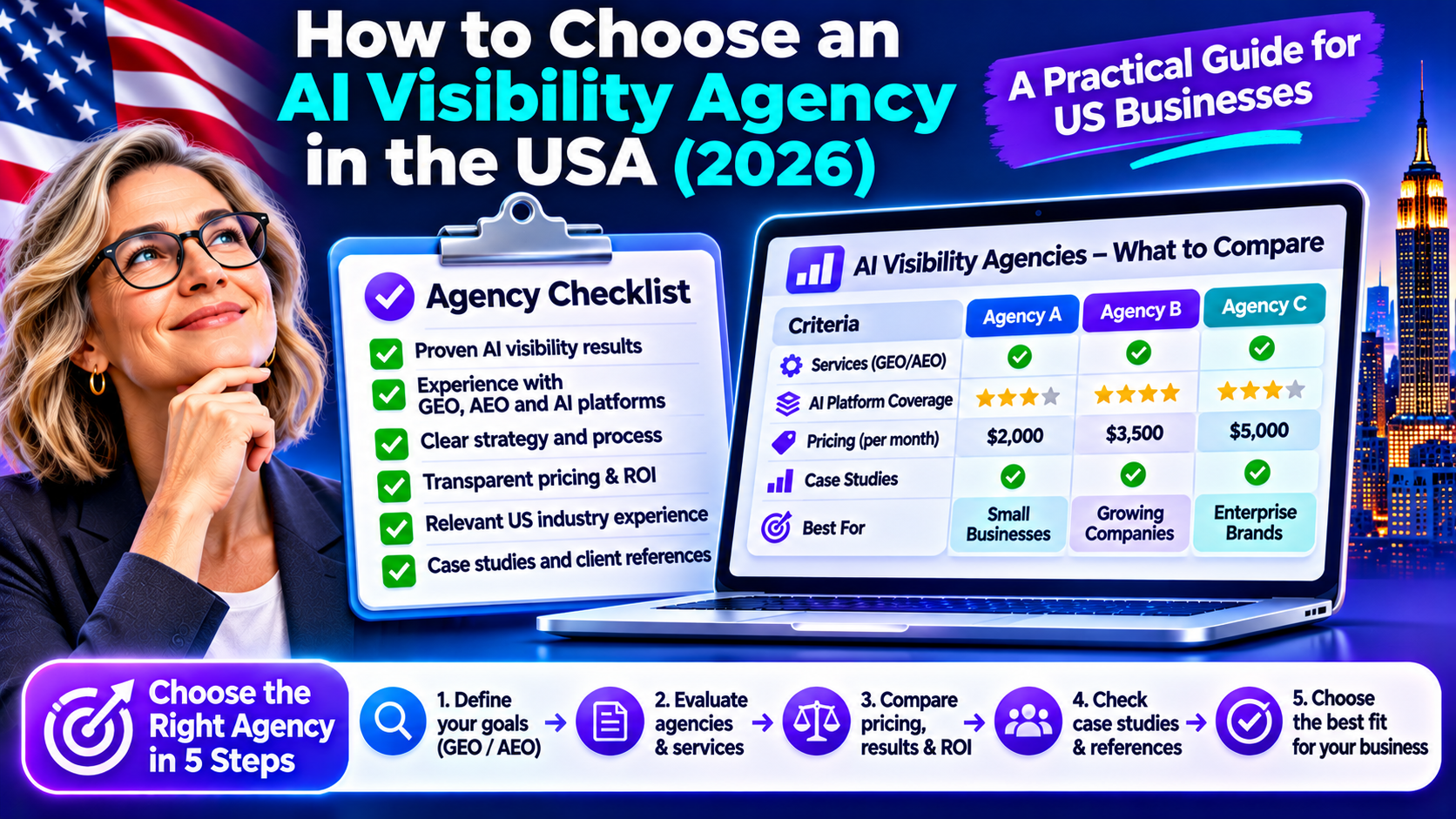
How to Choose an AI Visibility Agency in the USA (2026)
Businesses are being recommended—or overlooked—in AI-generated answers. When a buyer asks ChatGPT, Gemini, Perplexity or Google AI experiences to suggest a service provider, the response may influence which brands enter the consideration set. Choosing an AI Visibility agency therefore requires more than finding a firm that advertises “GEO” on its website. You need a partner who understands your buyers, can improve the quality and accessibility of your information, and can measure meaningful progress.
This independent guide explains how US businesses can evaluate Generative Engine Optimization (GEO), Answer Engine Optimization (AEO) and AI Search agencies. It includes a practical hiring process, a weighted scorecard, budget and contract questions, warning signs, and four US-based agency profiles from the AI Visibility Directory.
Quick answer: Define your commercial goals, establish a repeatable AI visibility baseline, shortlist agencies with relevant experience, ask each to propose measurable work, and compare capabilities—not promises of guaranteed AI recommendations.
What does an AI Visibility agency do?
An AI Visibility agency helps organizations understand and improve how their brands, products and expertise appear in AI-mediated discovery. Depending on the firm, this may include technical SEO, GEO/AEO strategy, prompt research, content planning, digital PR, citation analysis, online reputation management and measurement.
The labels overlap. SEO supports discoverability in traditional and AI-powered search; AEO often emphasizes useful, answer-ready information; GEO usually emphasizes presence and representation in generative responses. These are not three separate, guaranteed ranking mechanisms. Google's official guidance says its AI search features continue to rely on foundational SEO practices, valuable original content and sound technical accessibility—not special tricks designed only for AI. Google Search Central: AI features and your website.
An agency's responsibility should be to make credible improvements to your digital presence and measure the resulting signals, not to promise control over a model's responses.
Step 1: Define what success means for your business
Before contacting agencies, answer four questions:
- Which buyers matter? Define industries, company sizes, regions and purchase situations.
- Which questions matter? Identify commercially relevant prompts such as “best cybersecurity consultant for healthcare organizations” or “alternatives to [competitor] for a small team.”
- Which platforms matter? Start with the AI experiences your customers actually use rather than paying to monitor every available model.
- Which outcomes matter? Choose a mix of visibility measures and business indicators such as qualified enquiries, demo requests, sales conversations and assisted conversions.
A local professional-services firm may care about location-specific recommendations. A B2B SaaS company may focus on vendor comparison prompts. A consumer brand may prioritize accurate product descriptions and reputation. The right agency should adapt its program to those needs.
Establish a baseline before optimization
Ask prospective agencies to record an initial prompt set, date, geography, language, model or search product, brand mentions, citations, competitor appearances, and the evidence supporting every observation. Repeat similar sampling over time.
Answers can vary by prompt wording, model version, user context and time. A single screenshot is not a reliable performance baseline. Where feasible, report sample sizes, change methodology and uncertainty alongside headline percentages.
Step 2: Understand the four core service capabilities
1. Technical discovery and SEO foundations
An agency should check whether relevant pages are accessible, indexable, well organized and easy to understand. This includes crawlability, meaningful page structure, internal links, structured data where appropriate, mobile usability and rendered content accessibility. Google advises following established SEO practices for AI Overviews and AI Mode rather than inventing AI-only technical requirements.
Ask for: a prioritized technical audit, the exact issues found, implementation ownership, and a validation plan after changes go live.
2. Content and buyer-question coverage
The partner should map real buyer questions to authoritative pages, comparisons, case studies, product details and original expertise. High-value content helps a visitor make a decision and gives search systems better source material. Mass-produced generic articles, without distinctive evidence, are not a strong strategy.
Ask for: a prompt-to-page map, content briefs, examples of expert review, and a plan for updating existing content rather than only publishing new pages.
3. Brand evidence and third-party visibility
Brands are described across review sites, industry publications, communities, partner pages and independent research. An agency may assess these sources and recommend earned media, legitimate expert contributions, corrected business information or original research. It should never promise to purchase fabricated reviews or secretly manipulate citations.
Ask for: an evidence-based source analysis, disclosure of paid outreach, and ethical digital-PR methods.
4. Monitoring, experimentation and reporting
A good program distinguishes observed visibility from commercial impact. It tracks changes across a consistent prompt sample and links results, when possible, to actual website analytics, CRM data and lead quality. Monitoring software can support the process, but dashboards alone do not improve visibility.
Ask for: a sample report, an explanation of measurement limits, a testing backlog and a schedule for reviewing results.
Step 3: Decide which type of US agency you need
| Agency type | Typical strengths | Most relevant buyer |
|---|---|---|
| Technical AI Search specialist | Crawlability, information retrieval, complex architecture, large websites | Enterprise and technically complex businesses |
| B2B AEO/GEO growth agency | Buyer intent, content strategy, digital PR, pipeline attribution | SaaS and B2B service companies |
| Full-service marketing agency | SEO, content production, account management, wider channel coordination | Businesses wanting outsourced execution |
| SEO and thought-leadership agency | Expert content, editorial authority, lead-generation strategy | Firms selling expertise or high-value services |
No category is universally superior. A company struggling with JavaScript rendering may need technical specialists; one with excellent technical SEO but weak third-party reputation may benefit more from content and digital PR.
Step 4: Shortlist four US-based providers
The following companies have existing profiles in this directory. They are examples for evaluation, not a performance ranking or endorsement. Information is based on publicly described services; confirm current scope during procurement.
WebFX — managed AI Search and broader digital marketing
View WebFX in the directory | Official AI Search services
WebFX, based in Harrisburg, Pennsylvania, advertises GEO and AI Search services spanning audits, content optimization, technical SEO, citation research and monitoring through its OmniSEO technology. It may fit businesses that want a managed program integrated with broader marketing execution. Its official page advertises services starting at $3,000 per month, but deliverables and commitments vary by package. Request a current, written quote.
Omniscient Digital — B2B AEO and organic growth
View Omniscient Digital in the directory | Official AEO services
Austin-based Omniscient Digital focuses on B2B buyer questions, competitive consideration, technical foundations, content strategy, third-party visibility and pipeline measurement. It may fit software and B2B firms that want AI visibility connected to buying decisions. Its site indicates full-service engagements start at $120,000 per year; that figure is not necessarily a standalone AEO price.
iPullRank — technical AI Search and Relevance Engineering
View iPullRank in the directory | Official services
New York-based iPullRank emphasizes Relevance Engineering, technical SEO, information retrieval, content architecture, AI Search measurement and digital PR. It may fit mid-market and enterprise organizations with complex websites and substantial technical requirements. Ask specifically what the proposed engagement includes and who is responsible for implementation.
First Page Sage — GEO, content and thought-leadership programs
View First Page Sage in the directory | Official website
San Francisco-based First Page Sage emphasizes GEO/AEO, thought leadership, SEO and lead generation. It may fit companies seeking expert-led editorial visibility alongside AI Search initiatives. Ask for examples aligned with your sector and a clear explanation of how reported visibility relates to qualified demand. Treat rankings published by agencies about the industry—including rankings that include themselves—as vendor-produced research rather than independent proof of superiority.
Shortlisting tip: Start with two agencies whose strengths match your main constraint and two with a different but plausible approach. Compare proposals on the same question set rather than on sales presentation quality.
Step 5: Use a weighted agency scorecard
Give each criterion a score from 1 (weak) to 5 (strong). Multiply by its weight to compare proposals. These weights are an illustrative procurement tool, not a validated market benchmark.
| Criterion | Weight | What to look for |
|---|---|---|
| Relevant industry and buyer expertise | 20% | Work involving comparable customers and buying journeys |
| Technical and content execution | 20% | Prioritized implementation plan and named specialists |
| Measurement transparency | 20% | Baselines, repeatable prompt sampling and business outcomes |
| Credible evidence and references | 15% | Verifiable case studies, clear scope and reference calls |
| Commercial fit and contract clarity | 15% | Detailed deliverables, costs, termination and data access |
| Communication and ownership | 10% | Reporting cadence, accountable team and escalation process |
Example calculation: If Agency A scores 4, 5, 3, 4, 3 and 5 in that order, its weighted score is 3.95 out of 5. Use the result to structure a discussion, not as an automatic selection rule. For regulated businesses, privacy or legal compliance might deserve a separate mandatory pass/fail requirement.
Step 6: Ask these 15 questions during the agency interview
- Which AI Search problems do you think are most important for our business, and why?
- How will you identify real buyer prompts rather than arbitrary keyword lists?
- Which models, locations and languages will your measurement include?
- Can you show how sampling works and explain answer variability?
- Will we receive access to raw observations and historical data?
- How do you separate citations, mentions, sentiment, recommendations and referral traffic?
- Which technical changes will you implement versus merely recommend?
- How will you validate claimed improvements after deployment?
- Who writes and approves our content? Can subject-matter experts review it?
- How do you earn external mentions and disclose paid relationships?
- What client examples can you substantiate in a comparable industry?
- How do you connect AI visibility to CRM pipeline or qualified enquiries?
- Who is assigned to our account, and how often will we meet?
- What is excluded from the fee, and what triggers additional charges?
- What happens to accounts, dashboards, content and data when the contract ends?
Ask each shortlisted agency for a written response. Comparable answers are more useful than vague assurances that a vendor “understands the algorithm.”
Step 7: Understand costs, scope and contract terms
An agency proposal typically includes some combination of baseline research, ongoing monitoring, strategic advice, technical optimization, content production, outreach and reporting. A low headline fee may cover only a dashboard or advisory meetings; a higher fee may include hands-on production and engineering work.
Make the scope explicit:
- Setup: onboarding, analytics access, initial audits and prompt-library creation.
- Recurring: reporting frequency, prompt refreshes, optimization hours and account management.
- Content: number and type of deliverables, interviews, editing and approvals.
- Technical work: implementation responsibility, staging checks and remediation verification.
- Digital PR: legitimate outreach scope, paid-placement disclosures and exclusions.
- Software: licenses, tracked prompt limits, competitor seats, data export and access after termination.
- Contract: term, renewal, cancellation notice, ownership, confidentiality and security terms.
Compare total cost over the first six months, not just monthly fees. For example, a hypothetical $4,000 monthly retainer plus a $2,000 setup charge totals $26,000 before optional extras. That example is an illustration, not an industry average.
Should you request a free audit?
A brief introductory review can be useful, but a free assessment may be too shallow to serve as a reliable baseline. Look for transparent methodology and practical recommendations; don't assume an agency's free report represents a comprehensive technical or market audit.
Step 8: Watch for these red flags
- Guaranteed placement: No agency controls whether a generative system recommends your company. WebFX explicitly states it cannot guarantee placements.
- Vague evidence: Claims of dramatic increases without defined prompts, sample sizes, dates or comparable baselines.
- Citation counts without context: A high citation number may be irrelevant if it concerns the wrong audience or low-value questions.
- AI-only technical hacks: Claims that proprietary markup, secret files or prompt tricks replace sound SEO and useful information.
- Uncontrolled bulk content: Large-scale article production without original expertise or editorial review.
- Hidden outreach practices: Purchased reviews, misleading endorsements or undisclosed sponsored placements.
- No implementation owner: A recurring “strategy” retainer with nobody accountable for making changes.
- Unclear data ownership: No provision for exporting tracked prompts, analytics and deliverables after cancellation.
Treat an agency's case studies and self-published rankings as leads for verification, not independent evidence on their own.
Step 9: Choose the right measurements
A useful reporting framework separates different layers of performance.
| Layer | Example metrics | Important limitation |
|---|---|---|
| Brand presence | Mention rate, recommendation rate | Results depend on prompt sample and model conditions |
| Source visibility | Domain and URL citation coverage | Mentions do not always include clickable citations |
| Reputation | Factual accuracy, sentiment themes | Automated sentiment and accuracy judgments need review |
| Competitive positioning | Share of sampled brand mentions | Not representative of all possible user questions |
| Website behavior | AI referrals, engagement, form submissions | Some AI-originated visits are difficult to attribute |
| Business outcomes | Qualified leads, sales pipeline, revenue | Multiple channels may influence the same conversion |
A credible partner should explain which data is directly observed, which is estimated and which cannot be attributed reliably. Tie leading visibility signals to commercial outcomes, but avoid equating a change in mention rate with proven new revenue.
Step 10: Run a 30-day selection process
Week 1 — Define requirements. Confirm target buyers, most relevant AI experiences, baseline analytics and an initial budget. Select 30–50 commercially meaningful prompts if that fits the business; there is no universal required sample size.
Week 2 — Research providers. Use the GEO & AEO Agencies category to identify candidates. Collect comparable proposals and a list of actual delivery team members.
Week 3 — Interview and validate. Apply the scorecard, review technical plans, request relevant references and examine example reports. Ask each agency to distinguish immediate fixes from long-term experiments.
Week 4 — Select and negotiate. Agree on initial deliverables, review gates, reporting conventions, data access, ownership and cancellation terms. Schedule a 60- or 90-day review with realistic expectations: visibility trends can be investigated early, while business attribution may require more time and data.
Common questions about hiring an AI Visibility agency
Is GEO different from SEO?
GEO emphasizes discoverability and representation in generative answers, while SEO covers a broader set of search visibility practices. In practice they share technical, content and authority foundations. Google says conventional SEO principles remain relevant for its AI search features.
Do small businesses need a dedicated GEO agency?
Not always. A business with a limited budget may first benefit from accurate website information, useful service pages, local profile maintenance and ordinary technical SEO. Consider dedicated agency services when demand and potential customer value justify ongoing monitoring and implementation.
Can an agency guarantee that ChatGPT recommends my brand?
No credible provider can promise a particular recommendation in every AI response. Outputs vary across queries and systems. Seek measurable work and transparent reporting rather than guaranteed placements.
How long does it take to see results?
Technical corrections and baseline measurement can be assessed within weeks, while changes in brand representation, third-party coverage and commercial impact may take longer. Require milestones, not an arbitrary guaranteed result date.
What is better: GEO software or a GEO agency?
Software helps monitor visibility and discover opportunities. An agency can investigate causes and execute changes. Some businesses need both; others may manage monitoring internally. Compare AI Visibility software options with GEO and AEO agencies to decide.
How can I check whether an agency is US-based?
Verify its publicly listed headquarters, official corporate information and actual delivery arrangements. Having American customers or a US-facing website does not necessarily mean a company is headquartered in the United States.
Conclusion: Hire for measurable work, not buzzwords
The right AI Visibility agency is the one that understands your customers, identifies credible improvements, executes them responsibly and reports results transparently. Choose based on the work your business needs: enterprise technical expertise, B2B content strategy, broader managed marketing or thought-leadership programs.
Start with the US GEO & AEO agency directory, read the individual provider profiles and request comparable proposals. You can also explore our Best GEO Agencies in the USA guide and GEO vs AEO vs SEO explainer for additional context.
Sources and editorial disclosure
This independent educational guide draws on publicly available documentation, including:
- Google Search Central — AI features and your website
- Google Search Central — optimizing for generative AI features
- WebFX — AI Search Optimization services
- Omniscient Digital — AEO services
- iPullRank — services and Relevance Engineering
- First Page Sage — company website
Provider descriptions reflect their own published service information and are not independently verified performance rankings. This directory does not endorse a provider by including it. Prices and capabilities may change; verify them directly before purchasing.
Last reviewed: November 15, 2026.