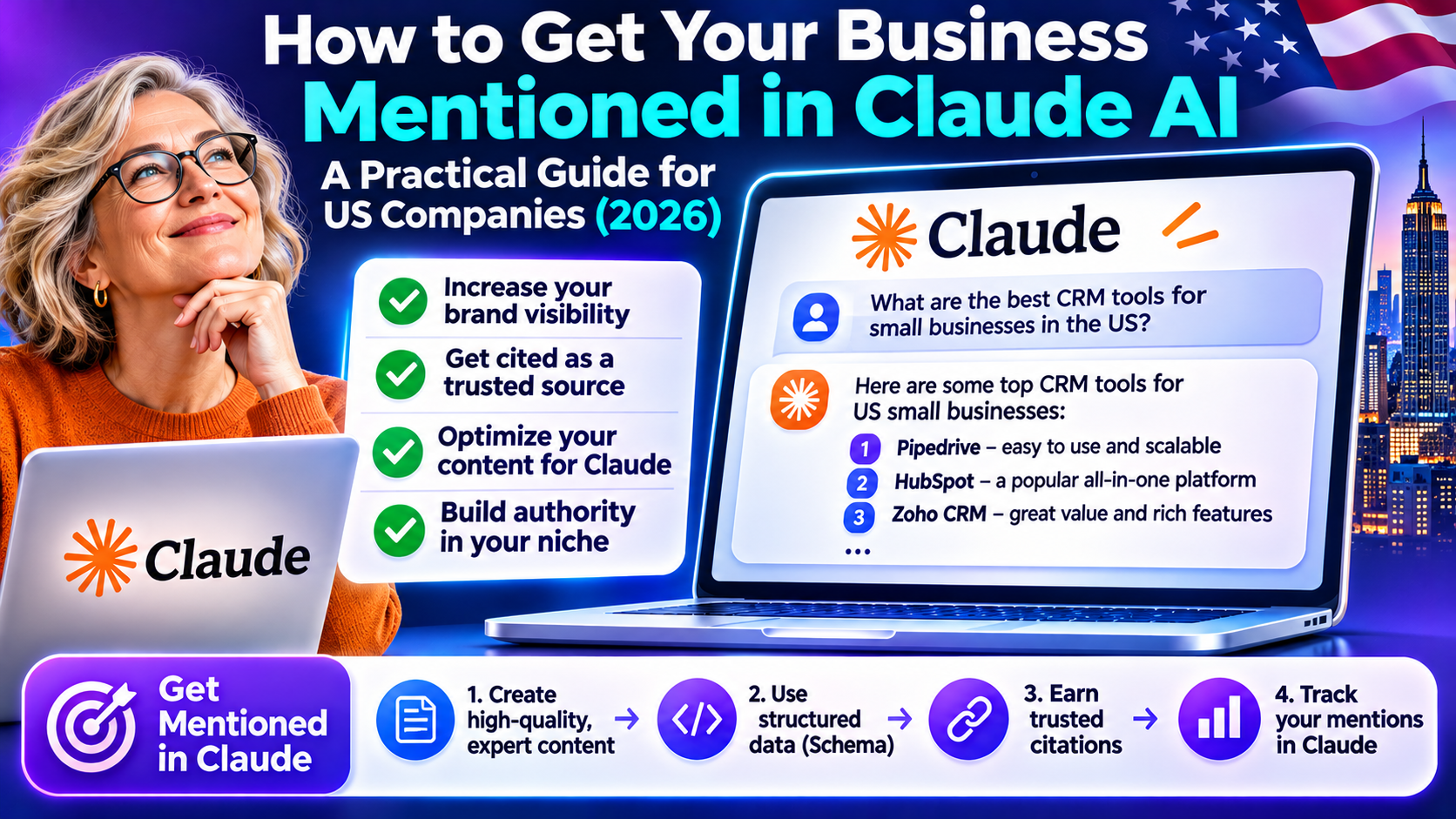
How to Get Your Business Mentioned in Claude AI: A Practical Guide for US Companies (2026)
When a potential buyer asks Claude for recommended software, agencies, suppliers, or local service providers, does your business appear—and is the information accurate? This guide explains how US businesses can improve their discoverability in Claude's web-enabled answers, test their performance, and measure what matters. There is no official submission form or shortcut that guarantees your brand will be mentioned or recommended.
Quick answer: Make relevant pages publicly accessible; check access for Anthropic's search and user-requested retrieval bots; describe your company and offerings clearly; publish useful, original answers to real customer questions; strengthen credible independent coverage; and measure mentions, links, factual accuracy, and outcomes using consistent prompts. Treat every improvement as a test, not a guaranteed ranking lever.
What Does “Being Mentioned in Claude” Actually Mean?
There are several distinct outcomes:
- Brand mention: Claude names your company while answering a relevant question.
- Recommendation or shortlist inclusion: Claude includes your business among possible suppliers for a stated need.
- Source citation: A Claude answer links to your website or another source discussing your business.
- Accurate representation: The response correctly explains what you offer, who you serve, and where you operate.
- Qualified traffic or enquiry: A user visits your website or contacts you after encountering the company in an AI-assisted workflow.
A mention is not automatically a recommendation, and a link to an industry article is not necessarily a citation of your own site. Track these separately. Claude responses can vary by prompt, model, tools, country, date, and what sources are available during that session.
How Claude Finds Web Information in 2026
Claude can use web search to retrieve up-to-date information and return cited sources when it is useful for the user's question. Some conversations use web search; others rely on the model's existing knowledge or on information supplied by the user. The presence or absence of your brand in a single chat is not a definitive audit of your market visibility.
Anthropic documents three distinct crawler/fetcher identities:
| Anthropic robot | Main purpose | Why it matters |
|---|---|---|
Claude-SearchBot |
Search-related discovery and relevance | Blocking it may reduce your site's visibility in Claude's search answers. |
Claude-User |
Retrieval requested through users' interactions | Blocking it may prevent Claude from fetching your pages when users ask about them. |
ClaudeBot |
Web collection that may contribute to model development | Its access relates to training preferences, not a direct method for securing citations or recommendations. |
These are separate controls. Anthropic says its robots honor robots.txt, and site owners can manage them independently. Do not assume that allowing ClaudeBot is a prerequisite for appearing in Claude's web-search results. A business can make an informed choice about AI training while separately considering search and user-requested access. See Anthropic's crawler documentation.
12 Practical Steps to Improve Your Business Visibility in Claude
1. Verify Public Access to Your Important Pages
Start with your home page, about page, services, products, location pages, pricing or request-a-quote page, and essential documentation. Confirm that visitors can open these pages without a login, broken redirects, CAPTCHA loops, or a mandatory JavaScript interaction. Examine how the pages render on mobile and whether their essential information is available in ordinary page content.
Action: Make a list of ten revenue-relevant URLs. For each, record its HTTP status, canonical URL, whether content is visible in a browser without logging in, and the last review date. A public page can still fail retrieval because of network configuration, access controls, or bot restrictions.
2. Audit robots.txt for Claude Search and User Fetches
Check https://yourdomain.com/robots.txt and look for rules applying to Claude-SearchBot, Claude-User, and broader User-agent: * directives. If you want your public marketing pages discoverable through Claude's web-enabled features, avoid unintentionally blocking the relevant search and user-retrieval bots. Keep private, sensitive, and account-specific content restricted.
Example of an illustrative robots.txt policy for public pages:
User-agent: Claude-SearchBot
Allow: /

User-agent: Claude-User
Allow: /
This example is not necessary on every site: default permissions and other rules may already provide access. Review the complete robots policy and any CDN or web-application firewall restrictions before changing it. Do not change your ClaudeBot training preference merely to pursue search visibility. For authoritative definitions and configuration guidance, consult Anthropic's official crawler page.
3. Write a Clear, Verifiable Company Description
Claude needs enough evidence to distinguish your business from similarly named companies. Explain, in plain language, the legal or brand name, primary service, core products, target customers, operating regions, and meaningful specialization.
Example: Instead of saying “We deliver innovative digital transformation,” a US cybersecurity consultancy might say “We help mid-sized healthcare providers in Texas implement Microsoft 365 security, endpoint management, and compliance programs.” Be specific without making unsubstantiated claims.
4. Publish Pages That Answer Real Buying Questions
Identify what prospects ask when they compare vendors: “Which providers support HIPAA-aware workflows?”, “Which GEO agency handles B2B SaaS?”, “Does this software offer monthly plans?”, or “How long does an implementation take?” Create useful product, service, FAQ, comparison, and case-study pages that answer these questions directly.
Avoid publishing dozens of near-identical city pages or generic AI-generated articles. Strong pages add firsthand explanations, relevant examples, limitations, and current details.
5. Make Your Business Facts Consistent
Check your official website, LinkedIn company page, relevant business directories, professional association profiles, and reputable third-party listings. Align company names, locations, service definitions, and key product information. Consistency reduces contradictory evidence but does not guarantee Claude will prefer your company.
For location-based businesses, ensure physical locations and service areas are accurately described; don't claim a US headquarters if the business is only selling into the United States.
6. Publish Original Evidence and Expertise
Useful evidence can include customer case studies with appropriate permission, benchmark research with methodology, publicly documented product demonstrations, technical tutorials, or expert-authored explanations. Describe how results were measured, when observations were collected, and which limitations apply.
For example, a B2B software vendor could publish an implementation study describing goals, integration requirements, timing, and measured operational outcomes. This is more useful than an unsupported claim that it is “the #1 provider.”
7. Improve Technical SEO and Navigability
Use descriptive page titles, a logical heading hierarchy, internal links, sensible canonical URLs, and a sitemap. Avoid hiding all substantive content behind scripts or inaccessible widgets. Keep product information discoverable through clear navigation.
Schema markup can describe entities and page content where appropriate, but there is no verified special “Claude ranking schema.” Use structured data accurately and do not exaggerate its effect on AI answer inclusion.
8. Earn Relevant Independent Coverage
Third-party sources can help users—and AI-enabled search tools—cross-check your company. Seek legitimate coverage through industry publications, credible review platforms, conference talks, professional organizations, relevant partnerships, or customer stories.
Focus on topical relevance and editorial quality. Do not buy fake reviews, fabricate awards, or distribute mass-produced citations solely to manipulate AI results.
9. Update Product, Pricing, and Availability Information
Outdated pricing, retired products, old addresses, or contradictory feature lists can produce confusing answers. Establish an editorial owner for high-value pages, update important changes, and retain visible dates where useful.
If your company offers custom pricing, say so. If a free trial is limited or feature availability varies by plan, disclose that distinction. Accuracy matters as much as mention frequency.
10. Test Claude Using a Repeatable Prompt Library
Build a fixed list of 20–30 questions representing real buying intentions rather than one convenient branded prompt. Include discovery, shortlist, comparison, suitability, and fact-checking questions. Test relevant unbranded prompts, such as “Which US providers offer enterprise AEO consulting for B2B SaaS?” alongside explicitly branded verification prompts.
For each result, note the date, account or workflow, model if visible, web-search usage if known, geographical context, exact prompt, whether the brand appeared, whether it was recommended, citations provided, and factual mistakes. Keep the raw response or an authorized record of it.
Important: Testing the same prompt repeatedly does not reproduce the exact distribution of all customer experiences. Treat results as a sample, not a census of Claude usage.
11. Track Sources, Brand Accuracy, and Outcomes
Analyze whether Claude mentions your name, cites your site, links to a third-party page about you, or confuses your offerings with a competitor's. Compare month-over-month results with the same prompt set, methodology, and observed settings.
Review referral sessions where analytics can identify Claude-related links or referrers. Some activity will not be attributed, especially when users copy URLs, switch devices, or discover you through an indirect route. Monitor enquiries and qualified conversions, not only citation counts.
12. Improve the Weakest High-Value Topics First
Cluster prompt results by product, industry, location, and buyer stage. If your brand is absent for important service questions, improve the matching service page and obtain credible supporting evidence. If Claude confuses your location or offerings, correct the authoritative source pages. If citations point to stale content, refresh the source or provide clearer updated alternatives.
Re-test after meaningful changes using the same baseline prompts. Improvements cannot be attributed confidently to one change unless you control for variation and other factors; record changes and report trends cautiously.
Claude AI Visibility Measurement Scorecard
Use this worksheet once per monitoring period:
| Metric | Definition | Example calculation |
|---|---|---|
| Brand Mention Rate | Share of tested responses mentioning the brand | 8 of 25 = 32% |
| Recommendation Rate | Share of eligible purchase-intent responses including the brand as a candidate | 5 of 20 = 25% |
| Website Citation Coverage | Share of tested web-enabled answers linking directly to your site | 3 of 25 = 12% |
| Brand Accuracy | Share of factual assertions checked that are correct | 18 of 20 = 90% |
| Competitive Mention Share | Your brand mentions divided by all measured brand mentions among tracked competitors | 8 of 40 = 20% |
| Claude-Attributed Enquiries | Enquiries identified through tagged links, declared source, or measurable referral evidence | 2 in a month |
Measurement rules: Use a stable prompt set, define whether multiple mentions count once per answer, and report denominators. The above numbers are illustrative only. If some prompts do not trigger web search, do not treat absent citations as proof that your site is ineligible for retrieval.
Example: A US-Based Managed IT Services Company
Consider a hypothetical managed IT services firm in Denver serving 25–200-employee healthcare practices. Its initial prompt testing shows that Claude names national competitors but not the firm in answers about Microsoft 365 administration for regional medical offices.
The company could create a clear healthcare IT service page; document geographic coverage; explain its response times and certifications accurately; publish a permitted client case study; improve technical access for relevant bots; and check whether credible local or industry profiles describe its work. It then repeats its 25-prompt benchmark four weeks later.
The outcome may improve, remain unchanged, or vary across runs. The useful business question is whether verified mentions, accurate referrals, and qualified consultations increase—not whether a particular test returns the company every time.
30-Day Implementation Plan
| Period | Priority actions | Deliverable |
|---|---|---|
| Days 1–5 | Check website access, robots rules, key company facts, existing referrals | Technical and entity baseline |
| Days 6–10 | Build 25 buyer prompts and document Claude responses | Measurement baseline |
| Days 11–17 | Improve core service/product pages, FAQs and internal links | Updated high-intent pages |
| Days 18–24 | Publish one original evidence asset and correct inconsistent external profiles | Credibility improvement log |
| Days 25–30 | Re-test prompts, assess accuracy and links, define next month's priorities | First comparison report |
For resource-constrained businesses, start with a single important product or service line and the ten most commercially relevant prompts. Scale measurement only after the process is reproducible.
Manual Monitoring vs Specialist Software
Manual sampling is inexpensive and useful for understanding answer quality, but it takes time and provides only a narrow view. Specialist software can help organize prompt sets, repeat testing, collect sources, track competitors, and prepare reports. Before buying, ask whether a vendor actually measures Claude for your country, model, prompt types, and plan; do not assume that every AI Visibility package covers identical environments.
In the AI Visibility Directory, you can explore US-headquartered software providers such as Profound, Evertune, Scrunch AI, Brandlight, Conductor, and seoClarity. Verify current Claude coverage and pricing directly with each vendor before purchasing.
For hands-on services, compare WebFX, Omniscient Digital, iPullRank, and First Page Sage. The directory provides company information rather than a promise of outcomes.
See also How to Monitor Your Brand in ChatGPT and Other AI Platforms, How to Increase AI Citations, and What Is AI Visibility?.
Mistakes to Avoid
- Treating a single answer as a ranking: Outputs vary and are shaped by the question and retrieval context.
- Confusing crawler purposes:
ClaudeBotis not the same asClaude-SearchBotorClaude-User. - Assuming technical access ensures mentions: Being accessible is a prerequisite for some retrieval paths, not a recommendation guarantee.
- Inventing authority: Fake reviews and unsupported awards harm credibility.
- Measuring only branded prompts: If you ask “Tell me about OurCompany,” you are testing recognition, not unbranded discovery.
- Ignoring factual accuracy: More mentions do not help when the underlying information is wrong.
- Attributing every gain to GEO work: Model changes, news coverage, and sampling variation can affect results.
Frequently Asked Questions
Can I submit my company directly to Claude for recommendations?
There is no generally documented paid or free submission process that guarantees placement in Claude answers. Focus on accurate public information, legitimate discoverability, and relevant evidence.
Does Claude use Google search results?
Claude can retrieve web information through its web-search tools and cited sources. Do not assume that all Claude answers are simply Google rankings, or that Google Search Console reflects every Claude citation. Search sources and retrieval behavior can evolve.
Should I allow ClaudeBot to train on my website to get mentioned?
No such trade-off has been established. Anthropic documents ClaudeBot for potential training-related collection and separate Claude-SearchBot and Claude-User functionality for search and user-requested access. Choose training permissions independently from your search-discoverability goals.
Is special Claude schema or an llms.txt file required?
Anthropic's public guidance does not establish a mandatory Claude-specific schema or llms.txt requirement for appearing in web-enabled answers. Clear accessible pages, trustworthy evidence, and ordinary technical quality are safer priorities than unproven files or markup.
How long until my business appears in Claude?
There is no reliable universal timeline. The outcome depends on whether retrieval occurs, the relevant question, available sources, technical access, and the strength of evidence. Establish a baseline and measure over several weeks without promising a specific result.
Can a GEO agency guarantee Claude citations?
No provider controls all of Claude's answers or the underlying retrieval conditions. Evaluate agencies by their methods, transparent reporting, technical expertise, and evidence—not a guaranteed number of mentions.
How do I know whether Claude sends traffic to my website?
Check available referral and landing-page analytics, use tagged links in campaigns you control, and ask leads how they discovered you. Treat unattributed visits as unknown rather than assigning them to Claude without evidence.
What if Claude gives incorrect information about my company?
Document the precise error and cited sources. Correct your own pages, investigate inaccurate third-party references, and follow Anthropic's relevant feedback or content-reporting channels where appropriate. Recheck after corrections rather than assuming instant updates.
Official Sources and Further Reading
- Anthropic: Does Anthropic crawl data from the web, and how can site owners block the crawler?
- Claude Help Center: Enable and use web search
- Anthropic: Claude can now search the web
- Claude Help Center: Report, block, and remove content from Claude
- Google Search Central: Creating helpful, reliable, people-first content
Editorial note: This is independent, educational guidance. It does not guarantee mentions, citations, or recommendations. Claude features and crawler documentation can change. Last reviewed: November 15, 2026.