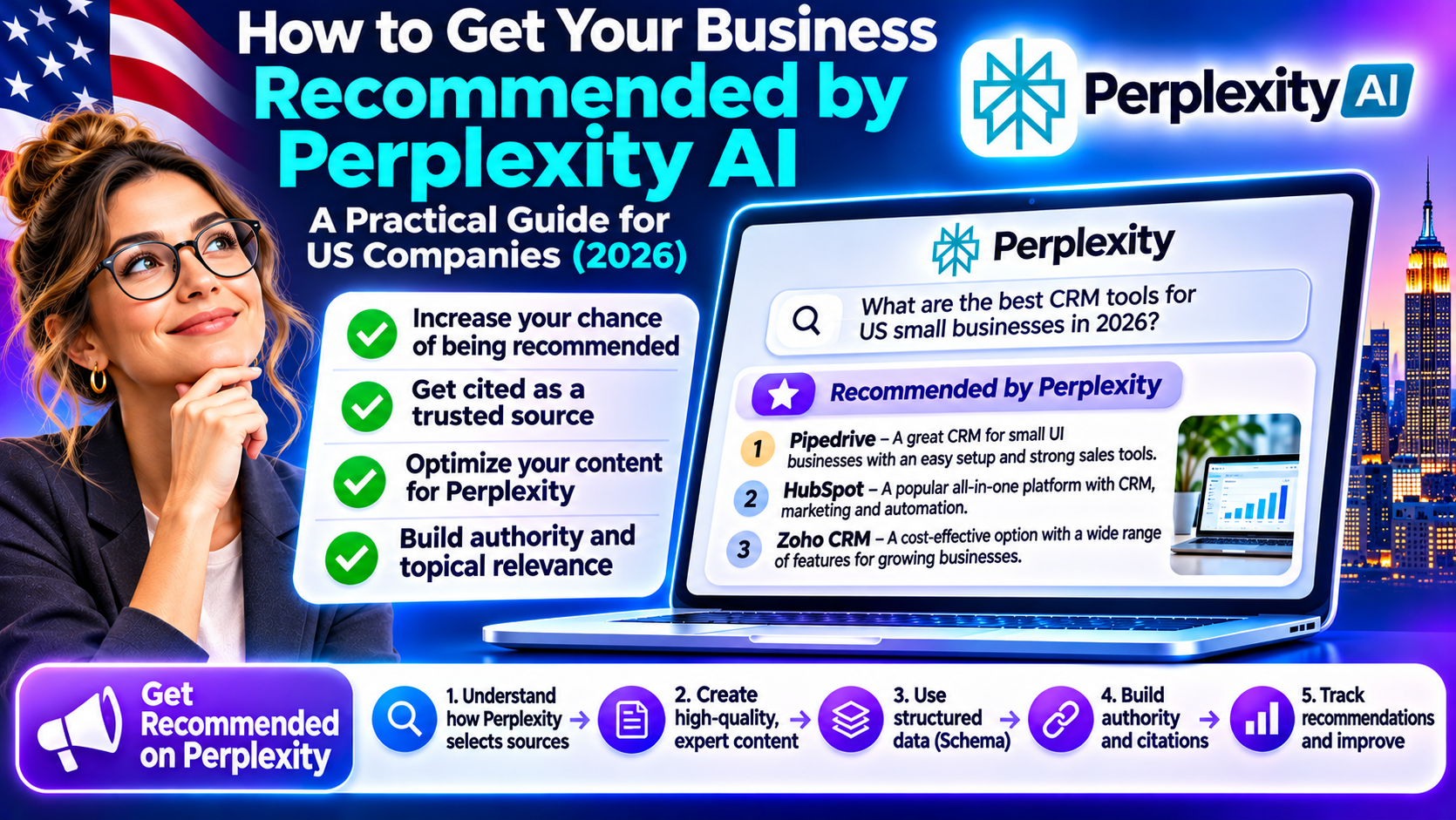
How to Get Your Business Recommended by Perplexity AI: A Practical Guide for US Companies (2026)
Want your business to appear when someone asks Perplexity for a supplier, agency, software platform, or local service? Start by making your website accessible and your expertise easy to verify. Then publish useful answers to buyers' questions, earn credible third-party coverage, and measure where your company actually appears.
Perplexity is an AI answer engine that searches the web and produces responses with source citations. Those links make it useful for business discovery—but no website owner or agency can guarantee a Perplexity recommendation or citation. Perplexity does not publish a complete ranking formula for selecting businesses or sources.
This independent guide explains twelve practical actions US businesses can take, what Perplexity officially documents, which ideas are reasonable experiments rather than confirmed ranking factors, and how to run a 30-day visibility test.
What does it mean to be recommended by Perplexity?
There are three different outcomes worth distinguishing:
- Brand mention: Perplexity names your company in its answer, perhaps in a list of possible providers.
- Brand recommendation: The answer describes your company as a relevant option for a specific request, with or without an explicit endorsement.
- Website citation: Perplexity links to a page on your domain as evidence for part of its answer.
These outcomes may occur together, but they are not interchangeable. A directory or publisher could be cited while your company is merely named; your company website could be cited without an explicit recommendation. Always record them separately.
Perplexity describes its system as searching the web and generating conversational answers with numbered citations. The citations can change based on the question, follow-up context, available sources, and product experience. A result observed once is not a stable ranking. Perplexity: How does Perplexity work?
First: understand how Perplexity accesses websites
Perplexity documents two distinct agents:
| Agent | Documented purpose | Practical implication |
|---|---|---|
PerplexityBot |
Crawls to surface and link websites in Perplexity search results | Check that your public pages and infrastructure do not accidentally block it |
Perplexity-User |
May fetch a page in response to a person's question | User-initiated access is different from general search crawling |
According to Perplexity's crawler documentation, PerplexityBot should be allowed in robots.txt and through relevant firewall rules if you want to make your public website discoverable in its search. The company also says Perplexity-User generally ignores robots.txt because a user requested the fetch. Do not treat robots.txt as a security or privacy barrier. Protect confidential pages with real authentication and authorization.
Crawler accessibility creates an opportunity to be retrieved; it does not mean Perplexity will select, recommend, or cite your site.
Strategy 1: Audit access for PerplexityBot
Open https://yourdomain.com/robots.txt and inspect the rules that apply to PerplexityBot. Look for broad Disallow: / rules, accidental blocking of key service pages, and conflicting agent-specific sections. If appropriate for your publishing policy, a simple allow group is:
User-agent: PerplexityBot
Allow: /
Do not copy this blindly over an existing robots file. Preserve restrictions for internal paths and any other crawler policies your organization needs. Robots rules apply according to their grouping and path precedence; a broad allow rule should be reviewed by your developer.
Then check the infrastructure. A CDN or web application firewall can return a challenge or access-denied status even if robots.txt permits crawling. Review logs for legitimate Perplexity requests, relevant HTTP responses, and rate-limit blocks. Perplexity publishes current IP ranges for both agents and recommends combining user-agent matching with IP verification when configuring security rules. A user-agent string alone can be spoofed.
Success check: Public priority pages can be fetched without unintended blocking, while private areas stay protected.
Strategy 2: Make important information available as readable text
Perplexity needs evidence it can interpret. Essential descriptions should not exist only in images, inaccessible PDFs, login-gated interfaces, or content that appears only after complex browser interactions.
Review your homepage and the five highest-value product or service pages. Can a visitor find the business name, geographic service area, offering, customer type, contact method, and differentiators in ordinary text? Are pages returning normal HTTP responses? Are headings descriptive? Can relevant pages be reached through links?
For a US B2B software provider, a useful service page might state what the software does, which teams use it, supported integrations, limitations, security information, and a clear next step. For a local contractor, show the actual service area, licensed services, business hours, and verified contact details.
This is sound website-accessibility and SEO practice, not an officially confirmed Perplexity ranking factor.
Strategy 3: Define precisely what your company should be recommended for
A company cannot be relevant to every possible request. Identify the questions that represent a good potential customer.
For example, a cybersecurity consultancy serving US healthcare organizations might focus on prompts such as:
- "Which cybersecurity consultants specialize in healthcare compliance for mid-sized US clinics?"
- "How do I compare HIPAA security assessment providers?"
- "What questions should I ask before hiring a healthcare cybersecurity firm?"
Build a list of 20–30 prompts covering needs, comparisons, alternatives, service location, implementation, and pricing. Group them by purchase stage. Do not create awkward text that repeats the exact prompts verbatim. Instead, make sure your website genuinely addresses the underlying customer problems.
Success check: Each prompt category maps to one or more high-quality pages or verifiable business facts.
Strategy 4: Publish direct, specific answers to buyer questions
People use answer engines to resolve practical uncertainties. Help them by publishing pages that contain clear answers and supporting detail.
A good buyer-facing guide can include:
- An opening answer in plain language
- The criteria that influence the decision
- A step-by-step procedure or comparison table
- Costs or realistic pricing considerations when available
- Exceptions, risks, or limitations
- Examples from actual work
- References to authoritative external sources
For a Minneapolis industrial equipment supplier, a guide titled "How to choose an industrial water filtration system for a food-processing facility" can be more useful than a page filled with generic marketing claims. Include capacity ranges, maintenance demands, compliance considerations, and when to speak with an engineer.
Avoid presenting generic AI-generated articles as original expert research. Invest in useful, specific, accurate information.
Strategy 5: Publish first-hand evidence and original research
Original evidence gives readers—and potentially cited-answer systems—something distinctive to reference. Consider anonymized customer case studies, test methodology, product benchmarks, professional insights, original surveys with sample sizes, or real implementation examples.
A Dallas software company might publish a transparent comparison of deployment time across integration methods, including the test environment and exclusions. A regional accounting firm might publish an explanation of common payroll implementation failures based on its own documented engagements, protecting customer confidentiality.
Include dates, methods, units, limitations, and named expertise where appropriate. Do not fabricate testimonials, invent percentages, or present marketing estimates as independently verified facts.
Why it matters: These materials can improve the informational value of a page. The exact impact on Perplexity's source selection has not been publicly quantified by Perplexity.
Strategy 6: Establish accurate, consistent business identity
Make the company identifiable across your own site and credible third-party properties. Keep the legal or trading name, product names, headquarters, actual service locations, contact details, and ownership relationships consistent.
Review your website's About and Contact pages, relevant professional associations, business profiles, credible industry directories, and official company social profiles. Correct old addresses, inactive websites, and inconsistent descriptions.
For US local businesses: Maintain an accurate Google Business Profile and other legitimately used local profiles as part of broader discoverability. These are general business-information practices, not proof that any particular directory directly feeds Perplexity recommendations.
For businesses operating nationwide, say so accurately; never invent offices in states where you do not operate.
Strategy 7: Build credible independent references
When researching a vendor, buyers often consult more than the vendor's own site. Industry associations, trade publications, reputable customer reviews, independent testing, professional directories, and genuine editorial coverage can help them evaluate a company.
Develop relationships with relevant publications and participate in legitimate industry discussions. Offer data, expertise, or useful case material instead of purchasing fabricated mentions.
Do not assume that a paid listing or a backlink guarantees recommendation in Perplexity. Treat third-party credibility as part of sound marketing and brand validation, not a secret algorithmic trick.
Strategy 8: Maintain clear product, service, and pricing information
A recommendation may hinge on precise fit: company size, budget, platform compatibility, industry, supported regions, service availability, or other constraints. Make that information accessible when you can.
For a SaaS company, publish an accurate feature comparison, supported integrations, security documentation, pricing tiers or a clear quote process, and intended customer segments. For a professional-services firm, explain the scope, deliverables, exclusions, typical engagement process, and actual geographic coverage.
Update information when offerings change. If you do not publish prices, say that pricing is quoted rather than inventing a dollar amount. Clarify whether trial access, free audits, and paid consultations are different offerings.
Strategy 9: Improve technical structure and internal linking
Organize the site so people and crawlers can understand relationships among pages. Link from category pages to services, from services to examples, and from buying guides to appropriate product or contact information.
Use clear headings, meaningful navigation labels, descriptive links, canonical URLs, and appropriate structured data where applicable. Structured data should match visible page content. A business's actual location and ownership details should not conflict with its schema.
There is no publicly established special Perplexity schema or llms.txt requirement that guarantees citations. Standard accessibility and SEO engineering should come before experimental additions.
Strategy 10: Analyze citations that Perplexity already selects
Choose ten commercially relevant prompts and inspect the sources linked in Perplexity's replies. Record what kinds of pages appear: official vendor pages, independent comparisons, specialist articles, trade publications, or directories.
Open the cited pages and assess whether they actually support the answer. Note which buyer questions your own site answers less thoroughly. Do not copy competitors' content or treat a single answer as conclusive evidence of how Perplexity ranks sources.
This competitive research is especially useful for discovering unmet information needs. If Perplexity cites a guide explaining how to compare software, consider whether your business can publish a more useful, evidence-rich guide with genuinely different data.
Strategy 11: Test brand mentions and citations with a repeatable protocol
Set up a baseline rather than checking one question and celebrating one response.
Suggested small-business testing protocol:
- Select 20 representative non-branded prompts and five branded fact-check prompts.
- Define the US location or audience for each prompt where relevant.
- Run a consistent testing procedure, recording the date, exact prompt, session context, and answer.
- Capture whether the company was named, recommended as relevant, and cited through its own domain.
- Verify linked citations manually and record inaccuracies.
- Repeat the sample monthly, acknowledging normal response variability.
Use a consistent sampling method and don't treat these observations as a full census of all Perplexity users. Tools may automate repeated tests, but their estimates depend on their own prompt selection and methodology.
Example monitoring worksheet
| Prompt | Brand named? | Relevant recommendation? | Own site cited? | Inaccurate claim? | Date |
|---|---|---|---|---|---|
| Best payroll software for a 20-person US team | Yes/No | Yes/No | Yes/No | Yes/No | YYYY-MM-DD |
| Alternatives to a named competitor for small firms | Yes/No | Yes/No | Yes/No | Yes/No | YYYY-MM-DD |
| How to choose payroll software for multiple states | Yes/No | Yes/No | Yes/No | Yes/No | YYYY-MM-DD |
Strategy 12: Turn visibility experiments into business outcomes
It is tempting to treat more citations as the end goal. A commercial program should also monitor relevant website visits, demo requests, consultations, calls, and qualified leads.
Use website analytics to examine identifiable traffic referred by Perplexity, where present, and connect it with conversions. Remember that some people may see a brand in an AI answer and later visit directly or search for it elsewhere; precise attribution may be impossible.
Report the results of technical changes and content updates alongside your prompt observations. Compare month-over-month data rather than assuming one activity caused a change. The company may improve citations without increasing leads, or improve leads without a visible increase in sampled citations.
How to measure Perplexity visibility: five practical KPIs
Use stable definitions so reports remain comparable.
| KPI | Suggested definition | Interpretation |
|---|---|---|
| Brand mention rate | Prompts naming your company ÷ eligible prompts tested | How often your company appears in the sample |
| Relevant recommendation rate | Prompts presenting your company as a fitting option ÷ eligible commercial prompts | How often it is proposed to a suitable buyer |
| Own-domain citation rate | Prompts linking to your website ÷ eligible prompts | How often your own site is cited |
| Brand accuracy rate | Verified factual claims that are accurate ÷ factual claims reviewed | Whether AI descriptions are dependable |
| Perplexity referral conversions | Website conversions associated with identifiable Perplexity referrals | Commercial value from traceable traffic |
Illustrative example—not actual performance: If a company is mentioned in 6 of 20 tested questions and its website is cited in 3, its sampled brand mention rate is 30% and own-domain citation rate is 15%. This does not mean 30% of all Perplexity searches mention the company.
A smaller, carefully reviewed set of decision-relevant prompts can be more useful than a very large set chosen only to produce a favorable score.
A 30-day implementation plan for a US business
Week 1 — Establish a factual baseline
- Confirm ownership of the website, business facts, and major service pages.
- Check
robots.txt, PerplexityBot accessibility, CDN/firewall behavior, and server response codes. - Build a 20-prompt sample from real sales and customer questions.
- Record mentions, recommendations, citations, and factual errors.
- Select the five biggest content or accessibility gaps.
Week 2 — Improve the most valuable pages
- Update homepage and service descriptions with concrete capabilities and audiences.
- Add answers to priority buyer questions.
- Correct stale facts and contradictory third-party information where possible.
- Fix broken links, obvious crawl issues, and misleading metadata.
- Improve navigation to pricing, comparisons, case studies, and contact pages.
Week 3 — Add evidence and authority
- Publish one strong, first-hand case study or technical guide.
- Cite reliable independent sources for factual or regulatory claims.
- Review credible trade associations and relevant directory coverage.
- Request legitimate editorial corrections or updates where needed.
- Do not buy fake reviews, placements disguised as editorial coverage, or manufactured citations.
Week 4 — Re-test and plan the next cycle
- Repeat the original prompt sample with documented conditions.
- Check whether your website can now be accessed successfully by the expected crawlers.
- Review citation accuracy and identifiable referral traffic.
- Compare results cautiously and identify the next three actions.
- Share a simple report with the marketing, product, or management team.
A month is a useful diagnostic sprint, not a guaranteed timeframe for appearing in Perplexity. Repeat the process quarterly or monthly depending on the importance of AI search to your customer acquisition.
Common mistakes to avoid
Mistake 1: Assuming any mention is an endorsement. A neutral list item, a critical reference, and a buyer recommendation are different outcomes.
Mistake 2: Confusing a citation with a recommendation. Perplexity can cite a source while recommending another provider.
Mistake 3: Blocking the crawler but changing only content. Check both robots rules and infrastructure access before investing heavily in visibility work.
Mistake 4: Believing an explicit allow rule guarantees results. PerplexityBot access is about discovery, not automatic inclusion.
Mistake 5: Testing with only branded questions. Asking "What is [my company]?" does not reveal how well you perform in non-branded purchasing questions.
Mistake 6: Publishing many near-duplicate AI articles. A smaller number of accurate, original guides is more defensible than hundreds of thin pages.
Mistake 7: Treating vendor dashboards as exact market share. AI visibility tools provide estimates based on selected prompts, dates, locations, and models.
Mistake 8: Promising placement to clients. There is no official business-submission program that guarantees Perplexity recommendation.
Which US AI Visibility providers can help?
For businesses that prefer to purchase software or hire a specialist, the AI Visibility Directory includes US-headquartered companies serving different needs. These are examples, not a ranking or endorsement.
Software and monitoring platforms
- Profound — AI search visibility intelligence and citation analysis.
- Evertune — GEO analytics and brand intelligence.
- Scrunch AI — AI visibility monitoring and agent-oriented website optimization.
- Brandlight — enterprise brand representation and AI reputation intelligence.
- Conductor — enterprise AI search performance integrated with SEO workflows.
- seoClarity — enterprise SEO and AI visibility analytics.
Agencies and consulting
- WebFX — managed GEO and AI search optimization.
- Omniscient Digital — B2B AEO, SEO, content strategy, and organic growth.
- iPullRank — technical AI search strategy and relevance engineering.
- First Page Sage — GEO, thought leadership, and lead-generation services.
Browse AI Visibility Platforms and GEO & AEO Agencies to review your options. Verify pricing, platform coverage, company ownership, and current offerings directly with each vendor.
Frequently asked questions
Can I submit my business directly to Perplexity for guaranteed recommendations?
No guaranteed placement process is documented in the official materials reviewed. Make the business discoverable through credible public information and measure actual results rather than paying someone who promises submission-based rankings.
Does PerplexityBot need to be allowed in robots.txt?
Perplexity recommends allowing PerplexityBot for sites that want to be surfaced and linked in its search results. Also verify that your firewall or CDN does not inadvertently block legitimate requests. This does not guarantee citation.
What is the difference between PerplexityBot and Perplexity-User?
PerplexityBot is intended to discover and surface websites in search. Perplexity-User can fetch content in response to a person's question. Perplexity says the latter generally ignores robots.txt because it supports a user-requested action.
Will schema markup make my business appear?
There is no documented Perplexity-specific schema that guarantees inclusion. Use accurate, appropriate structured data as part of a well-maintained website, not as a shortcut.
Do I need to pay for Perplexity ads to appear in organic answers?
No paid advertising requirement for organic inclusion is documented in the reviewed sources. Advertising products and organic source selection should be assessed separately.
Can a small local business appear alongside national brands?
It may appear for relevant local or specialized questions, but results depend on the query and supporting sources. Publish real service-area details, accurate contact information, and useful local expertise rather than inventing multiple business locations.
Can I measure Perplexity referral traffic?
Often you can identify at least some referrals in website analytics. This is incomplete: not every impression results in a click, and some later visits may appear as direct or branded-search traffic.
How long does it take to get recommended?
There is no reliable universal timeframe. Technical access, information relevance, external coverage, competing sources, and variability between queries can affect what appears. Treat the first 30 days as a baseline and improvement cycle.
Are AI Visibility platforms required?
No. Small businesses can begin with a spreadsheet, a prompt sample, site logs, and analytics. Specialist monitoring platforms become useful when the number of prompts, competitors, markets, and reporting stakeholders grows.
Does appearing in Perplexity mean my business is trusted or certified?
No. A mention, recommendation, or citation is not a certification or official endorsement. Keep your own claims precise and verify the original sources.
Related AI Visibility guides
- What Is AI Visibility?
- How to Monitor Your Brand in ChatGPT and Other AI Platforms
- How to Increase AI Citations to Your Website
- How to Choose an AI Visibility Agency in the USA
- AI Visibility Software: How to Choose the Right Platform
Official sources and further reading
- Perplexity — Perplexity Crawlers:
PerplexityBot,Perplexity-User, robots.txt controls, IP lists, and firewall configuration. - Perplexity Help Center — How Does Perplexity Work?: web search, AI-generated answers, and numbered citations.
- Perplexity — Introducing the Publishers' Program: Perplexity's description of cited sources and publisher relationships.
- Google Search Central — Search Essentials: general technical and people-first publishing foundations, provided as cross-platform SEO context rather than evidence of Perplexity's ranking process.
Editorial note: This independent guide distinguishes Perplexity's documented crawler behavior from broader SEO/GEO recommendations and practical experiments. None of the recommendations guarantees a mention, recommendation, or citation. Last reviewed November 15, 2026.