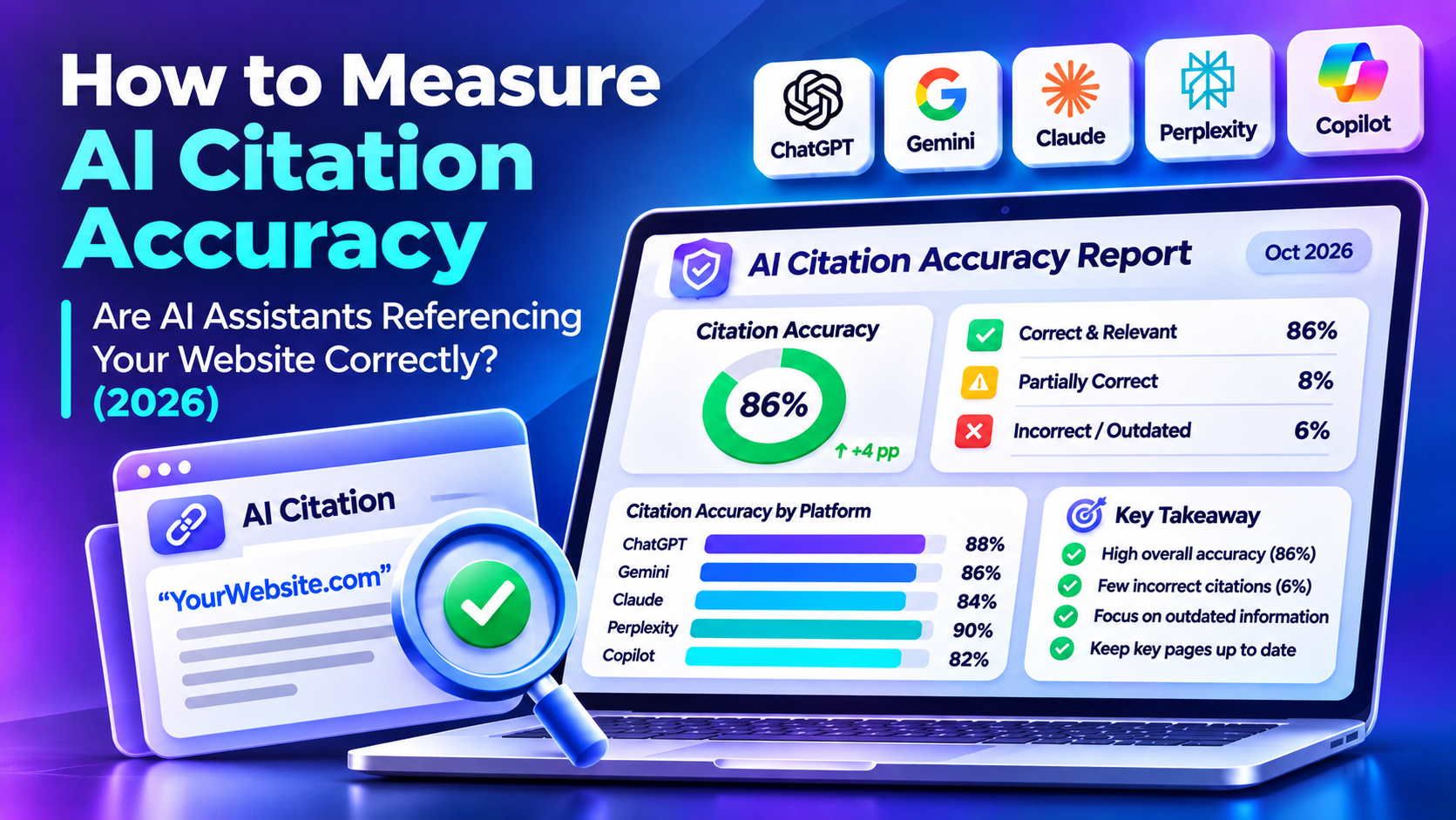
How to Measure AI Citation Accuracy: Are AI Assistants Referencing Your Website Correctly? (2026)
An independent, practical guide for US businesses. Updated November 15, 2026.
A citation in ChatGPT, Perplexity, Claude, Google AI search or Microsoft Copilot can bring attention to your website. But a visible link is not proof that the associated answer is accurate. An AI assistant might cite a working URL that says something different from its claim; link to a page that no longer exists; or use an accurate source to make an outdated statement about your company.
That creates an important question for marketing teams: When AI assistants cite our website, do those citations actually support what the assistant says? This guide explains how to audit citation accuracy without confusing it with the number of citations, the number of brand mentions or a platform's own quality scores.
What is AI Citation Accuracy?
AI Citation Accuracy is an operational measure of the proportion of reviewed AI citation instances that pass a defined set of accuracy checks. There is no single universally adopted industry formula. Your organization must publish its audit rules and use them consistently.
A defensible audit separates at least four dimensions:
- Link validity: Does the visible source URL open and resolve to an appropriate destination?
- Source relevance: Is the source about the entity, product, topic or claim being discussed?
- Claim support: Does the cited material actually substantiate the specific claim attached to it?
- Freshness and factual correctness: Is the claim still true for the date and context of the question?
Some organizations add a fifth dimension: attribution precision. A link might point to a long report that supports a statement, but the cited passage may be difficult to locate. Precision matters when readers must verify specific figures or quotations.
Citation accuracy is not identical to answer accuracy. A response can contain an accurate statement without a citation, and a response can cite a relevant page while making another unsupported statement elsewhere. Audit both when your business decisions depend on trustworthy AI outputs.
AI Citation Accuracy vs Coverage, Share and Brand Mentions
| Metric | Question answered | Typical unit |
|---|---|---|
| Citation Coverage | In how many tested AI answers is our domain cited? | Percentage of eligible answers |
| Citation Share | What portion of citation instances in a defined sample belongs to our domain? | Percentage of citations |
| Citation Accuracy | What portion of reviewed citation instances passes our accuracy rules? | Percentage of audited citations |
| Brand Mention Rate | In how many answers is our brand named? | Percentage of eligible answers |
| Recommendation Rate | In how many answers is our brand actively recommended under a defined rubric? | Percentage of eligible answers |
For example, your domain could appear in 40 of 100 eligible answers (40% coverage), but only 24 of its 30 sampled claim-to-citation links might correctly substantiate the associated statements (80% citation accuracy). These percentages address different questions and should never be merged into a single score.
Related guides: Measure AI Citation Coverage, Measure AI Share of Voice, and Brand Mention Rate vs Recommendation Rate.
A Clear Formula for Citation Accuracy
For a strict pass/fail audit:
AI Citation Accuracy (%) = (Accurate citation instances / Audited citation instances) × 100
In this definition, a citation is accurate only when its destination can be verified, the page is relevant and it adequately supports the attached claim in the stated context. If you also require factual freshness, include that requirement explicitly.
Example: a marketing team reviews 80 citation instances in AI answers. Of these, 52 pass the full rubric, 12 link to a related page that does not support the specific claim, 8 support an outdated product detail, 5 lead to inaccessible or broken destinations, and 3 cannot be assessed because the original evidence is unavailable.
Using a conservative policy that treats all reviewed instances as part of the denominator, accuracy is 52 / 80 × 100 = 65%. Report the three unassessable citations separately: 3 of 80 were unverified. A second, clearly labeled assessable-only rate would be 52 / 77 = 67.5%. Do not switch denominators between months to make a chart look better.
| Audit result | Citations | Share of all audited |
|---|---|---|
| Accurate and supported | 52 | 65.0% |
| Related but does not support the claim | 12 | 15.0% |
| Outdated or contextually wrong | 8 | 10.0% |
| Broken or inaccessible destination | 5 | 6.25% |
| Unverifiable | 3 | 3.75% |
| Total | 80 | 100% |
All numbers above are fictional and illustrate a possible audit, not measured results from any vendor or AI assistant.
How to Collect a Reliable Citation Sample
1. Define the business questions first
Choose prompts representing the customer decisions that matter to your organization. For a US cybersecurity firm, these could include product comparisons, questions about supported integrations, compliance capabilities, service locations and pricing models. Avoid focusing solely on brand-name prompts: they can overstate visibility among people who already know the company.
Classify prompts into informational, commercial, comparison, local and brand-specific groups. Record their priority and reason for inclusion.
2. Keep the tested experience consistent
A citation in ChatGPT Search is not necessarily comparable with an answer produced without web search. The same applies across Claude, Gemini, Perplexity, Copilot and Google AI Overviews. Record the app, mode, country, language, prompt, date and whether visible source links were available. AI results can change with models, retrieval modes and personalization.
3. Save the actual answer and citation context
For each tested response, preserve the relevant AI-generated claim, visible cited URL, accessed landing URL, date, and a copy or screenshot of the surrounding answer when lawful and consistent with platform terms. Keep a stable response identifier and a citation identifier. A source list shown beneath an answer may not map clearly to every individual sentence; mark ambiguous mappings as such instead of inventing an attachment.
4. Sample claims, not just URLs
One response may cite a domain three times to support three different claims. Those are three claim–citation instances for this audit. Conversely, one citation badge attached to multiple distinct claims may require separate claim checks. State your unit of analysis and prevent duplicate counting of the same claim–citation pair.
5. Review across platforms and topics
A practical pilot might review 20 claim–citation pairs per platform across five AI experiences, for 100 total instances. This is a manageable manual audit, not necessarily a statistically representative sample. Increase coverage for important markets, sensitive claims and high-value commercial topics. Avoid publishing narrow findings as universal platform accuracy rankings.
The 10-Step AI Citation Accuracy Audit
Step 1: Check whether the visible link works
Open the cited URL. Record its HTTP result, redirects, errors and access restrictions. A redirect can be legitimate; inspect the final page rather than automatically marking it wrong. A page requiring a subscription might be valid but not fully auditable without authorized access.
Pass: The destination resolves and the relevant material can be checked. Flag: The link is broken, loops, reaches an unrelated page or cannot be assessed.
Step 2: Confirm the citation points to the intended source
An AI assistant may link to a homepage when the relevant evidence exists on a specific product page. The homepage may be topically related without providing the claimed detail. Record the canonical URL and, where possible, the exact section containing the evidence.
Step 3: Extract one verifiable claim
Turn a long AI sentence into a focused claim. Example: "Company X offers SOC 2 Type II reporting" is directly testable. "Company X is the safest option" requires a different evidence standard and may reflect an unsupported comparative judgment. Break combined statements into their verifiable components.
Step 4: Check whether the page supports the claim
Read the relevant passage in context. The page must actually support the specific assertion. Mere keyword overlap is insufficient. If a page says an integration is "on the roadmap," it does not support an AI answer saying the integration is available today.
Step 5: Verify dates and version applicability
Many inaccuracies arise from time. Check when the source was published, whether it has been updated, which product plan or version it describes and the date of the AI question. A 2024 pricing page cannot automatically establish a current 2026 price.
Step 6: Check identity and geography
Ensure the cited company, brand and legal entity are the intended ones. This matters particularly for firms with similar names, acquisitions and products sold through multiple subsidiaries. Verify whether a statement applies to the United States rather than another country.
Step 7: Evaluate numbers and qualifications
Check units, currencies, ranges, percentages and footnotes. "Starts at $100" is not the same as "costs $100". Statistics need denominators and study dates; rankings need a defined methodology. If a citation gives a conditional claim, the AI answer should preserve that qualification.
Step 8: Review attribution and source independence
Distinguish the company's own marketing claims from independent testing or regulatory evidence. A vendor page may accurately describe what the vendor claims, without independently proving performance or superiority. Record whether the answer represents that distinction fairly.
Step 9: Classify the error and severity
Assign one primary reason: broken link; wrong entity; irrelevant page; unsupported claim; outdated claim; numeric distortion; omitted qualification; or cannot verify. Give each issue a severity rating. For instance, an outdated office phone number and an inaccurate medical or financial claim have different consequences.
Step 10: Record remediation and retest
If your owned page is outdated, correct it. If the page is accurate but the AI answer is wrong, document the mismatch and consider the feedback channel offered by the platform. Preserve evidence, update helpful source content where warranted, and rerun your prompt sample later. Do not promise that any page edit will force an AI assistant to change its answer.
A Practical 0–2 Scoring Rubric
Use individual dimension scores when you need diagnostic detail. This is an editorial scoring framework, not an official Google, Microsoft or OpenAI measurement standard.
| Dimension | 0 points | 1 point | 2 points |
|---|---|---|---|
| Link validity | Broken or wrong destination | Accessible but indirect | Correct, accessible destination |
| Source relevance | Unrelated | Broadly related | Directly relevant |
| Claim support | Contradicts or does not support | Partial/ambiguous support | Explicit support |
| Timeliness | Clearly outdated | Date cannot be established | Appropriate for stated date |
| Attribution | Misleading or wrong entity | Attribution incomplete | Correct, clear attribution |
The maximum score is 10. Do not equate a score of 8/10 with 80% factual accuracy. A weighted quality score and a strict pass rate answer different questions. For the headline Citation Accuracy KPI, use the predefined binary rubric; keep the 0–10 score as a diagnostic supplementary view.
For higher-risk content, use an override: if Claim support = 0 or Attribution = 0, the entire citation fails regardless of total score. Document the override before testing.
Example: Auditing an AI Answer About a Software Provider
Imagine a US business asks an AI assistant: "Does ExampleCRM include unlimited support in its entry plan?" The answer states that unlimited telephone support is included and cites a valid ExampleCRM pricing page. On inspection, the page says that the entry plan includes email support, while telephone support is offered on a higher tier.
The citation is link-valid and topically relevant, but claim-inaccurate. A report that counts every working link as an accurate citation would miss this failure.
Now suppose the AI assistant cites an older press release announcing a feature that has since been removed. The release itself was accurate when published, but the answer presents the feature as currently available. The audit should flag a temporal mismatch and, where possible, link the current product documentation as authoritative counterevidence.
Finally, if the AI answer cites a third-party review correctly noting a company's stated capabilities but falsely presents that review as independent testing, the audit should flag misleading attribution. These examples show why one blended "citation quality" number is less useful than documented failure categories.
Build a Citation Accuracy Worksheet
Use one row per claim–citation instance. A minimal CSV or spreadsheet should contain the following columns:
| Column | Example value |
|---|---|
| Test ID | CHAT-2026-0115-01 |
| Platform and mode | ChatGPT Search |
| Prompt category | Pricing comparison |
| Prompt text | Does Provider A offer API access? |
| AI answer date | 2026-11-15 |
| Claim under review | API available on basic plan |
| Visible citation URL | https://example.com/pricing |
| Final destination URL | https://example.com/plans |
| Evidence passage / section | Basic plan feature table |
| Link validity | Pass |
| Source relevance | Pass |
| Claim support | Fail |
| Timeliness | Pass |
| Attribution | Pass |
| Overall strict outcome | Fail |
| Error type | Unsupported plan claim |
| Severity | Medium |
| Reviewer | Analyst initials |
| Evidence captured at | Timestamp |
| Follow-up action | Recheck vendor plan documentation |
The provider and URLs are fictional. Do not record personal customer information in your monitoring worksheet unless you have an appropriate legal basis and security controls.
Additional KPIs Worth Tracking
1. Strict Citation Accuracy: Accurate claim–citation instances divided by all audited instances, using your chosen treatment of unverifiable records.
2. Unsupported Claim Rate: Instances whose attached sources do not support the assertion divided by audited instances. This measures a specific failure mode.
3. Broken Citation Rate: Citations resolving to invalid or unusable destinations divided by tested citation URLs. State how you classify redirects and login-restricted resources.
4. Stale Citation Rate: Instances relying on information that is outdated for the question's date divided by audited instances. Decide whether historical questions are evaluated at the historical or present date.
5. High-Severity Citation Error Rate: High-severity errors divided by audited instances. Use a written severity rubric, especially for legal, health or financial information.
6. Unverifiable Rate: Cases without sufficient accessible evidence divided by total reviewed cases. This guards against silently excluding difficult checks.
7. Correction Follow-Through: Confirmed issues corrected in your own content divided by confirmed issues under your control. External AI answer changes are not guaranteed.
Report all these metrics by platform, prompt segment and reporting period, and include sample counts. A 95% accuracy score from 20 audited citations should not be presented as more certain than an 85% score from 2,000 citations without considering sampling differences.
What First-Party Search Dashboards Can and Cannot Tell You
Microsoft's Bing Webmaster Tools AI Performance report reports citations, cited pages and grounding queries for supported AI experiences including Copilot and Bing AI summaries. Microsoft explicitly says this is aggregated citation activity, not a ranking, authority or source-quality judgment. Its data does not expose every individual answer and source claim. Therefore, it cannot directly calculate the strict claim-to-citation accuracy rate described in this guide.
Google Search Central's AI features guidance explains eligibility and familiar SEO fundamentals for AI Overviews and AI Mode. Google Search Console information can inform search-performance analysis, but should not be mislabeled as a universal, claim-level citation verification dataset.
OpenAI's ChatGPT Search help warns that citations and search results can be incomplete, outdated or incorrect and recommends opening sources to confirm that they support an answer. This manual check is central to measuring citation accuracy.
For cross-platform citation audits, you typically need a controlled collection process, saved response context, evidence review and consistent human or validated automated classification. Automated language-model judgments can assist with triage but should not be treated as infallible ground truth.
Manual Auditing vs AI Visibility Monitoring Software
Manual review is inexpensive and offers clear reasoning, but becomes labor-intensive as the sample grows. Automation helps collect responses, normalize URLs, deduplicate citations and identify likely mismatches. However, citation monitoring and citation accuracy verification are not the same feature. Ask prospective software vendors whether they inspect claim-to-source alignment or merely count cited links.
US-based companies already listed in the AI Visibility Directory include:
- Profound — AI search intelligence and citations analysis.
- Evertune — GEO analytics and competitive insights.
- Scrunch AI — AI visibility monitoring and agent experience tooling.
- Brandlight — brand representation, reputation and AI intelligence.
- Conductor — enterprise AI search and SEO measurement.
- seoClarity — enterprise search intelligence and AI visibility.
For organizations needing external implementation or auditing support, explore WebFX, Omniscient Digital, iPullRank and First Page Sage.
These are directory entries, not assertions that any named vendor provides the exact strict citation-verification workflow described above. Request demonstrations and confirm their current capabilities before buying.
A 30-Day Citation Accuracy Improvement Plan
Days 1–7: Define and capture
Choose 30–50 priority prompts, identify the important markets and AI platform modes, write a short pass/fail rubric and record a baseline sample. Save the claim text and source URL for each citation. Assign an owner for the audit process.
Days 8–14: Verify and classify
Open the cited destinations, locate supporting passages, check dates, and classify errors. Review a sample with two reviewers to identify disagreements. Refine the rubric before scaling rather than changing definitions halfway through a reporting period.
Days 15–21: Correct what you control
Repair broken owned links, update inaccurate product pages, publish clearer FAQs and clarify distinctions between product tiers, locations and dates. When a third-party page is wrong, request a correction through appropriate channels. Do not manipulate reviews or manufacture purportedly independent endorsements.
Days 22–30: Retest and report
Repeat the same prompt sample and separate the new results from the initial baseline. Report strict accuracy, broken-link rate, stale information, serious errors and unverified cases. Changes are observations, not proof that any one page edit caused the AI system's behavior to change.
Common Mistakes When Measuring AI Citation Accuracy
- Assuming a working URL proves a factual claim. It only proves some level of destination availability.
- Confusing citations with brand recommendations. A website may be cited in a negative or neutral answer.
- Using one AI model to grade all other models without checks. Automated evaluators can miss context, dates and source qualifications.
- Ignoring citation mapping. A source list may not establish which source supports which sentence.
- Excluding difficult cases without disclosure. Publish your treatment of inaccessible and ambiguous records.
- Failing to separate link-level and claim-level errors. A broken URL and an unsupported claim need different remedies.
- Overclaiming statistical certainty. Small, targeted audits are directional rather than definitive market-wide accuracy studies.
- Changing your counting unit between months. A citation per URL and a citation per claim are not interchangeable.
- Treating first-party aggregate dashboards as claim audits. Their primary purpose is citation visibility, not factual adjudication.
- Promising a guaranteed fix in AI answers. Improving source quality does not control another system's generated response.
Frequently Asked Questions
Is AI Citation Accuracy an official KPI?
It is a useful operational KPI, but there is no single universal definition adopted across all AI search platforms. Publish your test unit, dimensions, pass criteria and denominator.
Can a correct citation still lead to a wrong answer?
Yes. A cited page can be relevant and correct while the AI system misinterprets its contents, omits a qualification or attaches it to a different claim.
Is a brand mention a citation?
No. A brand name in an answer is a mention. A visible link or source attribution is a citation under this guide's measurement rules.
What if the cited page has been updated since the answer was generated?
Preserve the answer timestamp and use archived or historical evidence when legitimately available. State whether you are evaluating correctness at answer time or current accuracy. Do not silently mix them.
Can I measure citation accuracy from Bing Webmaster Tools alone?
No. Its AI Performance report provides aggregated citation data for supported Microsoft AI experiences, not a complete corpus of claim-level evidence checks.
Should I count paywalled citations as inaccurate?
Not automatically. Mark them as restricted or unverifiable unless you can lawfully access enough evidence to determine whether the claim is supported.
Should I automate the scoring process?
Automation can help prioritize reviews, fetch URLs and compare passages. Human quality assurance is especially important for ambiguous claims and high-impact business decisions.
How often should we audit?
Monthly is a reasonable baseline for many businesses. Check high-impact product launches, pricing changes and serious reputation issues more frequently, using stable sampling rules.
What is a good AI Citation Accuracy score?
There is no reliable universal benchmark. Start by establishing a transparent baseline and aim to reduce the most serious error categories, rather than comparing unsupported headline percentages between vendors.
Does higher citation accuracy guarantee more traffic?
No. Accuracy measures evidence quality, not click-through rates, brand preference or conversions. Track those business outcomes separately.
Conclusion: Audit What the Source Actually Says
AI citations are useful only when readers can trust the relationship between the AI claim and the cited evidence. Begin by collecting representative claim–citation pairs, checking destinations and source passages, separating link errors from factual errors and publishing consistent scoring rules.
Make citation quality part of your AI visibility reporting, alongside Citation Coverage, AI Share of Voice and Brand Mention Rate. Browse AI Visibility software providers and US GEO/AEO agencies for tools and professional support.
Sources and Further Reading
- OpenAI Help Center — Searching the web with ChatGPT
- Microsoft Bing Webmaster Tools — AI Performance
- Microsoft Bing Webmaster Blog — Introducing AI Performance (February 10, 2026)
- Google Search Central — AI features and your website
- Google Search Central — Optimizing for generative AI features
Editorial disclosure: This is independent educational content. Listed providers are examples of businesses operating in AI Visibility, not endorsements or guarantees of particular functionality. All example data is fictional.