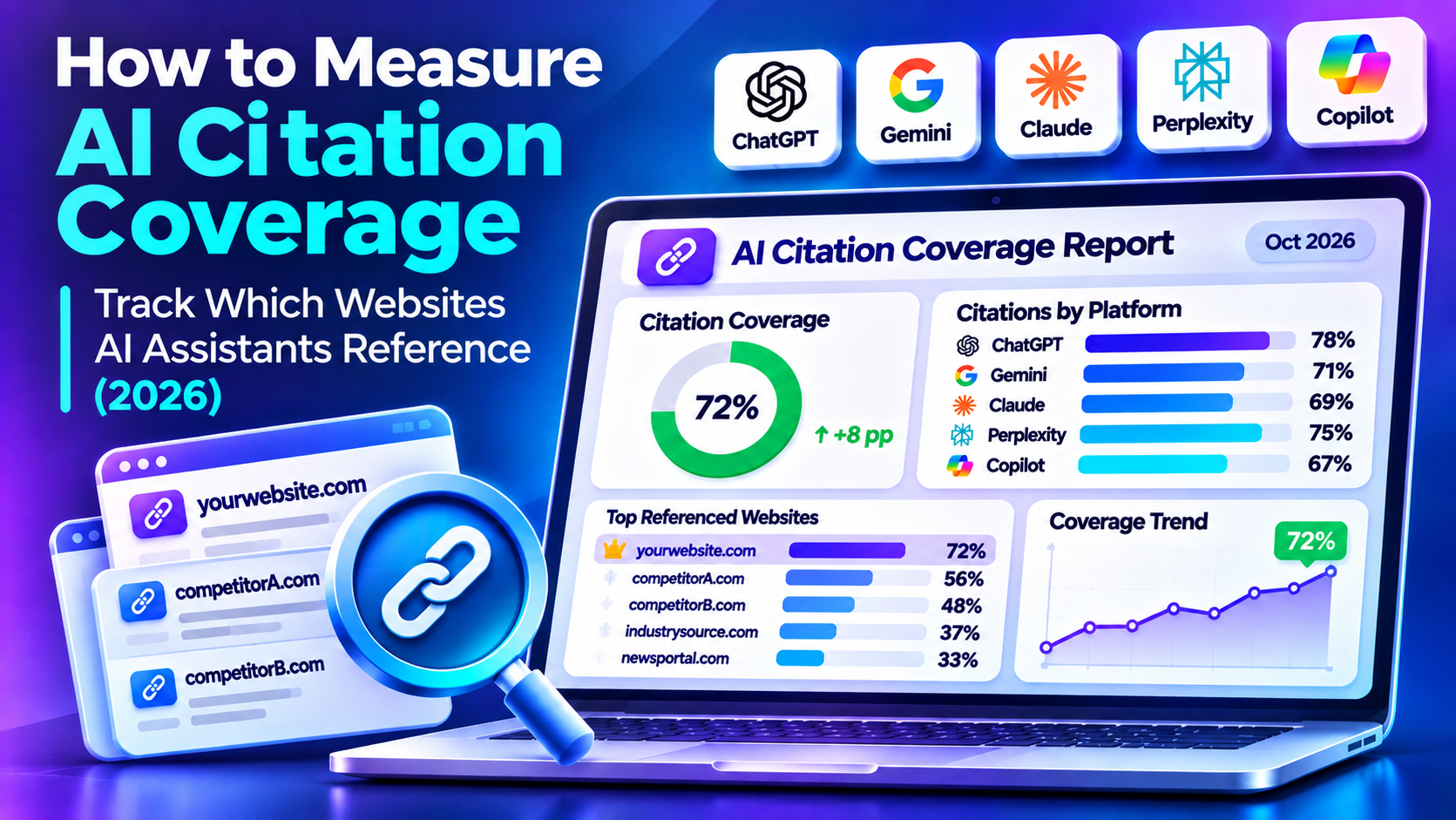
How to Measure AI Citation Coverage: Track Which Websites AI Assistants Reference (2026)
An independent measurement guide for US businesses. Updated November 15, 2026.
When an AI assistant responds to a question, it may show links to websites that support its answer. Those links are AI citations. For a business, tracking which domains and pages receive those citations can reveal whether its content is appearing as a source, which competitors are visible, and which publishers repeatedly influence the research journey.
But what does AI citation coverage actually mean? Unlike search rankings, it does not have a single industry-wide formula. You must define a set of questions, identify eligible AI answers, decide what counts as a citation, and then calculate the proportion of responses referencing your website. A sound process produces a useful directional KPI; an arbitrary set of screenshots does not.
This guide explains the definitions, calculation methods, sampling rules, tracking tools, and next steps for US marketing teams. It covers ChatGPT Search, Google AI Overviews and AI Mode, Perplexity, Claude with web search, and Microsoft Copilot, while distinguishing visible citations from brand mentions and website visits.
Quick answer: What is AI citation coverage?
AI Citation Coverage is the percentage of sampled, citation-eligible AI answers that visibly reference at least one page from your website. In this article, each AI answer counts once, regardless of how many pages from your site it cites.
Formula:
AI Citation Coverage (%) = (Eligible AI answers citing your domain / Total eligible AI answers sampled) × 100
Illustration: If 24 out of 120 eligible AI answers cite your website, your observed AI Citation Coverage is 20%. This is a result for your test sample and measurement rules, not a population-wide probability that all AI users will encounter your business.
A second useful metric is Page Citation Breadth: the number of distinct pages on your site cited during the measurement period. It helps distinguish reliance on one popular page from broader content coverage.
1. First, distinguish five commonly confused metrics
| Metric | What you count | What it tells you |
|---|---|---|
| AI Citation Coverage | Eligible answers with ≥1 visible citation to your domain / eligible answers | How often your site is cited in your sample |
| Citation Share | Your site's citation events / all citation events in the defined competitor/source set | Your relative share of cited sources |
| Unique Cited Pages | Distinct canonical URLs on your domain with ≥1 citation | How widely AI references your site content |
| Brand Mention Rate | Answers mentioning your business name / sampled answers | Brand visibility even without citations |
| AI Referral Traffic | Visits attributable to AI referring sources | Whether some users subsequently visit your website |
A company may have high brand mentions and low citation coverage when AI assistants discuss it but link to review websites or competitor pages. A publisher may have high citation coverage with few mentions of its company name because its articles are regularly used as factual sources.
Do not treat a citation as proof of endorsement. An AI system may cite a site while explaining a limitation, offering criticism, or simply supporting a factual statement.
2. Define the population before you calculate a rate
The denominator is the most important decision. Decide whether your test includes:
- Only answers where the interface provides web citations, such as a research answer with visible source links; or
- All prompts submitted, including responses without web retrieval or citations.
These are different questions. For a citation-eligible answer coverage KPI, use the first definition and record exclusions. For an all-prompt citation occurrence KPI, use every response and report that metric separately. Never mix them between reporting periods.
For the first method, an eligible answer is a successfully captured result from a specified AI search/research experience in which a citation could normally be displayed. You should document whether you exclude errors, blocked queries, refusals, unsupported environments, and answers where web retrieval was not activated. Avoid dropping zero-citation answers simply because they weaken your score if citations were possible in that mode.
Recommended baseline: Start with 20–40 high-intent buyer questions, use each question across your chosen platforms, and repeat testing on a defined schedule. Aim for sufficient observations to detect meaningful changes, not an arbitrary headline number.
3. Build a prompt library around real customer decisions
Generic prompts such as “Tell me about marketing” are poor measures of whether an AI assistant cites a US industrial equipment supplier or a B2B SaaS vendor. Use questions tied to actual customer research.
Create four groups:
- Problem awareness: “How can a manufacturing company reduce unplanned machine downtime?”
- Solution research: “What are the most useful approaches to predictive maintenance?”
- Comparison: “Compare predictive maintenance software for US mid-sized factories.”
- Vendor evaluation: “Which questions should I ask before choosing a maintenance software provider?”
Document each prompt's intent, audience, industry, geographic context, and target topic. Mark branded prompts separately from unbranded prompts. Branded tests are often easier to win and can inflate apparent coverage if they dominate your sample.
Do not silently change prompt wording halfway through the study. If buyer behavior changes, introduce a new prompt cohort and preserve the original for trend analysis.
4. Choose AI platforms and keep their experiences separate
Citation interfaces differ between platforms, and even within the same platform. ChatGPT with web search is not equivalent to a chat response generated without web retrieval. Gemini Apps, Google AI Overviews, and Google AI Mode should not be treated as one identical experience.
| Platform or experience | Suggested observation |
|---|---|
| ChatGPT Search | Record visible cited URLs and the answer context |
| Google AI Overviews | Record linked sources when an AI Overview appears for the tested query |
| Google AI Mode | Capture sources in the AI Mode response |
| Perplexity | Record displayed source references and cited domains |
| Claude with web search | Capture citations when web search is actually used |
| Microsoft Copilot | Record visible supporting links where available |
Always record the platform, product mode, country/locale, date, prompt, and citation URLs. Model versions, personalization, availability, and retrieval conditions can change, so compare similar conditions and disclose what you cannot control.
5. Capture the evidence, not just a yes/no result
For each test, store a row containing:
| Field | Example |
|---|---|
| Date | 2026-11-15 |
| Platform / mode | Perplexity web answer |
| Prompt ID | COMP-014 |
| Query intent | Commercial comparison |
| Geographic scope | United States |
| Citation eligible? | Yes |
| Your domain cited? | No |
| Cited domains | publisher-a.com; competitor-b.com |
| Source URL(s) | Full URLs, one record per citation if needed |
| Brand mentioned? | Yes |
| Brand recommended? | No |
| Snapshot reference | Archived response or screenshot filename |
| Reviewer / confidence | Analyst 1; confirmed |
Store the answer's context, not only the citation list. A link might be present in an expandable source panel but not visibly supporting the specific claim you care about. Define whether those links count, and apply your rule consistently.
When possible, retain a snapshot for quality assurance while respecting platform terms and privacy obligations. Avoid capturing personal user information in test prompts.
6. Normalize domains and URLs before counting
Different citation URLs may point to the same underlying page. Before scoring, normalize:
www.example.comandexample.cominto a common registrable domain when appropriate.- HTTP/HTTPS and obvious tracking query parameters without breaking distinct content pages.
- Redirected links to the final destination where this can be checked safely.
- Canonical page variants for URL-level breadth metrics.
- Subdomains deliberately: decide whether
docs.example.combelongs with the main domain.
Do not merge two unrelated domains owned by the same parent unless the business question expressly calls for an entity-level metric. Record both the raw URL and the normalized value so decisions are auditable.
Important: Domain citation coverage does not equal company recommendation coverage. If a publisher cites your blog post to explain a concept, your website can receive a citation without the company appearing in a vendor recommendation.
7. Worked example: Citation Coverage across five AI experiences
Consider an illustrative US B2B company testing 120 eligible AI answers. Analysts find 24 answers with at least one citation to its domain.
Coverage = 24 / 120 × 100 = 20%
Breaking it down by platform:
| AI experience | Eligible answers | Answers citing your domain | Citation coverage |
|---|---|---|---|
| ChatGPT Search | 24 | 7 | 29.2% |
| Gemini / Google AI search test | 24 | 4 | 16.7% |
| Claude with web search | 24 | 3 | 12.5% |
| Perplexity | 24 | 6 | 25.0% |
| Microsoft Copilot | 24 | 4 | 16.7% |
| Total | 120 | 24 | 20.0% |
All data above is fictional. “Gemini / Google AI search test” denotes one consistently defined test environment, not an interchangeable mix of products.
The overall 20% is an unweighted aggregate across equally sized platform samples. If you run different numbers of tests per platform, the pooled rate will weight platforms by sample size. That may or may not match the commercial importance of those platforms. Consider reporting the per-platform metrics as primary and an explicitly weighted portfolio average as secondary.
A second example: Citation share versus coverage
Suppose those same 120 eligible answers contain 360 total source citation events, including repeated domains, and your website receives 30 of those citation events across the 24 cited answers.
- AI Citation Coverage: 24 / 120 = 20.0%
- Citation Event Share: 30 / 360 = 8.3%
- Unique Cited Pages: perhaps 9 distinct pages (if the URL review confirms it)
All three numbers are meaningful, but none should be labeled as another. This also differs from the per-grounding-query Citation Share available in Bing's reporting interface, whose scope and calculation are defined by Microsoft.
8. Track which external websites AI assistants reference
The real value of citation analysis extends beyond your own domain. Create a source-domain frequency table for your selected prompt cohort.
| Cited source type | What to investigate |
|---|---|
| Competitor websites | Which product pages, technical guides or comparisons receive links? |
| Industry publishers | Are research reports or expert roundups repeatedly cited? |
| Review and directory platforms | Which independent company profiles influence buyer research? |
| Government or standards bodies | Are official facts central to the question? |
| Community discussions | Which user experiences and questions recur? |
| Your own website | Which URLs attract citations, and where are the gaps? |
Rank sources by number of eligible answers citing the domain rather than only the raw number of links. A single answer containing five links from one domain should not automatically count as five times as influential in an answer-level frequency table. You can report raw citation events alongside answer-level frequency.
Next, inspect why sources are likely relevant: fresh data, original research, clear product specifications, expert context, neutral comparisons, or authoritative documentation. This informs content planning; it is not evidence that copying the cited pages will make an AI assistant cite you.
9. Segment citation coverage by business intent
A single percentage can hide an important commercial problem. Split results into topics and intent groups:
- Educational: Explanatory questions; useful for building authority and awareness.
- Problem/solution: Questions where your expertise might be cited.
- Comparison: Queries about alternatives, pricing or buying criteria.
- Brand-specific: Questions that mention your company or product.
- Local: US city and state questions where local relevance is part of intent.
Imagine educational prompts showing 35% coverage while comparison prompts show just 5%. That suggests a different task than improving general brand awareness: examine comparison pages, published product data, case evidence, review-platform accuracy and buyer information.
Track your most valuable cohorts separately before averaging across everything.
10. Use available first-party reporting carefully
Bing Webmaster Tools: AI Performance
Microsoft's AI Performance report shows aggregated citation activity for supported Copilot, Bing AI and partner experiences. It includes cited pages, citation volume and grounding-query data. Its data is useful for trends and page-level diagnostics, but it is not a complete log of every AI citation across the web. Microsoft's documentation explicitly cautions that counts do not establish rankings or authority.
Bing also documents Citation Share within its expanded AI Performance capabilities, focused on relative presence for a given grounding query. Check current feature availability in your own account before promising this report to stakeholders.
Google Search Console: Generative AI reports
Google's Search Console generative AI performance reports help site owners understand visibility within Google's generative search features. They are useful complementary measurements, but should not be treated as an interchangeable source-by-source citation event dataset for every AI assistant.
Other platforms
Some AI search interfaces display source links that can be sampled manually, while independent software offers monitoring, historical tracking and competitive analysis. Verify each product's actual platform coverage, source collection method and export capabilities before comparing its metrics with yours.
Rule: Do not add counts from unrelated reporting tools and call the sum “total AI citations” unless the source populations, intervals, duplicates and definitions have been reconciled.
11. Decide whether manual tracking or software is justified
A small US business can start with 20–40 prompts and a spreadsheet, provided its team can capture results consistently. For a brand operating across multiple markets, product lines or competitors, manual review becomes more expensive and error-prone.
When evaluating monitoring software, request answers to these questions:
- Does the platform capture actual visible source URLs or only brand mentions?
- Does it track citation coverage by prompt, answer, domain and URL?
- Can users export raw response and citation records for auditing?
- Are sampling frequency and geographic conditions disclosed?
- How does it handle answers without web search or citations?
- Can it separate branded and unbranded queries?
- Can you compare competitor domains and identify citation gaps?
- Does it distinguish citations from clicks, mentions and recommendations?
For US businesses comparing providers, our directory includes software profiles for Profound, Evertune, Scrunch AI, Brandlight, Conductor and seoClarity. Compare current features directly with each vendor; inclusion here is not a claim that all six support every measurement described above.
For implementation support, consider comparing WebFX, Omniscient Digital, iPullRank and First Page Sage.
12. Diagnose low citation coverage without chasing shortcuts
If your website is rarely cited, run four checks before commissioning an elaborate GEO project.
Technical: Can normal search crawlers reach your pages? Are key documents indexable, linked internally and readable in text? Review Google's AI features guidance.
Information value: Does your site publish original, clear and relevant information for the questions you are testing? Pages that repeat generic statements with no evidence offer little distinct value.
Source competition: Are independent research sites, industry associations or competitor product specifications more directly relevant to the answer? Map those patterns instead of assuming that more keywords alone will solve the gap.
Measurement: Did you sample the correct questions, modes and countries? Are brand names, URLs and citations accurately coded? A change in one AI system's display behavior can look like a marketing decline even when your underlying website has not changed.
There is no guarantee that updating a page, adding schema, permitting a crawler or acquiring a link will cause an AI assistant to cite it. Use these checks to improve the quality and accessibility of your information, then observe whether your measured sample changes.
13. A 30-day citation coverage measurement plan
Week 1 — Define the baseline
Select 20–40 important buyer prompts, a consistent US geographic context, and the AI experiences you will test. Create the spreadsheet columns and written counting rules. Run an initial sample and review at least 10% of classifications with a second reviewer.
Week 2 — Map the sources
Normalize domains and URLs. Identify the most cited competitors, publications, directories and content types. Report citation coverage separately for product research, comparison and educational questions.
Week 3 — Prioritize corrections
Fix genuine crawl or indexing problems; correct outdated product and business facts; strengthen high-value pages with original evidence, clear answers and useful comparisons. Document each edit date rather than assuming immediate impact.
Week 4 — Repeat and interpret
Rerun the same prompt cohort under comparable conditions. Report changes in citation coverage, citation share, unique cited pages, branded versus unbranded results, and AI referral conversions. Separate genuine observations from interpretations and unproven causal claims.
Continue monthly. Because AI answers vary across users, time, locations and model behavior, report directional trends and sample sizes, not exaggerated certainty.
14. Reporting dashboard template
A practical monthly scorecard could include:
| KPI | Baseline | Current month | Interpretation |
|---|---|---|---|
| Citation-eligible answers tested | 120 | 120 | Keep sample stable |
| Answers citing your domain | 24 | 30 | +6 sampled answers |
| AI Citation Coverage | 20.0% | 25.0% | +5 percentage points |
| Distinct cited pages | 9 | 11 | Broader cited content |
| Citation Event Share | 8.3% | 9.1% | Relative share in test set |
| AI referral conversions | 3 | 4 | Attribution may be incomplete |
All figures are fictional and are provided to illustrate reporting only. A change from 20% to 25% does not by itself prove that your SEO changes caused the increase. Consider sample variability, platform behavior, query mix and the evidence available.
15. Common mistakes to avoid
- Counting brand mentions as citations. A mention without a linked source is not a visible citation.
- Using an unspecified denominator. “35% citation coverage” means little without a defined set of eligible answers.
- Treating all sources as equal to endorsement. A citation can support neutral or negative context.
- Counting repeated links inconsistently. Distinguish answer-level citation coverage from raw citation events.
- Comparing unrelated AI modes. Identify whether web search and source links were available.
- Ignoring geography and prompt intent. US buyer questions can differ from global informational questions.
- Assuming first-party reports cover every AI platform. They generally report their own supported surfaces.
- Calling fluctuations causation. A before-and-after chart alone does not isolate why citations changed.
Frequently asked questions
Is AI Citation Coverage an official metric?
Not as one universal standard across every AI assistant. This article defines an operational, answer-level version. Different vendors and first-party interfaces may use other definitions. Always publish your counting rules.
Is Citation Coverage the same as Citation Share?
No. Coverage measures what percentage of eligible answers cite a domain. Citation Share measures its proportion of citation activity within a specified source or query set. The two can move in different directions.
Do ChatGPT, Claude and Gemini always display citations?
No. Whether visible citations appear depends on the product experience, tools used, question and response. Define the tested environment and keep modes separate.
Can my brand be mentioned without receiving a citation?
Yes. AI systems can name a business in prose while linking to a third-party page—or show no visible link at all.
Can I calculate citation coverage from Google Search Console alone?
Google's reports provide useful visibility data for its generative Search features, but not a universal cross-assistant answer-level dataset. A custom cross-platform coverage KPI requires defined sampling or suitable third-party collection.
Does Bing AI Performance prove that my pages rank above competitors?
No. Microsoft says citation counts reflect visible source references, not rankings, authority or page importance.
Should I measure individual pages or whole domains?
Both. Domain-level coverage answers whether your website appears. Page-level reporting reveals which individual content assets are referenced and whether the citations are concentrated.
What should I do if my coverage is zero?
Check technical access, confirm that your prompts are relevant and eligible for citations, inspect third-party sources being referenced, and improve useful content. Zero in a small test sample does not prove that your business never appears in AI answers.
How often should citation coverage be measured?
Monthly is a practical starting point. For launches or intensive campaigns, weekly testing can be helpful if the methodology remains stable and the sample size is sufficient.
Does improving citation coverage guarantee more leads?
No. Citations are an exposure signal. You still need relevant audiences, useful landing pages, working conversion paths and business outcome tracking.
Conclusion: Measure the sources, then improve the evidence
AI Citation Coverage becomes useful when it is defined, repeatable and connected to business questions. Build a stable prompt sample, capture citations by domain and page, report coverage and share separately, and study which competing sources are being referenced.
Start with a defensible baseline. Improve your website's genuinely useful information and technical discoverability. Repeat measurements over time and validate downstream outcomes, including enquiries and conversions.
Explore AI Visibility software companies or browse US GEO and AEO agencies to compare approaches to measurement and implementation. For related concepts, read How to Measure AI Share of Voice, AI Brand Mention Rate vs Recommendation Rate and How to Increase AI Citations.
Sources and further reading
- Microsoft Bing Webmaster Tools — AI Performance
- Microsoft Bing Webmaster Blog — Introducing AI Performance, February 2026
- Google Search Central — Generative AI performance reports
- Google Search Central — AI features and your website
Editorial disclosure: AI Visibility Directory is an independent directory. Company profiles are informational, not endorsements or paid rankings. Features and provider offerings may change.