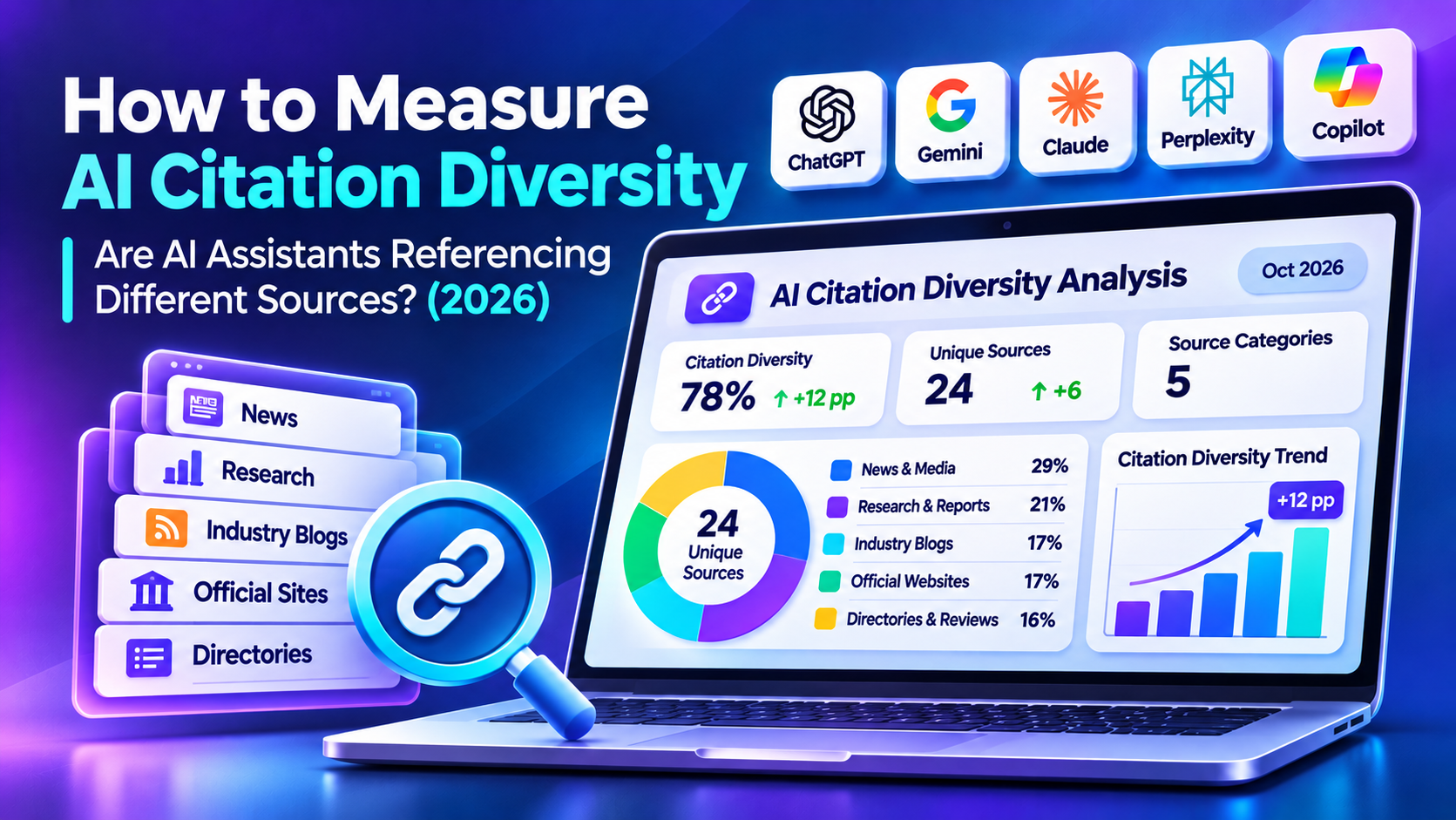
How to Measure AI Citation Diversity: Are AI Assistants Referencing Different Sources? (2026)
An independent measurement guide for US businesses. Updated November 15, 2026.
A brand can appear frequently in AI-generated answers while the supporting citations come from just one or two websites. Another brand may receive fewer citations overall, but across independent publications, product documentation, professional associations, customer reviews, and other sources. Which situation indicates stronger AI visibility? Neither citation volume nor diversity alone answers that question. You need to measure both—and examine whether the cited material is relevant and accurate.
This guide explains how to measure AI Citation Diversity across ChatGPT, Gemini, Claude, Perplexity, Microsoft Copilot, and Google AI search experiences. You will learn how to count unique cited domains, quantify source concentration, compare platform-level differences, audit citations for quality, and build a repeatable reporting process.
Important: AI Citation Diversity is an operational measurement framework, not a universally standardized Google, OpenAI, or Microsoft ranking factor. The formulas below are transparent analytical choices you can adopt consistently; they do not guarantee recommendations or citations.
What Is AI Citation Diversity?
AI Citation Diversity describes the variety and distribution of source websites referenced by AI-generated answers within a defined collection of prompts, platforms, locations, and dates. It answers two related questions:
- Variety: How many distinct source domains or publishers appear?
- Concentration: Do a few sources account for most citations, or are citations more widely distributed?
The measure can be applied to all citations in a market or topic, to citations associated with answers mentioning your brand, or to citations pointing specifically to your own website. These are different populations and must be labeled separately.
For example, a company could own 12 distinct pages cited 50 times but still have only one cited domain. That is substantial page-level diversity within the company website, not publisher diversity across the web.
For most competitive AI visibility assessments, analyze both domains and URLs, and separate first-party sources (your own site) from independent third-party sources.
Why Citation Diversity Matters for US Businesses
Citation diversity can illuminate how information about a business is represented across the public web. A concentration of citations on one source may reveal a narrow information footprint, a strong authoritative source, or simply the AI platform's retrieval preferences. It is not automatically a problem.
A broader collection of relevant, independent cited publishers may indicate that a brand's products, expertise, and claims are documented in multiple places. That can help marketers identify opportunities for public relations, original research, industry participation, and content improvement.
But more domains are not inherently better. Five irrelevant or inaccurate sources are less useful than one authoritative document accurately supporting a claim. Always pair diversity with a citation-quality audit.
Define the Denominator Before Calculating Anything
Choose a reproducible sampling scope before comparing results:
- Business and competitive set: Your brand and named competitors, including spelling variants.
- Prompts: A fixed set of commercial, informational, local, and comparison questions.
- Platforms: The AI search or answer experiences being tested; note whether web retrieval was active.
- Market: United States, with a documented language and geographic setting where possible.
- Period: A fixed test window, such as November 1–30, 2026.
- Sample: Repeated answer observations, not a single response per prompt.
- Citation unit: Each visible cited URL occurrence, or one unique URL per answer. Choose one and disclose it.
For the example in this article, one citation instance means one unique cited URL per answer. Duplicate links to the same URL within a single answer count once; the same URL in a different answer counts again. Normalize redirect destinations and tracking parameters consistently.
Keep the raw source URL and its normalized domain. Where possible, group subdomains under their registrable domain (for example, news.example.com and www.example.com may both belong to example.com). Preserve publication ownership separately: several domains can belong to one publisher, and hosted platforms can contain independent publishers under one domain.
Six Metrics for a Citation Diversity Dashboard
1. Unique Cited Domains
Count the number of distinct registrable domains in the sampled citation instances.
Formula: Unique Cited Domains = COUNT(DISTINCT normalized_source_domain)
This is a count, not a percentage. It tends to grow with sample size, so always report it alongside the number of answers and citation instances. Compare equal-sized samples or use a rarefaction-style subsampling method to avoid rewarding the larger sample mechanically.
2. Unique Cited Pages
Count distinct normalized URLs. This distinguishes broad coverage of one publisher from coverage across many publishers.
Formula: Unique Cited Pages = COUNT(DISTINCT normalized_source_url)
A company may have 25 distinct cited URLs but only two cited domains. Show both rather than calling the result “25 sources.”
3. Top-Source Concentration
Measure the proportion of citation instances attributable to the most frequently cited domain.
Formula: Top-1 Concentration (%) = (Citations from top domain / All citation instances) × 100
You can also report Top-3 Concentration, the combined share of the three most frequently cited domains. Higher concentration means a smaller number of domains dominate that sample. It does not automatically mean poor answer quality.
4. Effective Number of Sources (Inverse Simpson)
A simple domain count treats a domain with one citation the same as one with a hundred. The inverse Simpson concentration index accounts for distribution:
Effective Sources = 1 / SUM(p_i²)
Here, p_i is the proportion of all citation instances attributed to domain i. If citations are distributed evenly across five domains, the effective number is five. If a single domain dominates, the effective number drops toward one. This is an interpretable diversity metric, not a vendor-standard AI KPI.
5. Independent Third-Party Source Share
Measure how often citations come from sources other than the brand's own website and controlled properties:
Third-Party Citation Share (%) = (Independent third-party citation instances / All relevant citation instances) × 100
Define independence carefully. A company's microsites and subsidiaries should not automatically count as independent coverage. A source can be third-party yet sponsored, syndicated, unverified, or low-quality; classify those properties separately where practical.
6. Cross-Platform Domain Overlap
Compare the sources cited by two AI assistants using the Jaccard overlap:
Jaccard Overlap = |Domains cited by both platforms| / |Domains cited by either platform|
Multiply by 100 for a percentage. Low overlap means the platforms drew on different domain sets in your sample, not that one platform is better. Make sure the prompts and date ranges are comparable.
Worked Example: 100 AI Citation Instances
Imagine a US B2B software company collecting 100 citation instances from a balanced set of purchasing-related prompts. The fictional results are:
| Cited domain | Citation instances | Share |
|---|---|---|
| industryjournal.com | 40 | 40% |
| softwareguide.com | 25 | 25% |
| yourcompany.com | 15 | 15% |
| techassociation.org | 10 | 10% |
| marketreview.com | 5 | 5% |
| researchlab.edu | 5 | 5% |
| Total | 100 | 100% |
All domains and figures in this example are fictional.
Unique cited domains: 6.
Top-1 concentration: 40/100 = 40%.
Top-3 concentration: (40 + 25 + 15)/100 = 80%.
Inverse Simpson: 1/(0.40² + 0.25² + 0.15² + 0.10² + 0.05² + 0.05²) = 1/0.26 = 3.85 effective sources (rounded).
Third-party citation share: Assuming all five non-company domains are independent, (100 − 15)/100 = 85%.
Interpretation: Six domains appeared, but citations were concentrated in the top three. The effective number of sources (3.85) reflects that imbalance. A next step is to verify whether the high-volume sources support the associated claims and whether additional credible sources exist for important buying questions.
A Cross-Platform Comparison Example
Suppose the same prompt set produces these illustrative results:
| AI experience | Citation instances | Unique domains | Top-1 concentration | Effective sources |
|---|---|---|---|---|
| ChatGPT Search | 80 | 18 | 25% | 9.1 |
| Gemini with cited sources | 70 | 14 | 30% | 7.4 |
| Claude with web search | 60 | 12 | 35% | 6.2 |
| Perplexity | 90 | 20 | 22% | 11.0 |
| Microsoft Copilot | 75 | 16 | 28% | 8.0 |
These numbers are invented solely to demonstrate a report layout. They are not measured industry benchmarks. Platforms differ in when and how citations appear; an answer with no visible citations should not silently be counted as though it cited zero domains in the same way as a cited answer. Record answer eligibility and citation availability separately.
Compare each platform with its own prior baseline before making cross-platform judgments. Maintain stable prompts, test settings, and counting rules.
How to Measure AI Citation Diversity in 12 Steps
Step 1 — Choose Your Use Case
Decide whether you are analyzing general topic-level source diversity, citations in answers about your company, citations in competitor comparisons, or the number of distinct pages from your own domain. Those are separate reports.
Step 2 — Create a Prompt Library
Prepare approximately 30–60 questions for a manageable first audit. Include educational, solution-seeking, product-comparison, local, and purchase-intent prompts. Use real customer language; avoid only testing prompts engineered to mention your brand.
Step 3 — Define Eligible AI Experiences
Specify the product and mode used: ChatGPT with web search, Gemini with displayed citations, Claude using web search, Perplexity, or Copilot. Keep the retrieval and citation context visible in the record. Do not mix plain model responses with retrieved answers without labeling them.
Step 4 — Run Repeatable Samples
Capture multiple responses per important prompt and platform over a defined period. Record date, market, prompt ID, model or product context when known, and the full response. AI output is variable; a single run is a weak basis for a KPI.
Step 5 — Extract Visible Citation URLs
Collect each actual cited URL. Separate clickable citations from uncited brand mentions and from links appearing only in page text. Record whether a citation could be opened and whether it was relevant to the answer.
Step 6 — Normalize Sources
Remove analytics tracking parameters consistently, follow redirects if safe, extract the registrable domain, and standardize URL representations. Preserve original URLs for auditing. Do not inadvertently merge distinct publishers on shared hosting platforms.
Step 7 — Classify Source Ownership
Tag each source as first-party, independent editorial, customer/review site, industry association, public agency, academic source, marketplace, sponsored/affiliate, or unknown. Classify corporate ownership when possible to avoid inflated independence.
Step 8 — Count Domains and Pages
Compute unique normalized domains and URLs by platform, topic, competitor, and month. Always report the sample size and total citation instances.
Step 9 — Calculate Concentration
Compute top-1 and top-3 shares, then the effective number of sources using the inverse Simpson formula. Compare concentration across equal-sized samples or use standardized subsamples.
Step 10 — Audit Source Quality
Sample citations and verify that the source supports the claim, is current, and does not misrepresent your business. Diversity is valuable only when the underlying evidence is credible. Pair this step with the AI Citation Accuracy Guide.
Step 11 — Benchmark Competitors and Platforms
Compare your brand against competitors on matching prompts and eligibility rules. Look for domains appearing repeatedly in competitor-recommendation answers but missing from your brand's answers. This identifies research priorities, not guaranteed outreach targets.
Step 12 — Report and Act
Create a baseline, review the report monthly, and prioritize correcting inaccurate information, publishing useful original evidence, and earning legitimate editorial references. Document any change to prompt sets or scoring rules before comparing months.
Citation Diversity Worksheet: Suggested Columns
A spreadsheet or analytics database should have one row per citation instance, with at least the following fields:
| Field | Example | Purpose |
|---|---|---|
| observation_id | OBS-0045 | Unique answer instance |
| prompt_id | BUY-012 | Stable question identifier |
| observed_at | 2026-11-15 | Collection date |
| ai_platform | ChatGPT Search | Platform and retrieval mode |
| target_brand | Example Software Inc. | Brand being evaluated |
| source_url | https://example.org/report | Original cited URL |
| normalized_domain | example.org | Domain grouping |
| source_owner | Independent | Ownership classification |
| source_type | Trade publication | Source category |
| source_supports_claim | Yes / No / Unclear | Accuracy check |
| citation_visible | Yes | UI/response eligibility |
| source_retrieved | Yes / No | Verification status |
Create a separate answer-level table for prompts that generate no visible citations. Otherwise the denominator can silently exclude such answers and overstate how often sourcing occurs.
Simple Spreadsheet Calculations
If normalized domains occupy column G, and citation instances occupy rows 2–101, a unique-domain count in supported spreadsheet applications can use =COUNTA(UNIQUE(G2:G101)), assuming there are no blank source cells.
A source's citation count can use =COUNTIF($G$2:$G$101, A2) when A2 contains the domain name. Divide by the total number of citation instances to calculate its share. For the inverse Simpson index, sum the squares of the source shares, then calculate =1/SUMSQ(B2:B7) if B2:B7 contains proportions such as 0.40 and 0.25.
Exact spreadsheet functions vary by application. Always check whether URL deduplication, blank rows, and multiple links per answer have been handled correctly.
How to Interpret Citation Concentration Responsibly
Consider these common patterns:
High citation volume, low diversity. A small set of sources dominates. Investigate whether those sources are authoritative and sufficiently current. A government regulator's site could legitimately dominate an industry-specific compliance question.
High diversity, weak relevance. Many sources appear, but few substantiate the claims. Prioritize citation quality and source accuracy over additional coverage.
High third-party diversity, little first-party presence. AI assistants frequently rely on independent coverage but seldom cite the company's website. Review product documentation, technical accessibility, business facts, and original research; do not assume third-party coverage will automatically produce direct website citations.
Low cross-platform overlap. Different assistants cite different sources. This may reflect distinct retrieval pipelines, modes, dates, or query interpretations. Diagnose the differences instead of treating them as a ranking penalty.
Concentration shifts sharply month to month. Check whether the prompt library, sample size, product settings, or normalization rules changed before attributing the shift to improved GEO performance.
What Reporting Tools Can and Cannot Tell You
Bing Webmaster Tools AI Performance
Microsoft's AI Performance reporting shows citation activity for supported Copilot, Bing AI, and select partner experiences, including citations attributed to the site's pages. In June 2026, Microsoft introduced Citation Share for particular grounding queries. In October 2026, it introduced Topics Portfolio (beta), including an approximate Sites Cited measure for topics. These are useful directional signals but do not supply a complete cross-platform list of every publisher cited in every answer.
Google Search Central and Search Console
Google documents eligibility and best practices for AI Overviews and AI Mode, emphasizing established Search fundamentals and useful content. Its reporting surfaces do not replace a controlled, cross-provider source-level citation audit. Be precise about the Google experience being tested and what data is actually exposed.
Manual Tests and Third-Party Software
A controlled prompt study can collect individual citations across AI platforms, but it requires careful sampling and manual spot checks. Commercial platforms may offer citation analytics, competitive benchmarks and reporting, although their domain normalization and metric definitions may differ. Ask vendors to explain the underlying denominator and export format.
US AI Visibility Platforms and Agencies to Consider
These are existing profiles in the independent AI Visibility Directory, not endorsements of specific citation-diversity calculations.
For software research, explore Profound, Evertune, Scrunch AI, Brandlight, Conductor, and seoClarity. Confirm each provider's current reporting capabilities before purchasing.
Businesses seeking strategic implementation can review WebFX, Omniscient Digital, iPullRank, and First Page Sage.
A 30-Day AI Citation Diversity Audit Plan
| Period | Work | Deliverable |
|---|---|---|
| Days 1–5 | Set scope, prompts, sample rules and competitor set | Written measurement protocol |
| Days 6–10 | Collect pilot responses, inspect citation formats and refine normalization | Validated collection worksheet |
| Days 11–17 | Capture the main sample and verify domains/ownership | Clean citation dataset |
| Days 18–23 | Calculate variety, concentration and platform overlap | Baseline KPI report |
| Days 24–27 | Audit citation accuracy and prioritize content/PR opportunities | Quality and action register |
| Days 28–30 | Publish a short findings report and plan next month's repeat | Repeatable monitoring plan |
Avoid assigning a universal target such as “20 cited domains is good.” A narrow regulatory niche may reasonably have few authoritative sources, whereas broad consumer-product searches may cite a much larger set of websites.
Common AI Citation Diversity Mistakes
- Confusing domain diversity with URL diversity. Twenty cited pages from one domain do not represent 20 independent publishers.
- Comparing unequal samples. More answers generally yield more unique sources.
- Counting every cited link multiple times within one response. Choose a counting rule and use it consistently.
- Treating subdomains as separate publishers without checking ownership. Normalize carefully.
- Calling every third-party mention independent. Paid placements and company-owned networks may inflate apparent diversity.
- Ignoring citation accuracy. A broad set of misleading sources is not necessarily beneficial.
- Mixing platforms and retrieval modes. Citation behavior differs across products and settings.
- Treating an analytical diversity score as a confirmed ranking signal. No such general guarantee is established.
- Failing to retain source evidence. Archive dates and URLs so audits can be repeated.
- Reporting only an aggregate number. Show results by topic, platform and prompt intent.
Frequently Asked Questions
What is a good AI Citation Diversity score?
There is no universal benchmark. Choose a clearly defined metric, compare stable samples over time, and evaluate source quality in context. An effective source count of four can be reasonable for a narrowly regulated topic but restrictive for a broad consumer category.
Is AI Citation Diversity the same as Citation Coverage?
No. Citation Coverage measures how often your domain is cited among eligible answers. Diversity measures how varied or concentrated the cited sources are within the chosen sample.
Is AI Citation Diversity the same as Citation Share?
No. Citation Share measures a site's portion of citation instances under a defined scope. Diversity measures the distribution of citations across all sources in that scope. A domain can gain citation share while overall source diversity falls.
Can I calculate diversity just from citations to my own website?
You can calculate unique cited pages and sections within your website, but that does not tell you whether AI assistants reference a diverse set of publishers. For publisher diversity you need citation data for other domains as well.
Should we try to get cited by as many websites as possible?
No. Prioritize accurate, relevant and independently useful sources. Artificial placement schemes, duplicate pages, or low-quality syndication may expand a domain count without creating useful evidence for customers.
Why do ChatGPT and Perplexity cite different domains?
They can use different retrieval techniques, ranking signals, current indexes, prompt interpretations and product settings. Differences do not, by themselves, establish which assistant is more trustworthy.
What is the inverse Simpson index?
It is a distribution-sensitive diversity metric expressed as an effective number of sources. It falls when a few domains account for most citations, even when the total number of unique domains stays the same.
Can I automate this measurement?
Partly. Automated tools can collect supported citation data, extract URLs and calculate metrics. Human verification remains important for redirects, publisher ownership, citation relevance, and factual support. Check each platform's permitted access methods and terms.
Can high citation diversity guarantee more customers?
No. Citation diversity is a diagnostic indicator, not a business conversion metric. Pair it with qualified website visits, assisted conversions, sales enquiries, and customer outcomes.
How often should we measure citation diversity?
Monthly is a practical starting point for an active marketing program. Faster-moving industries may require more frequent observation, but consistency of measurement matters more than collecting unstructured daily snapshots.
Conclusion: Measure Variety, Concentration and Quality Together
AI Citation Diversity is useful when it answers a concrete business question: Are AI assistants relying on a narrow or varied set of evidence when discussing our category, and how does that pattern change by platform or topic?
Start with unique cited domains, unique cited URLs, top-source concentration and an effective-source count. Then validate source ownership and factual accuracy. Keep a stable prompt sample and do not confuse a higher diversity score with guaranteed AI recommendations.
For a related sequence, read our guides to AI Citation Coverage, AI Citation Accuracy, and AI Share of Voice. Browse the AI Visibility Platforms directory to explore US-based providers.
Sources and Further Reading
- Microsoft Bing Webmaster Blog — Introducing AI Performance (February 10, 2026)
- Microsoft Bing — New AI Visibility Insights: Citation Share (June 16, 2026)
- Microsoft Bing — Topics Portfolio beta in AI Performance (October 2026)
- Google Search Central — AI features and your website
- Google Search Central — Optimizing for generative AI features
Editorial disclosure: This article provides an independent measurement method. Examples are fictional and no score is an official endorsement, search ranking factor, or guarantee of AI recommendations. Company links are provided for independent buyer research.