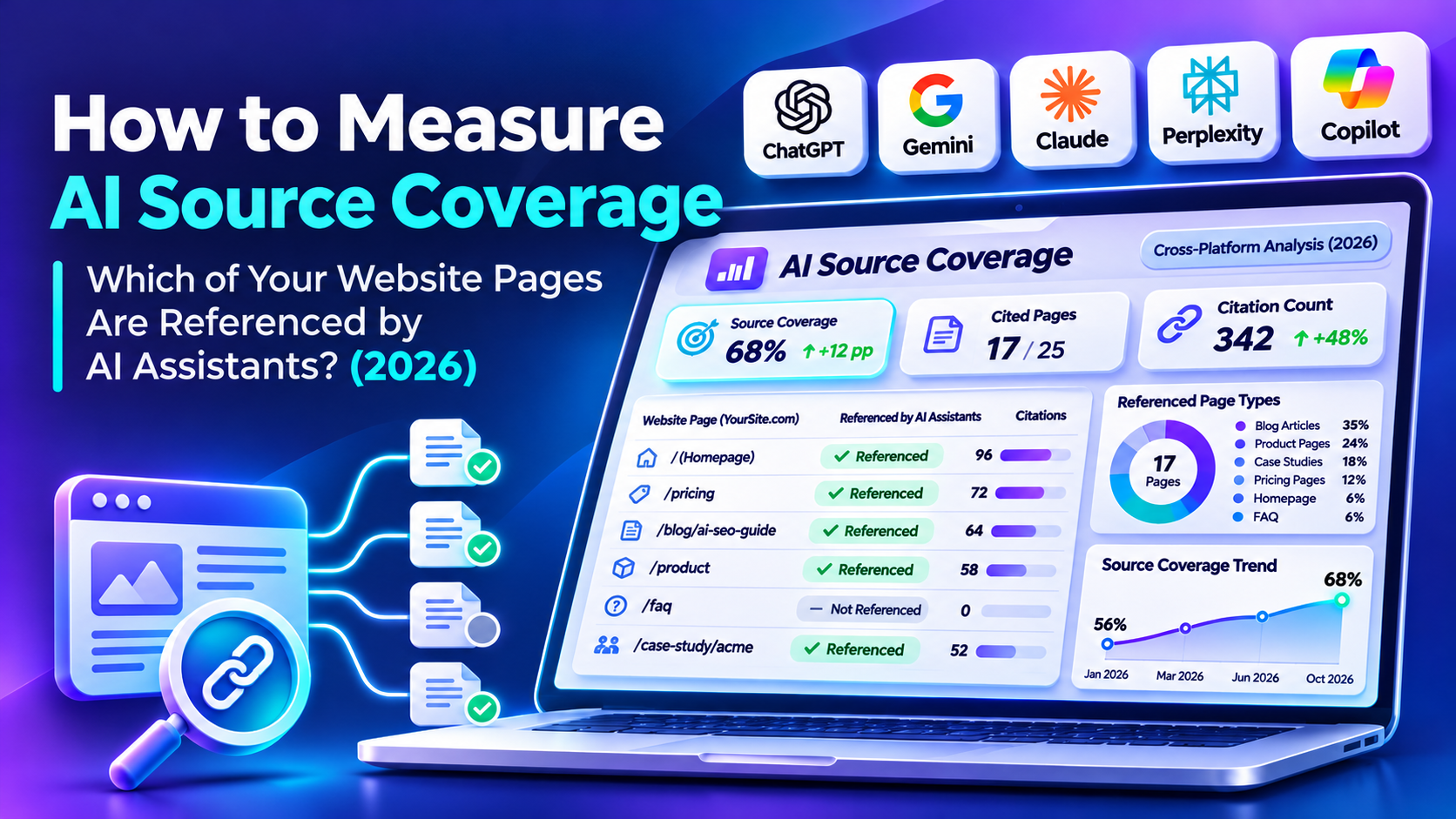
How to Measure AI Source Coverage: Which of Your Website Pages Are Referenced by AI Assistants? (2026)
An independent, practical measurement guide for US businesses. Last reviewed: November 15, 2026.
Does an AI assistant cite only your homepage, or does it also reference your product pages, technical guides, research, and customer resources? That is the question AI Source Coverage can help answer. It measures the breadth of a website's pages that are visibly referenced in a defined set of AI-generated answers. It is not the same as how often the site is cited overall.
A business might receive hundreds of citations to one popular article while its product documentation, pricing page, and comparison guides receive none. High citation volume does not necessarily indicate broad page-level coverage. This guide provides a transparent way to calculate coverage, investigate missing pages, and track changes across ChatGPT Search, Perplexity, Claude with web search, Microsoft Copilot, and Google's AI search experiences.
Important: AI Source Coverage is a proposed operational KPI, not an official standard used consistently by all AI vendors. A citation is an observed source reference; it is not proof of an endorsement, recommendation, high ranking, or conversion. Results depend on the prompts, geography, settings, model versions, and reporting source selected.
1. What is AI Source Coverage?
AI Source Coverage is the share of an explicitly defined set of eligible website URLs that receive at least one visible AI citation within a measurement window and test scope.
For example, suppose a B2B software company identifies 100 important, crawlable pages—product pages, help articles, buying guides, and research—and finds that 22 of those distinct URLs were cited at least once in 30 days of controlled testing. Its observed page coverage is 22%.
That result says nothing by itself about how many times the 22 pages were cited. One page might account for almost every citation. To interpret the result, combine coverage with citation frequency, source concentration, citation accuracy, and commercial outcomes.
Page coverage versus other AI visibility metrics
| Metric | Question answered | Typical denominator |
|---|---|---|
| AI Source Coverage | What portion of our eligible pages received a citation? | Eligible URLs in a fixed inventory |
| AI Citation Coverage | In what portion of eligible tested answers did our domain appear as a source? | Tested AI answers |
| Citation Frequency | How many source-reference occurrences did we observe? | Count of citation instances |
| Citation Share | What proportion of a defined citation pool belongs to us? | All citations in that pool |
| Unique Cited Pages | How many distinct canonical URLs were cited? | Count; no percentage required |
| AI Brand Mention Rate | How often was our company named? | Tested answers |
These metrics should not be interchanged. A brand mention without a source link is not a website citation. A cited page need not contain the brand name in the answer.
2. Define an accurate denominator before calculating a percentage
The most common source-coverage error is dividing cited pages by an arbitrary site-wide URL count. A site may include login screens, duplicate tag pages, staging URLs, expired events, search results, and other pages that should not be expected to appear as references.
Build a priority URL inventory from the pages relevant to the buyer questions being tested. Include canonical, public, substantive pages such as product descriptions, service pages, original research, comparisons, case studies, and useful guides. Mark page type, topic, target customer, canonical URL, and publication date.
Do not silently remove an important page just because it is currently blocked or unindexed; flag that technical condition separately. For analytical clarity, report both priority-inventory coverage (all priority URLs) and technically eligible coverage (priority URLs that meet the stated crawlability/indexability criteria). Publish the criteria whenever presenting either number.
Formula: priority-page source coverage
AI Source Coverage (%) =
  (Distinct priority canonical URLs cited at least once
   / Total distinct priority canonical URLs in the fixed inventory) × 100
Use one reporting period, one inventory snapshot, and one defined set of tested AI experiences. If inventory membership changes during the month, keep the original cohort for trend comparison and report newly added URLs separately.
Formula: citation intensity per cited page
Citation Intensity = Total recorded citation instances
                     / Number of distinct cited URLs
Intensity reflects repetition, not breadth. A URL cited multiple times still counts as one cited page for source coverage.
3. Worked example: 200 priority website pages
A fictional US company audits 200 priority pages during a 30-day measurement period. The test collects visible references from a standardized group of buyer questions, without claiming to represent every real AI interaction.
| Page type | Priority URLs | Distinct cited URLs | Coverage |
|---|---|---|---|
| Product and service pages | 40 | 4 | 10.0% |
| Guides and tutorials | 70 | 16 | 22.9% |
| Original research | 20 | 9 | 45.0% |
| Comparison pages | 30 | 5 | 16.7% |
| Case studies | 40 | 2 | 5.0% |
| Total | 200 | 36 | 18.0% |
The calculation is 36 ÷ 200 × 100 = 18%. This dataset is illustrative, not a real industry benchmark.
The result is more useful when segmented. Research pages have the broadest observed coverage; case studies have the narrowest. That does not establish that research is inherently favored by every AI system. It may reflect the question mix, the relevance of the documents, third-party exposure, or other factors. Before changing content, verify whether the prompt library contains questions for which each page type would be a useful source.
Suppose the same test records 180 total citation instances, with 95 instances linking to the five most frequently cited URLs. Then:
- Distinct cited URLs: 36
- Observed source coverage: 18%
- Citation intensity: 180 ÷ 36 = 5.0 per cited URL
- Top-five citation concentration: 95 ÷ 180 × 100 = 52.8%
A high concentration suggests citation activity is clustered on a few pages, even though the site has 36 cited URLs. The useful next question is whether that concentration matches the website's commercial content priorities.
4. Twelve steps to measure AI Source Coverage
Step 1 — Establish a business question and reporting scope
Decide what the audit should support: product discovery, technical expertise, local services, or purchasing comparisons. Set the US geography, measurement dates, language, AI platforms, and page types in scope. Avoid pooling unlike prompts without labels.
Step 2 — Export and clean your priority URL inventory
Export important pages from the CMS, sitemap, or content management database. Standardize redirects, resolve canonical URLs, exclude true duplicates, and distinguish live content from deleted or expired material. Save the inventory as a dated snapshot, such as priority-pages-2026-11.csv.
Step 3 — Record technical status without hiding problems
For each priority URL, record HTTP status, canonical destination, indexability, robots directives, and whether the main text is accessible without login. A page that fails a technical check remains visible in a separate remediation list. A noindex page should not be quietly treated as a missing citation mystery.
Step 4 — Build a balanced prompt library
Create prompts for informational questions, vendor comparisons, service selection, product features, pricing-related research, and problem solving. For a US software provider, a prompt might be: Which tools help a small US sales team monitor customer conversations? Include non-branded prompts so the test does not simply ask an assistant to find your website.
Step 5 — Test across platforms using consistent procedures
Capture which product or interface is used: ChatGPT Search versus a non-search chat, Gemini Apps versus Google AI Mode, Claude with web search, Perplexity, or consumer Copilot. Record test date, approximate locale, browser or account state, and any available model or search settings. Test each platform only in modes where visible web citations can be assessed.
Step 6 — Collect the actual citation URLs
For each response, record the displayed source URL, source label, cited claim, and screenshot or saved response where usage terms permit. Do not assume a page was cited because it appeared in a separate traditional search result. Some answers have no visible citations; record that explicitly instead of assigning invented sources.
Step 7 — Resolve redirects and normalize canonical pages
Normalize http versus https, tracking parameters, trailing-slash variants, and redirects according to a documented policy. Keep raw URLs for auditing and a separate canonical field for counting. Be careful with localized variants: en-us and en-gb pages may be distinct if they carry materially different content.
Step 8 — Join cited URLs to the inventory
Use exact normalized canonical URL matches. Count a priority page only when its URL was visibly cited in the defined sample or is included in a supported vendor export under the same measurement scope. Keep references to URLs outside the priority inventory in a separate row; they are interesting, but must not alter the denominator without a declared inventory change.
Step 9 — Calculate overall and segmented coverage
Compute the percentage of priority URLs cited at least once, then break it down by product area, content type, market, business priority, and AI platform. A page may appear in several platforms; deduplicate it once for overall coverage while preserving platform-specific counts.
Step 10 — Examine citation concentration and quality
Identify the top-cited URLs, the share of all citation instances they receive, and whether cited pages actually support the related claims. A technically working source link can still be irrelevant or outdated. Read our related guides on AI Citation Accuracy and AI Citation Diversity.
Step 11 — Look for meaningful coverage gaps
Classify missing priority pages into useful groups: technically inaccessible, missing topical relevance in the prompt set, outdated content, insufficient original evidence, weak internal discoverability, or unknown cause. Do not infer a causal explanation from absence alone. Prioritize fixes according to buyer relevance and the ability to validate a change.
Step 12 — Repeat with a stable cohort
Retest the same prompt library and priority URL set on a consistent cadence, for example monthly. Record added pages and changed prompts as separate cohorts. Look for persistent patterns over multiple cycles instead of treating a one-week spike as proof of success.
5. Platform-by-platform reporting: what can you actually observe?
| AI experience | Useful evidence | Important limitation |
|---|---|---|
| Microsoft Copilot / Bing AI | Bing Webmaster Tools AI Performance, cited pages and grounding-query associations | Aggregated data for supported Microsoft and partner surfaces; not a complete prompt log |
| ChatGPT Search | Visible source links and structured manual or vendor sampling | Not a universal first-party domain citation dashboard |
| Perplexity | Visible cited sources captured from reproducible searches | Results vary by question and session |
| Claude with web search | Visible citation links in web-grounded answers | Citation availability depends on the interaction and features used |
| Google AI Overviews / AI Mode | Observed links in supported AI search answers plus Search Console context | Standard Search Console metrics should not be assumed to equal URL-level AI citation counts |
Microsoft's official Bing Webmaster Tools AI Performance documentation describes page-level citation activity and exports for supported experiences. It explicitly warns that the data is aggregated, incomplete, and not a ranking or traffic measure. Google's AI features and your website guidance emphasizes established Search fundamentals and does not promise a special placement mechanism for AI Overviews or AI Mode.
If you combine vendor exports, manual tests, and first-party dashboards, mark the data source for each observation. Do not simply add counts across systems; their collection populations and citation definitions may differ.
6. Reusable AI Source Coverage worksheet
Use two worksheets or CSV tables: a page inventory and a citation events log.
Inventory sheet: one row per priority canonical URL
| Column | Example value | Purpose |
|---|---|---|
| Page ID | P-001 | Stable identifier |
| Canonical URL | https://example.com/services/analytics/ |
Matching key |
| Page type | Service page | Segment reporting |
| Priority | High | Business relevance |
| Target topic | AI analytics | Expected question cluster |
| Status | 200 / indexable | Technical review |
| In cohort? | Yes | Denominator control |
| Cited? | Yes / No | Derived from citation log |
| Platforms cited | Copilot, Perplexity | Breadth across experiences |
| Citation instances | 4 | Frequency |
Citation events: one row per observed source occurrence
| Column | Example value |
|---|---|
| Audit date | 2026-11-15 |
| Platform | Perplexity |
| Prompt ID | Q-014 |
| Response ID | R-014-02 |
| Raw source URL | https://example.com/services/analytics/?ref=search |
| Canonical URL | https://example.com/services/analytics/ |
| Linked page ID | P-001 |
| Claim supported? | Yes / No / Unclear |
| Collection method | Manual / Vendor report |
| Notes | Page supports a product feature claim |
Use the response ID to avoid accidental double-counting when multiple collectors capture the same answer. Keep source occurrences for citation intensity, but deduplicate canonical URLs when calculating page coverage.
7. A simple source-coverage dashboard
At minimum, publish the following metrics side by side:
| KPI | Illustrative value | Interpretation |
|---|---|---|
| Priority pages | 200 | Fixed denominator |
| Unique priority pages cited | 36 | Observed reach |
| AI Source Coverage | 18.0% | 36 of 200 pages cited |
| Total citation instances | 180 | Citation volume within the sample |
| Citation intensity per cited page | 5.0 | Average observed citations among cited pages |
| Top-five URL concentration | 52.8% | Citations clustered in five pages |
| Product-page coverage | 10.0% | Potential commercial content gap |
| Research-page coverage | 45.0% | Stronger observed research coverage |
Report these with the sample size, platforms, response collection method, period, denominator rules, and any changes to the inventory. Otherwise, a trend line can be more misleading than helpful.
8. How to improve coverage without chasing citation tricks
The goal is not to force every page into an AI answer. A shipping policy, careers page, or internal support form may rarely be a suitable source for commercial buyer questions. Focus on pages that deserve to be referenced because they directly answer relevant, verifiable questions.
For high-priority pages with low coverage, check whether the page provides clear information about products or services, useful examples, documented evidence, and current details. Strengthen navigation and internal links. Resolve rendering and crawler-access problems. Review whether authoritative third-party sources accurately describe the business. Then retest against the same prompts.
Do not assume adding special files, repeated keywords, synthetic citations, or large volumes of near-duplicate pages will reliably cause AI systems to cite your URLs. Google's published guidance for AI search features does not require special optimization files. Treat new tactics as experiments and document their outcomes.
9. A 30-day implementation plan
Days 1–7: inventory and scope
Identify 50–200 priority URLs, depending on business size. Record canonical URLs and page types. Select the five to ten topics most connected to purchasing intent. Create a balanced prompt set and decide which AI platforms to sample.
Days 8–14: evidence collection
Run prompt tests, collect visible source links, normalize URLs, and export any first-party page-level citation reporting available to you. Label platform, date, and collection method. Calculate a preliminary source-coverage baseline.
Days 15–21: prioritize fixes
Review missing high-priority pages, technical barriers, confusing page descriptions, outdated facts, and unsupported claims. Choose three to five changes that have a defensible business rationale. Preserve the baseline and document each change.
Days 22–30: repeat and report
Retest the stable prompt set. Report page coverage alongside citation frequency, accuracy, and commercial outcomes. Explain any uncertainty from small samples and platform variability. Plan the next review rather than claiming that one edit caused a change in AI visibility.
10. When should a US business use specialist software or an agency?
A spreadsheet may be sufficient for an early-stage business with a handful of priority pages and a modest prompt library. Larger websites, multiple locations, and recurring reporting can benefit from specialized tooling. The key buying questions are whether a product offers exportable URL-level data, reproducible prompt tracking, canonical URL handling, platform distinctions, and auditable sampling methods.
The following US-based providers are listed in our directory as possible starting points for further evaluation. The descriptions reflect broad product and service positioning; verify URL-level coverage features in a live demo rather than assuming every product calculates the exact metric defined in this article.
Monitoring and software:
- Profound — AI search intelligence and citation analysis.
- Evertune — AI brand visibility and GEO analytics.
- Scrunch AI — AI visibility monitoring and agent experience tools.
- Brandlight — enterprise brand and reputation intelligence.
- Conductor — enterprise SEO and AI search analytics.
- seoClarity — enterprise SEO and AI search intelligence.
Agencies and consulting:
- WebFX — managed GEO and AI search optimization.
- Omniscient Digital — B2B AEO, GEO, content and organic growth.
- iPullRank — technical SEO and Relevance Engineering.
- First Page Sage — GEO, thought leadership and lead generation.
Browse the AI Visibility Platforms directory or the GEO & AEO Agencies directory to investigate providers by service type.
11. Common source-coverage mistakes
- Counting citation instances as unique pages. Ten citations to one URL are still one cited URL.
- Using every sitemap URL as the denominator. Some URLs are not relevant or technically accessible; state your eligibility definition.
- Changing the inventory between reports without disclosure. A growing denominator can lower coverage even when additional pages are cited.
- Ignoring canonical and redirect variants. The same page may appear to be several different URLs.
- Combining incompatible platform exports. Different services collect different populations of answers.
- Treating absence as a technical penalty. The prompt mix or content relevance may explain missing citations.
- Equating cited URLs with business performance. Track referral visits, enquiries, and conversions separately.
- Assuming citations are accurate. Read the linked source and verify what it supports.
Frequently asked questions
Is AI Source Coverage an official Google or OpenAI metric?
No. This guide defines a transparent page-level KPI for operational analysis. Some commercial tools may use similar labels with different denominators; compare methods before comparing scores.
Is AI Source Coverage the same as AI Citation Coverage?
No. Source coverage asks what proportion of eligible website pages were cited. Citation coverage asks what proportion of tested answers cited your site. Both are useful, but they measure different dimensions.
Should every page on my website receive citations?
No. Many pages are not appropriate references for the buyer questions being measured. Prioritize pages that provide substantive, relevant, public information.
Can a cited page be counted more than once?
For unique-page coverage, count each canonical URL once during the period. For citation-frequency reporting, retain every distinct observed citation occurrence with a traceable response ID.
Why is my homepage cited while product pages are ignored?
Possible explanations include the question mix, broader homepage relevance, unclear product-page content, technical issues, or the sources available to the AI system. Investigate before deciding on a fix.
Does Bing Webmaster Tools provide a cited-pages report?
Yes. Its AI Performance section provides URL-level citation activity and related grounding-query associations for supported Microsoft AI experiences. It is an aggregated sample, not a complete log covering all AI platforms.
Can Google Search Console tell me exactly which pages Gemini cited?
Do not assume so. Google Search Console is useful for Search performance and technical diagnosis, but its standard reporting should not be treated as a universal page-level citation log for every Gemini interface.
How often should I update this KPI?
Monthly tracking is a reasonable starting point if the sample size is sufficient. Keep a stable URL cohort and prompt library so apparent gains or losses are interpretable.
Should I measure citations from third-party sites mentioning my brand?
Yes, but track those as a separate third-party source exposure metric. Do not include another company's URL in your owned-site page-coverage numerator.
Does better source coverage guarantee higher sales?
No. Citation exposure does not automatically translate into clicks, qualified visitors, leads, or revenue. Use web analytics and CRM data to evaluate business impact.
Conclusion
AI Source Coverage answers a practical question that domain-wide citation counts cannot: how broadly are your important pages being used as visible references in sampled AI-generated answers? Define a stable page inventory, count distinct cited canonical URLs, compare coverage across content types and platforms, and interpret the result alongside citation frequency, accuracy, and conversions.
An 18% source-coverage score can be informative—but only if the eligible page set, test questions, collection method, and timeframe are clearly described. Treat the metric as one diagnostic tool in a wider AI Visibility program rather than a shortcut to guaranteed citations.
Related reading
- How to Measure AI Citation Coverage
- How to Measure AI Citation Accuracy
- How to Measure AI Citation Diversity
- How to Measure AI Share of Voice
Official references
- Bing Webmaster Tools — AI Performance
- Microsoft Bing Webmaster Blog — AI Performance launch (February 2026)
- Google Search Central — AI Features and Your Website
Independent editorial disclosure: This article is educational and does not represent a ranking, endorsement, or guarantee of AI citations. Software features and platform reporting may change.