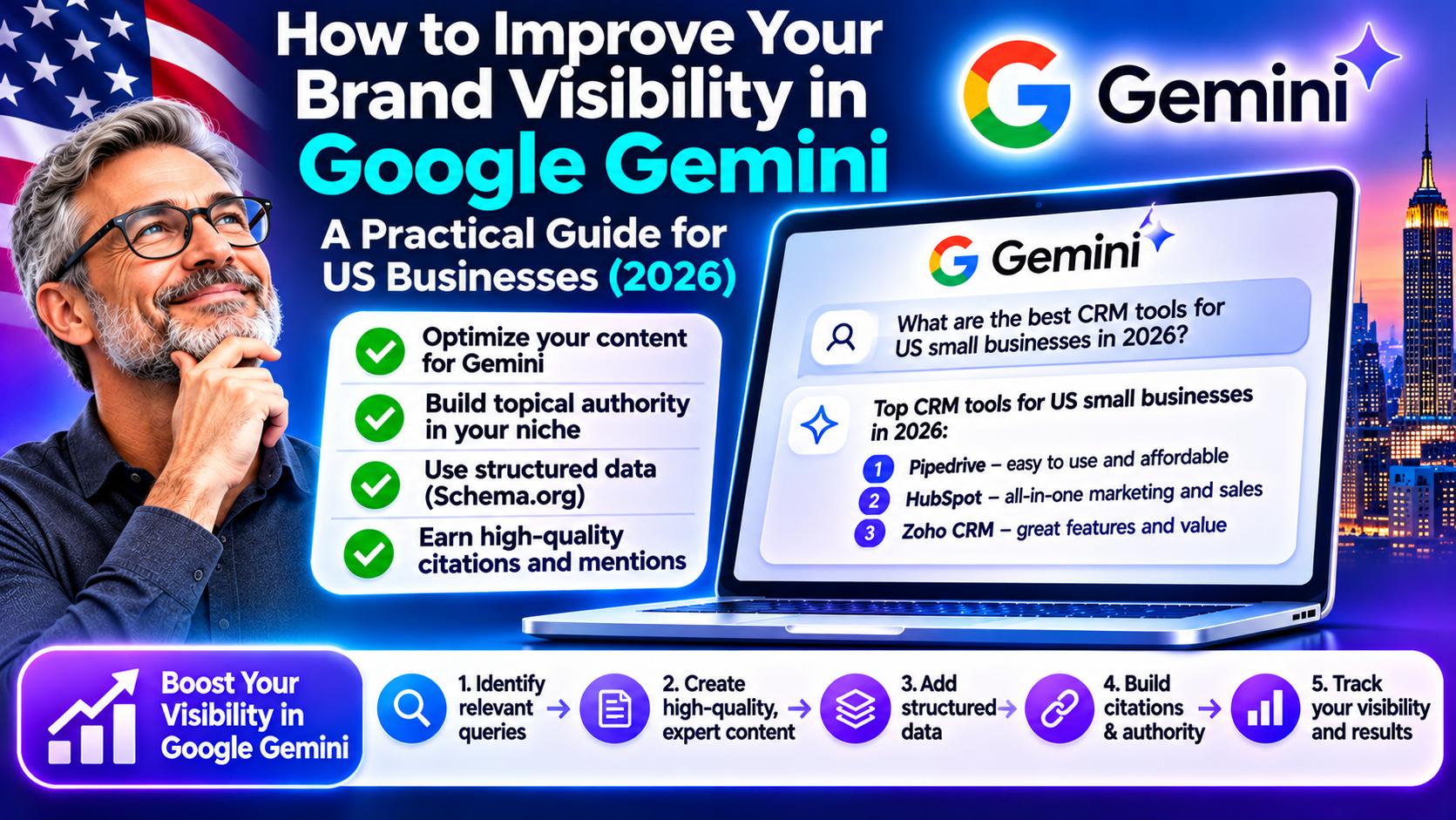
How to Improve Your Brand Visibility in Google Gemini: A Practical Guide for US Businesses (2026)
Can customers find your company when they ask Google Gemini about products, service providers or industry solutions? For US businesses, the practical goal is to make accurate, useful information about the company easy to discover, assess and reference—not to manipulate a model into recommending a brand.
This guide covers a 12-step action plan, the differences between Gemini Apps and Google's AI-powered Search, a repeatable prompt-testing process, measurement formulas, and a 30-day rollout. It also explains what companies cannot control. No optimization technique guarantees that Gemini will mention, cite or recommend a specific business.
Scope: This article primarily discusses brand visibility in the consumer-facing Gemini app. Google AI Overviews and AI Mode are related Google experiences, but they are not identical to Gemini Apps. Their outputs, source links, controls and reporting should not be treated as interchangeable.
What does brand visibility in Google Gemini mean?
Brand visibility describes how often—and how accurately—a business appears in Gemini responses to relevant questions. Examples include “Which US vendors offer AI visibility monitoring?”, “Compare software for tracking AI citations,” or “What should I look for in a GEO agency?” A brand can appear by name without being endorsed, be discussed as one option among many, or appear as a linked source.
For measurement, separate these events:
| Event | What it tells you | What it does not prove |
|---|---|---|
| Brand mention | Gemini names your organization | That Gemini recommends it |
| Recommendation | Brand is presented as a relevant option for a buying question | That the recommendation is stable across users |
| Source link | Gemini supplies a link to your site or another page discussing you | That all claims come from that link |
| Brand accuracy | Statements agree with verified company facts | That every response will be accurate |
| Referral visit | A visitor reaches your site from a measurable AI-related link | That every Gemini mention results in a click |
Gemini answers can vary by prompt phrasing, model, location, conversation context and the availability of sources. A single response is an anecdote, not a statistically reliable visibility score.
Gemini Apps vs Google AI Overviews and AI Mode
Gemini Apps is Google's conversational AI experience. Depending on context, Gemini may show related sources or links, but some responses have no visible source panel. Google's help documentation explicitly says links are not shown for every response.
Google AI Overviews summarizes some queries in Google Search, while AI Mode offers an AI-powered search experience with supporting links. Google Search Central says that a page generally must be indexed and eligible to show a snippet to appear as a supporting link in these Search features. This is not a published universal inclusion rule for all Gemini Apps answers.
Google Search Console can be used to evaluate Google Search performance, including reporting for generative search features where available. It should not be presented as a complete dashboard of mentions inside the standalone Gemini app. Keep app-based testing and Search reporting as separate evidence streams.
12 practical strategies to improve Google Gemini brand visibility
1. Make your most important pages accessible
Start with the fundamentals. Visit the company's homepage, product or service pages, pricing information, contact page, About page and support documentation without being logged in. Check that the content is actually visible as text, not only embedded in inaccessible widgets or gated documents.
Review whether your website unintentionally blocks Googlebot through robots.txt, access restrictions, security challenges or hosting rules. Use Google Search Console to investigate indexing and technical errors for Google Search. This step improves general discoverability; it does not guarantee inclusion in Gemini Apps.
Action: Choose the five pages most important to a buyer and confirm they are publicly accessible, mobile-friendly, and understandable without executing complex interactions.
2. Understand the difference between Googlebot and Google-Extended
Google's official crawler documentation explains that Google-Extended is a robots.txt control token, not a separate crawler that you should expect to see in server logs. Google says it can influence the use of crawled content for training future Gemini models and for grounding in certain Gemini experiences. Google-Extended does not affect Google Search inclusion or act as a Google Search ranking signal.
Avoid the common claim that adding a special Allow: / directive for Google-Extended guarantees more Gemini recommendations. Review crawler permissions with your technical team and make an informed policy choice about data use. Consider Google Search crawling separately from Gemini-related usage controls.
Action: Document the site's robots.txt choices and verify that they reflect your organization's intended policies.
3. State clearly what your business does
A vague homepage such as “We transform tomorrow with innovative solutions” gives buyers little information. Write a precise introduction explaining who you serve, what you sell, where you operate, and what differentiates your offer.
For example: “We are a US-based B2B consulting agency providing technical SEO, AI search visibility audits, and GEO implementation for SaaS companies.” Support that statement with service descriptions, geographic coverage, evidence, and contact information.
Action: Place a plain-language description on the homepage and About page, and make sure primary product and service pages are linked prominently.
4. Publish pages that answer real purchase questions
Research how prospective buyers describe their problems. A logistics company may ask about route optimization providers; a SaaS founder may ask for customer-support software alternatives; a marketing director may ask how to measure brand citations in Gemini.
Write useful articles that answer these questions with definitions, evaluation criteria, practical examples, limitations and next steps. Do not create dozens of near-identical pages only to cover every variation of a prompt.
Action: Interview customers or review genuine sales questions. Select 10 high-value questions and map each to an existing or new page.
5. Keep factual company information consistent
Check the company name, business category, website, headquarters, operating locations, leadership, products and contact information across your site and legitimate third-party profiles. Inconsistency can undermine trust for readers and complicate automated research.
For US local businesses, maintain an accurate Google Business Profile where eligible. For software vendors, ensure product and company details agree across legitimate software listings, product documentation and official announcements. Do not fabricate reviews or profiles.
Action: Create one internal master record of company facts, assign an owner, and review it each quarter.
6. Publish original experience and verifiable evidence
Credible differentiators include first-party research, transparent methodologies, documented case studies, original data, product demonstrations, customer examples shared with permission, and clear explanations of limitations.
A generic article saying “AI search is important” adds less value than a transparent analysis showing the prompts tested, sample size, platform, dates, outcomes and limitations. Originality improves usefulness for people; it is not a guaranteed Gemini citation mechanism.
Action: Publish one substantive evidence-based resource each month, using honest data and citations.
7. Strengthen third-party credibility
AI-powered experiences can reflect information found across many sources. Seek authentic editorial coverage, industry association profiles, customer case studies, high-quality software listings and relevant expert contributions. Focus on reputation-building activities that would make sense even if AI search did not exist.
Avoid paid link schemes, mass-produced fake mentions, undisclosed sponsored reviews and fabricated awards. Google cautions against trying to manufacture inauthentic mentions to influence AI-powered Search.
Action: Identify five trustworthy industry publications or communities where your company can contribute useful expertise.
8. Improve product, service and pricing clarity
If buyers ask Gemini to compare vendors, transparent pages help people evaluate the options. Describe product features, intended customers, supported integrations, service deliverables, onboarding steps, geographic limitations, and commercial terms.
If pricing is customized, say “Contact us for a quotation” and explain what affects the price. Do not invent a public price or bury important limitations. For local service companies, be specific about service areas and the work actually offered.
Action: Audit two important service or product pages against the questions your sales team receives most often.
9. Maintain a sensible website information architecture
Link relevant pages together so visitors can move from a broad explanation to supporting evidence, a product page, and a contact option. Use descriptive headings and readable HTML. Apply relevant structured data such as Organization, LocalBusiness, Product, or SoftwareApplication only when appropriate and consistent with visible content.
Google says that no special AI schema or llms.txt file is required to appear in AI Overviews or AI Mode. There is also no verified guarantee that such a file will result in Gemini Apps mentions.
Action: Add a clear path from your top informational pages to the matching commercial pages, and validate structured data against the visible content.
10. Test buyer prompts using a repeatable method
Create a prompt library covering the awareness, comparison and purchase stages. A US cybersecurity vendor might test:
- “What should a small manufacturer consider when choosing cybersecurity support?”
- “Which US cybersecurity providers specialize in manufacturing?”
- “Compare managed cybersecurity providers for a company with 100 employees.”
- “What evidence should I request before hiring a cybersecurity service provider?”
For each test, record the exact prompt, date, model or product surface, settings, geographic context, response, brand mentions, recommendations, supporting links and factual errors. Repeat a consistent sample over time. Avoid changing your test conditions and then attributing every difference to the website updates.
Action: Start with 20–30 relevant prompts rather than hundreds of poorly chosen questions.
11. Measure mentions, sources, accuracy and conversions separately
A practical monitoring program tracks what the model says and what visitors do afterward. Gemini's source links may be absent or inconsistent across individual replies, so do not count an unavailable citation panel as proof your website has been excluded everywhere.
Use website analytics to identify measurable traffic from AI referrals when referrer information is available. A missing referrer does not mean no visitor came from an AI conversation. Use CRM records and customer surveys for additional attribution clues.
Action: Report at least four separate metrics monthly: mentions, recommendation rate, accuracy and identifiable referral conversions.
12. Iterate using business outcomes, not just brand mentions
A business can appear in many informational answers and still receive no qualified opportunities. Prioritize buyer-stage questions, accurate brand representation, conversion pathways and commercial relevance.
When monitoring reveals a factual error, first correct public source information you control and identify influential sources that may need an update. When competitors appear more often, compare their documented product fit and evidence rather than blindly adding keywords.
Action: Run a monthly review of the prompt set, top errors, content improvements, referral traffic and qualified enquiries.
A practical Gemini visibility measurement framework
Use a fixed set of test prompts and define each metric before collecting results.
| KPI | Calculation | Interpretation |
|---|---|---|
| Brand mention rate | Responses naming the brand / all relevant tested responses × 100 | Overall observed presence in the test set |
| Recommendation rate | Responses explicitly recommending the brand / purchase-intent responses × 100 | Observed buyer-stage inclusion |
| Source-link coverage | Tested responses linking to the company's site / responses with links recorded × 100 | How often the company URL appears as a visible source in the tested sample |
| Brand accuracy | Correct verifiable brand claims / verifiable brand claims evaluated × 100 | Factual reliability in sampled outputs |
| Competitive presence | Responses mentioning brand / responses mentioning any tracked competitor or brand × 100 | Directional comparison within the chosen test set |
| AI referral conversions | Measurable conversions attributed to identified AI referrals | Business impact, subject to attribution limitations |
Example (illustrative only): A business tests 40 relevant prompts. Its name appears in 12 responses and is explicitly recommended in 6 of the 20 purchase-intent responses. Its observed mention rate is 30%, and its observed recommendation rate for the purchase-intent set is 30%. These are sample statistics, not platform-wide probabilities or official Gemini metrics.
Keep a record of prompts with zero visibility too. Reporting only successful mentions can make results look better than they are.
A reusable prompt-test worksheet
| Field | Example entry |
|---|---|
| Date | 2026-11-15 |
| Platform/surface | Gemini Apps — web |
| Prompt | “Which providers help US SaaS companies improve AI visibility?” |
| Prompt type | Vendor comparison |
| Brand mentioned? | Yes / No |
| Explicit recommendation? | Yes / No |
| Company website linked? | Yes / No / No sources shown |
| Factual errors? | Describe verified errors |
| Competitors mentioned | Names observed |
| Follow-up action | Improve relevant service-page clarity |
For rigorous research, capture the original response or an appropriately documented extract, with privacy-sensitive information excluded. Do not treat manually repeated prompts as representative of all Gemini users.
30-day implementation plan for US businesses
Week 1 — Establish the baseline
Audit the homepage, key product or service pages, robots.txt and indexing status. Check official Google documentation. Build a 20–30 prompt library reflecting actual US customer needs. Record initial Gemini responses and separate brand mentions from recommendations and source links.
Week 2 — Fix clarity and technical weaknesses
Clarify your business description, improve important service pages, make factual details consistent, repair obvious crawlability problems and add relevant internal links. Check that structured data reflects visible content. Document every change so later measurements have context.
Week 3 — Strengthen evidence and useful content
Publish or improve one substantial comparison, how-to article, original research resource or customer case study. Update verified external profiles and pursue genuine industry contributions. Do not buy fabricated reviews or seek artificial brand mentions.
Week 4 — Retest and decide the next changes
Repeat the baseline prompts with similar settings and record any movement in mentions, recommendations, accuracy and sources. Review traffic and enquiry outcomes. Set one or two evidence-driven priorities for the next month rather than expecting a definitive return on investment in 30 days.
Example: A US software company
Imagine a hypothetical Chicago-based SaaS company selling compliance management software to manufacturers. Its website previously described itself as an “intelligent transformation ecosystem,” without saying what its software did.
The team updates its core service pages to describe its features, target industries, integrations, security documentation and implementation requirements. It publishes a comparison guide explaining how to evaluate compliance software, provides an original case study with customer permission, and corrects inconsistent information on legitimate partner profiles.
It then tests 25 relevant Gemini prompts every month. If more responses accurately discuss the company over time, that is useful directional evidence—but the company must also examine paid conversions, demos, referral visits, and any changes to its test conditions. The outcome should not be presented as a proven causal effect without a controlled study.
What should you avoid?
- Promises of guaranteed recommendations. No legitimate agency can guarantee placement in every Gemini response.
- Confusing the Gemini app with AI Overviews. They have different interfaces and reporting limitations.
- Treating Google-Extended as a separate crawler or ranking boost. It is a usage-control token with specific effects described by Google.
- Buying fake reviews or manufacturing mentions. These undermine trust and may violate platform policies.
- Publishing thin near-duplicate pages. Focus on usefulness and distinct information, not prompt stuffing.
- Using citation count as the sole business KPI. Check accuracy, conversion outcomes and lead quality.
- Claiming every Gemini response has source citations. Google says related links are not available for all replies.
When to use software versus a US-based AI Visibility agency
An internal team can begin with a spreadsheet and regular prompt testing. For businesses tracking numerous products, regions and competitors, specialist platforms may help organize and scale monitoring. Agencies can help execute technical SEO, content strategy, digital PR and measurement programs.
US-based AI Visibility software companies in our directory include Profound, Evertune, Scrunch AI, Brandlight, Conductor and seoClarity.
US-based agencies in our directory include WebFX, Omniscient Digital, iPullRank and First Page Sage.
Explore the AI Visibility Platforms directory or GEO & AEO Agencies to compare potential providers. Directory inclusion is informational, not an endorsement or performance guarantee.
Frequently asked questions
Can I pay Google to make Gemini recommend my business?
There is no established process to purchase guaranteed organic brand recommendations in Gemini Apps. Any paid advertising opportunity should be evaluated separately from editorial and AI-generated answers. Be cautious of vendors claiming access to a secret recommendation system.
Does ranking first in Google mean Gemini will mention my brand?
No. Search rankings and Gemini responses are related areas of discovery but are not a single deterministic ranking system. Responses can vary by context and the availability of sources.
Does Gemini always show sources?
No. Google's Gemini Apps help explains that some responses have sources and related links, while others do not. Monitor source links as a separate observation rather than assuming every response must include one.
Should I allow Google-Extended to improve Gemini visibility?
First understand what the control does. Google says Google-Extended affects certain Gemini training and grounding uses, not Google Search indexing or Search rankings. It is a data-use policy decision, not a guaranteed visibility technique.
Is structured data required to appear in Gemini?
There is no verified universal special Gemini markup requirement. Use appropriate structured data because it helps describe content and can support Google Search features, not as a promise of inclusion in Gemini responses.
Can Google Search Console measure all Gemini app mentions?
No. Search Console reports Search performance and supported generative Search features; it is not a complete standalone Gemini Apps recommendation monitor. Use documented prompt tests or suitable third-party software for directional app-level analysis.
How long does it take to improve Gemini visibility?
There is no guaranteed timetable. Technical corrections may become effective as websites are recrawled, while changes in broader brand information and model behavior can take longer or may not appear at all. Evaluate a documented baseline over several months.
What is the most important first step for a small business?
Make sure the business is clearly described on an accessible website, that official facts are accurate and consistent, and that the site offers genuinely useful answers to customer questions. Then establish repeatable monitoring before investing in advanced tools.
Related guides
- What Is AI Visibility? A Complete Guide for Businesses
- How to Monitor Your Brand in ChatGPT and Other AI Platforms
- How to Increase AI Citations to Your Website
- How to Improve Your Company's Visibility in Google AI Overviews
- AI Visibility Software: How to Choose the Right Platform
Official sources and further reading
- Google Search Central — AI features and your website
- Google Search Central — Optimizing for generative AI features
- Google Crawling Infrastructure — Google's common crawlers and Google-Extended
- Google Gemini Apps Help — View related sources
- Google Search Console
Editorial note: This independent educational article describes practical methods, not guaranteed rankings or endorsements. Gemini product behavior, reporting and crawler policies can change. Last reviewed: November 15, 2026.