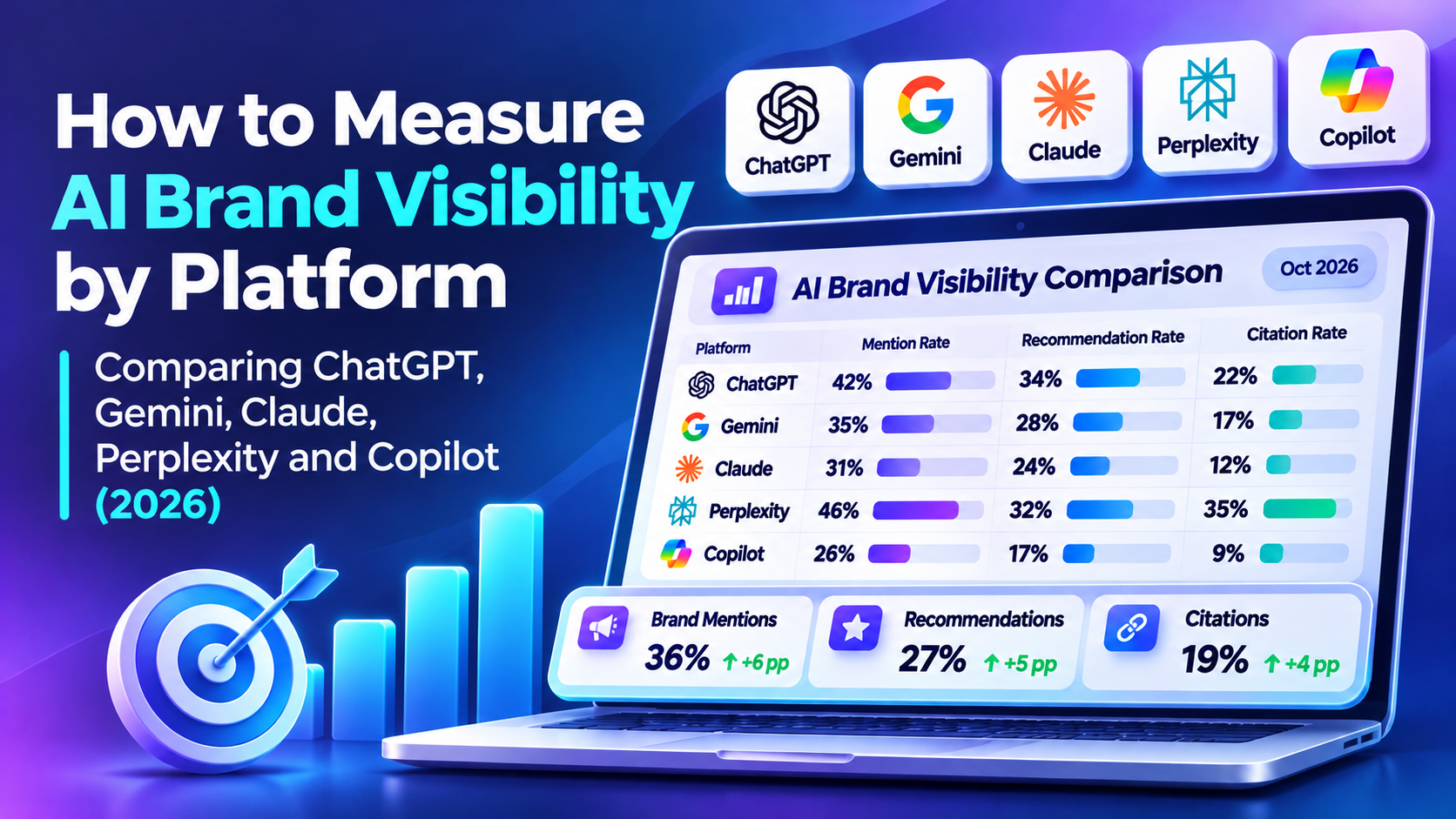
How to Measure AI Brand Visibility by Platform: Comparing ChatGPT, Gemini, Claude, Perplexity and Copilot (2026)
An independent measurement guide for US businesses. Last reviewed: November 15, 2026.
Your brand appears frequently when a prospect asks ChatGPT for vendors but rarely appears in Claude. Does that mean your overall AI Visibility is strong or weak? Neither conclusion follows without examining which platforms you tested, which questions you asked, and what you counted as a result. A single blended score can conceal major differences between AI assistants and between customer journeys.
This guide shows how to measure brand visibility independently in ChatGPT, Google Gemini, Claude, Perplexity, and Microsoft Copilot, then produce a transparent cross-platform comparison. It includes definitions, formulas, an illustrative dataset, a reproducible collection procedure, practical worksheets, a 30-day plan, and links to US-based AI Visibility companies.
Important: The metrics below are practical research definitions, not official rankings or comparable native platform statistics. Results from a controlled prompt sample describe that sample; they do not represent all user interactions with an AI platform or guarantee future recommendations.
1. What does AI brand visibility by platform mean?
Platform-level AI brand visibility measures how often and in what ways a named company appears within a defined set of answers generated by one AI assistant, under documented conditions. A good measurement program records at least four distinct outcomes:
- Mention: The response explicitly names the target brand or an approved alias.
- Recommendation: The response affirmatively presents the brand as a reasonable option for the user's need under a predefined coding rule.
- Citation: The response visibly links to the brand's website or a tracked third-party source, which is a separate observation from mentioning the brand.
- Accuracy: Verifiable statements about the company agree with trusted, current evidence.
A brand can be mentioned critically, recommended without a website citation, or cited without receiving an explicit recommendation. Counting all of these as a single "AI visibility" event produces misleading comparisons. For related concepts, see Mention Rate vs Recommendation Rate and AI Brand Accuracy.
2. Why measure each assistant separately?
The five assistants are different products with different interfaces, available tools, search/retrieval behavior, personalization, citation presentation, and release cycles. Some answers may use live web information; others may not. The same question may produce different brands or sources from one run to the next.
A "ChatGPT visibility rate" measured using ChatGPT Search is not necessarily comparable to one measured without web search. Likewise, Google Gemini Apps should not be silently merged with Google AI Overviews or AI Mode. Copilot's consumer search experience should not be conflated with an enterprise Microsoft 365 Copilot response using private organizational documents. Decide exactly what experience you are studying, and document it.
| Platform | Experience to document | What to inspect manually | Important reporting caveat |
|---|---|---|---|
| ChatGPT | Product surface, selected model/mode, web-search use | Mentions, recommendations, answer citations and cited URLs | Your controlled answers are not a complete census of ChatGPT users |
| Google Gemini | Gemini Apps, specific model/mode and web grounding if applicable | Mentions, recommendations, displayed sources and accuracy | Gemini Apps are distinct from Google Search AI Overviews and AI Mode |
| Claude | Claude product/model, web search enabled or disabled | Brand mentions, contextual endorsements and web citations | Citations depend on web-search/retrieval behavior |
| Perplexity | Search mode/model and location settings where available | Brand mentions, linked sources and cited domains | Source links are not proof of a positive recommendation |
| Microsoft Copilot | Consumer/web Copilot or another precisely named Copilot surface | Brand mentions, recommendations and visible citations | Bing Webmaster Tools covers supported Microsoft/partner AI citation surfaces, not every Copilot interaction |
The aim is like-for-like sampling where possible, transparent differences where not. Do not claim to measure all five platforms identically merely because the spreadsheet contains five columns.
3. Decide which business questions matter
Start with buyer questions rather than searching only for the brand name. Branded prompts such as "Tell me about Acme" often produce mentions by design and inflate visibility results.
Build a fixed library of 20–40 prompts representing your sales journey. Useful categories include:
- Discovery: "Which payroll software companies serve small US manufacturers?"
- Comparison: "What alternatives to [competitor] suit a 50-person accounting firm?"
- Problem/solution: "Which vendors help restaurants manage employee scheduling?"
- Budget-sensitive: "What are affordable inventory tools for a growing US retailer?"
- Regional: "Which commercial HVAC firms serve businesses in Austin, Texas?"
- Trust-focused: "What should I check before hiring a GEO agency?"
Use the same core questions on each platform. Note geographic qualifiers such as "in the United States" because location changes the candidate set. Keep branded, unbranded, and competitor-led prompts in separate panels instead of mixing them into one visibility score.
4. Define the observations before collecting responses
For each response, use explicit coding rules:
| Field | Rule |
|---|---|
| Eligible response | An answer generated successfully under the agreed test conditions; errors and refusals are logged separately |
| Brand mentioned | Exact brand name or unambiguous approved alias appears; ambiguous words require manual review |
| Brand recommended | The answer expressly presents the brand as a suitable choice, shortlist item, or endorsed option for the stated need |
| Brand cited | At least one visible linked source resolves to the company's owned domain; third-party citations are recorded separately |
| Mention position | Record whether it appears first, second, third, or later where an ordered list actually exists; do not infer rankings from unordered prose |
| Factual accuracy | Code each verifiable claim against a dated reference register; exclude unverifiable claims from the accuracy denominator |
| Competitor mentioned | Code each named competitor under the same alias rules |
If a response says "Acme is widely used, but this product does not serve small firms," it is a mention but not an affirmative recommendation for the small-firm prompt. If it says "consider Acme or Beta," both can be recommendations under the predefined rule. A response can recommend multiple brands.
For reliability, have a second reviewer independently classify a sample, resolve disagreements, and document changes to coding rules before comparing periods.
5. Record a sampling protocol
A reproducible study requires more than saved screenshots. Record the platform, the named product experience, model or mode if visible, web-search status, prompt, run time, country or localization, account settings, result text, citations, and the person or system coding the response.
For a modest baseline, consider 30 fixed prompts × 3 repeat runs × 5 assistants = 450 response opportunities. This is an example of workload, not a statistical guarantee. If an assistant refuses five prompts or search fails, preserve those failures in your log and make the eligible-response denominator explicit.
Use fresh sessions when feasible, avoid loading a brand-biased conversation history, do not impersonate real users, and respect each platform's terms and automation restrictions. If automation is used, document the approved method and avoid presenting API model responses as if they were identical to consumer-app outputs.
Repeat the same panel weekly or monthly. Changing prompts, geography, answer mode, and scoring rules between reporting periods can create an apparent visibility gain that is only a measurement artifact.
6. Calculate five platform-level KPIs
The following measures should be reported separately for each platform.
KPI 1 — AI Brand Mention Rate
Mention Rate (%) = Responses mentioning your brand / Eligible responses × 100
This answers: How often did our brand appear in this test set?
KPI 2 — AI Recommendation Rate
Recommendation Rate (%) = Responses recommending your brand / Eligible responses × 100
Under the coding rule in this guide, a recommendation is a subset of mentions; if your definitions differ, state why.
KPI 3 — Owned-Domain Citation Coverage
Owned-Domain Citation Coverage (%) = Responses visibly citing your domain / Citation-eligible responses × 100
For a fair comparison, identify which responses actually displayed a source/citation feature. Do not classify a platform with no citation display in a particular mode as having poor citation performance by default. Track citation-feature availability separately.
KPI 4 — Competitive Mention Share
Competitive Mention Share (%) = Your brand's mention-presence events / All tracked brands' mention-presence events × 100
A response may contain several brands, so the total mention-presence events can exceed the number of responses. Record the competitor set; otherwise changes in the number of tracked brands can distort results.
KPI 5 — Brand Factual Accuracy
Factual Accuracy (%) = Accurate verified claims / All verifiable claims about your brand × 100
Record unverifiable claims separately. A brand can have high mention rate but low factual accuracy. See our AI Brand Accuracy guide.
A useful sixth indicator is AI referral conversions in analytics where attribution is possible. It is a business outcome rather than a direct answer-level visibility metric, and some AI visits may not be identifiable by referrer.
7. Worked example: five-platform visibility benchmark
Assume a fictional US software brand tests 60 eligible responses on each platform, using the same unbranded prompt library and defined recommendation rules. The observations below are illustrative only, not claims about real platforms.
| Assistant | Eligible responses | Brand mentions | Mention rate | Recommendations | Recommendation rate |
|---|---|---|---|---|---|
| ChatGPT | 60 | 27 | 45.0% | 15 | 25.0% |
| Gemini | 60 | 18 | 30.0% | 9 | 15.0% |
| Claude | 60 | 12 | 20.0% | 6 | 10.0% |
| Perplexity | 60 | 24 | 40.0% | 12 | 20.0% |
| Copilot | 60 | 21 | 35.0% | 10 | 16.7% |
| Total | 300 | 102 | 34.0% | 52 | 17.3% |
The overall mention rate is 102 / 300 × 100 = 34.0%. This is the pooled observed rate in the designed sample, not the proportion of all AI users who will see the brand. The recommendation rate is 52 / 300 × 100 = 17.3% after rounding.
If you test unequal numbers of responses, use pooled counts for the overall sample rate and show each platform rate as well. Suppose ChatGPT has 100 tests with 40 mentions and Claude has 20 tests with 4 mentions. The pooled mention rate is 44 / 120 = 36.7%; the unweighted average of platform rates is (40% + 20%) / 2 = 30%. These answer different questions.
If you intentionally give every platform equal strategic weight, label the figure an equal-platform index, not an observed pooled mention rate. You may also show a buyer-channel-weighted index, but disclose the weights and evidence. Do not weight platforms according to unsupported assumptions about their market share.
8. Measure citations separately from recommendations
A citation is a visible reference to a source, not evidence of endorsement. A cited URL may support a factual explanation of why a product is not suitable. Conversely, a brand recommendation may appear without an explicit link.
Maintain separate logs for:
- Cited owned URLs, normalized to canonical URLs and domains.
- Cited third-party websites (publishers, directories, review platforms and partners).
- Source link validity and whether the linked page supports the nearby claim.
- Citation frequency versus distinct cited pages.
- Citation display availability in the tested mode.
For additional methods, see AI Citation Coverage, AI Citation Accuracy, and AI Source Coverage.
9. Use first-party reporting where it exists
Controlled prompt testing is useful, but first-party webmaster reporting can add evidence about citation activity or search impressions.
Microsoft Bing Webmaster Tools: The AI Performance report describes aggregate citation activity for supported Copilot, Bing AI summaries, and selected partner experiences. It can show cited pages and grouped grounding queries. Microsoft explicitly cautions that the results are representative aggregate data, not a complete log of all citations, and not a ranking or traffic measure. Do not attribute every event in that report solely to Copilot.
Google Search Console: Google's separate Search Generative AI performance reporting covers generative AI features in Google Search and Discover, including AI Overviews and AI Mode, where supported. That is not the same as a report of brand mentions in the standalone Gemini app. Search impressions and clicks also do not tell you whether a user saw a positive recommendation.
ChatGPT, Claude and Perplexity: For brand-level cross-platform comparisons, use documented, reproducible response sampling or a monitoring vendor, and validate the vendor's coverage. Do not assume official public webmaster dashboards provide an equivalent brand-mention denominator for every assistant.
Always identify which source produced a metric. Do not blend webmaster aggregated citation totals into manually observed response counts as though they shared the same denominator.
10. Build a repeatable monitoring worksheet
Set up one row per response opportunity rather than one row per prompt. This keeps repeats and failures auditable.
| Column | Example value |
|---|---|
| Test date (UTC) | 2026-11-15 |
| Platform | ChatGPT |
| Surface/mode | Web search enabled |
| Prompt ID | BUY-014 |
| Prompt text | Which US vendors help with ...? |
| Locale | en-US |
| Run number | 2 |
| Eligible | Yes |
| Brand mentioned | Yes |
| Recommended | No |
| Owned-domain citation | No |
| Third-party citation domains | example-industry-site.com |
| Competitors mentioned | BetaCo, DeltaCo |
| Claim accuracy | Accurate / inaccurate / unverifiable / not applicable |
| Response evidence | Archived result or approved export reference |
| Reviewer | Initials |
Do not log sensitive user data or use customer conversations without appropriate permission. Archive enough evidence to revisit ambiguous decisions, while respecting copyright, privacy, and platform terms.
11. Diagnose the pattern instead of celebrating one score
High ChatGPT mentions, low Gemini mentions
Check whether the prompts, modes and locations really match. Compare content gaps, accessible source evidence, and vendor-specific citation behavior. Do not jump directly to a crawler or indexing diagnosis without evidence.
Frequent mentions, weak recommendations
Review whether the assistant describes the company as suitable for the buyer's needs. Compare product fit, factual accuracy, value propositions, and alternative providers. Mention volume alone may overstate commercial opportunity.
Strong recommendations, few owned citations
Audit which third-party sources are used. An AI answer may rely on directories, reviews, or industry publications rather than the brand's website. Track owned and earned-source visibility separately.
High visibility, inaccurate product details
Create a dated register of official prices, features, coverage areas, and certifications. Fix contradictory or stale public information. Measure factual accuracy independently of sentiment and recommendation rate.
Large changes after a platform update
Preserve before-and-after response samples, test settings, and platform versions where available. A change may be associated with new retrieval behavior, user demand, content updates, or sampling noise. A dashboard trend by itself does not prove the cause.
12. Compare competitors fairly
Choose three to five competitors that buyers genuinely consider for the same need. Apply exactly the same name-alias rules to your brand and competitors, and avoid prompt wording that names your company more frequently than alternatives.
Report per platform: your mention rate, each competitor's mention rate, your observed competitive mention share, and your recommendation rate. A competitor appearing in several responses does not mean every mention was favorable. Keep sentiment and accuracy in separate columns.
For a formal AI Share of Voice calculation with a defined denominator, use our AI Share of Voice guide.
13. Select monitoring software intelligently
If manual collection becomes too time-consuming, evaluate a monitoring tool against a practical checklist:
- Does it actually cover your required consumer product experiences, rather than only related API models?
- Are prompts, modes, regions, and sampling frequency configurable?
- Can you retrieve original response evidence and cited URLs for audit?
- Are mentions, recommendations, citations, and sentiment defined separately?
- Can reports preserve historical snapshots when models change?
- Does the vendor disclose sampling limitations and handling of failed requests?
- Can you export data and compare consistent competitor sets?
- Are privacy, contractual terms, security and pricing appropriate for your business?
US-based software providers listed in our AI Visibility Platforms directory include:
- Profound — AI search visibility, prompt intelligence and analytics.
- Evertune — GEO and brand visibility measurement.
- Scrunch AI — AI visibility monitoring and agent experience.
- Brandlight — enterprise AI brand intelligence and reputation analysis.
- Conductor — enterprise AI Search and SEO workflows.
- seoClarity — enterprise search intelligence and AI visibility analytics.
These links are research starting points, not endorsements or proof that each product offers identical tracking capabilities. Confirm current engine coverage, sample definitions, and plan limits directly with each vendor.
14. A 30-day implementation plan
| Period | Tasks | Output |
|---|---|---|
| Days 1–5 | Choose target market, product surfaces, competitors, 30 prompts, and classification rules | Signed-off measurement protocol |
| Days 6–10 | Run baseline tests across all five assistants; capture sources and failures | Auditable raw-response log |
| Days 11–15 | Classify responses, review disagreements, and calculate per-platform metrics | Baseline dashboard |
| Days 16–21 | Audit factual errors, missing content, source gaps, and technical access where evidence warrants | Prioritized improvement backlog |
| Days 22–26 | Improve high-value pages and trusted business facts; document every intervention | Change log |
| Days 27–30 | Repeat the same tests and compare changes cautiously | Monthly report with limitations and next actions |
For a genuine before-and-after evaluation, allow additional time and repeated sampling; four weeks may be too short to establish lasting effects from content changes.
15. Frequently asked questions
Which AI platform is most important for my business?
The one that matters most to your actual customer discovery journey. Use sales interviews, referral data, relevant customer research, and test results to prioritize; do not assume one platform is universally most valuable.
Can I compare one answer from each platform?
You can observe differences, but one answer per platform is insufficient for a dependable performance comparison. Repeat prompts, document settings, and report sample sizes.
Is a brand mention the same as a recommendation?
No. A mention is any qualifying appearance of the brand. A recommendation requires a separate, explicit suitability or endorsement rule.
Can a response mention more than one competitor?
Yes. This is why total mention-presence events can exceed the number of responses, and why competitive mention share uses a different denominator than mention rate.
Should Google AI Overviews be counted as Gemini?
No. Keep the standalone Gemini experience separate from Google Search's AI Overviews and AI Mode unless reporting specifically defines a combined Google category.
Is Bing AI Performance a complete Copilot mentions dashboard?
No. It summarizes supported AI citation activity associated with websites, and its coverage includes experiences beyond Copilot. It does not provide a complete brand-mention census.
Why do brand visibility rates change between tests?
Responses may vary due to prompt wording, session context, model updates, search grounding, geographic settings, sampled information, and ordinary answer variability.
Should citations and recommendations be combined into one score?
Usually not. Report them separately. If you publish a composite index, define its components, weights, exclusions and purpose so readers can interpret it.
How often should a business measure visibility?
Monthly is a reasonable initial cadence for a small team, with more frequent checks when an important product release or information issue makes monitoring valuable. Consistency matters more than a high but unrepeatable test volume.
Can software guarantee that my company will be recommended?
No. Monitoring tools measure selected AI responses; optimization can improve the quality and availability of information, but no vendor controls every AI answer or user context.
16. Final checklist for your next report
- Five separately identified product experiences and modes
- Fixed prompt set covering actual buyer intent
- Recorded region, testing dates, runs and errors
- Explicit definitions of mention, recommendation and owned citation
- Per-platform counts and denominators
- Accuracy and third-party source checks
- Competitor metrics calculated with the same rules
- Transparent pooled or weighted summary, never an unexplained average
- Evidence archive and reviewer quality check
- Documented actions and cautious month-over-month interpretation
Official references and further reading
- Microsoft Bing Webmaster Tools: AI Performance — supported citation reporting, cited pages, grounding queries and limitations.
- Microsoft Bing: Introducing AI Performance — scope and purpose of publisher AI citation reporting.
- Google Search Central: Search Generative AI performance reports — separate reporting for generative features of Google Search.
- Anthropic Help: Using Web Search — citations in Claude web search and product behavior.
- Google Search Central: Search appearance — official search appearance and AI feature documentation.
Independent directory note
This guide is educational and does not constitute an official ranking of AI assistants or software products. Company products, platform capabilities, and analytics features may change. The numerical examples are fictional and are intended to make calculation procedures reproducible. Consult first-party documentation and independently verify commercially important claims.
Last reviewed: November 15, 2026.