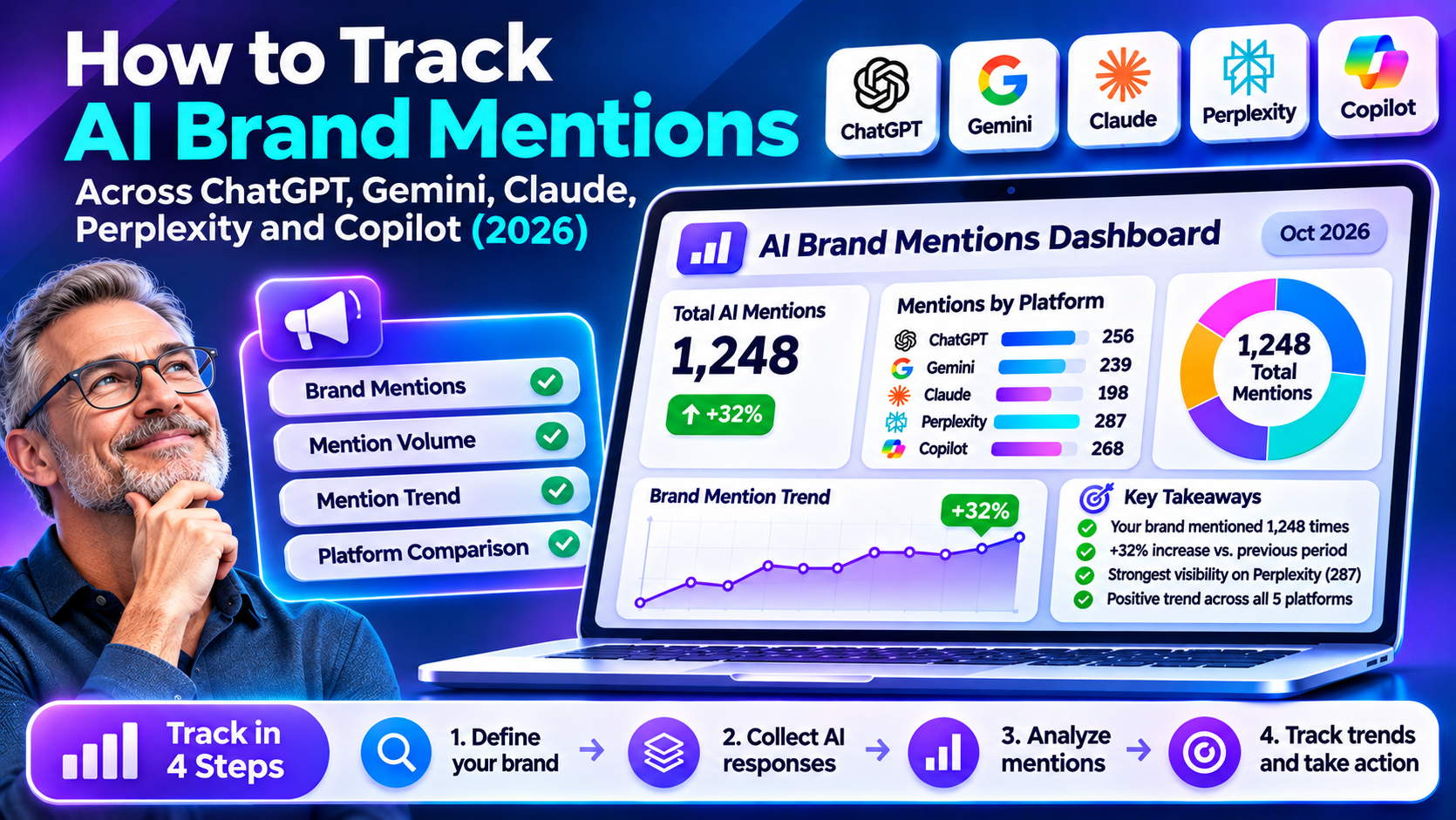
How to Track AI Brand Mentions Across ChatGPT, Gemini, Claude, Perplexity and Copilot (2026)
Does your company appear when buyers ask AI assistants for recommendations? A single ChatGPT answer cannot tell you. Businesses need a repeatable monitoring process across platforms, prompts, dates and locations to understand how often they are mentioned, recommended, cited or described correctly.
This 2026 guide explains how US businesses can build that process using a spreadsheet or specialist software. It covers five major AI assistants—ChatGPT, Google Gemini, Claude, Perplexity and Microsoft Copilot—with realistic measurement formulas, a sample scorecard, operational controls and a 30-day implementation plan.
The central distinction: a brand mention, a recommendation, a citation, and a website visit are different events. Count each separately. None guarantees a sale, and a single AI answer is not a stable search ranking.
Quick Answer: How Do You Track Brand Mentions Across AI Platforms?
- Define your exact brand name, recognized variations, competitors and US target markets.
- Create 30–50 realistic prompts representing informational, comparison, local and purchase-intent questions.
- Test each prompt on each relevant AI platform using documented settings and repeated samples.
- Save the answer text or authorized export, test date, model or product surface, citations and competitor mentions.
- Score mentions, recommendations, citations and factual accuracy independently.
- Repeat with the same protocol weekly or monthly, and analyze website referrals and conversions separately.
A spreadsheet is sufficient for a first baseline. Dedicated monitoring tools become useful when you need hundreds of prompts, multiple brands, audit trails, regional coverage or regular reporting.
1. What Counts as an AI Brand Mention?
An AI brand mention happens when an assistant names your company, product or an unambiguous brand variation in a response. The name may appear in a list, explanatory paragraph, comparison or recommendation. A citation occurs when an AI experience visibly references a page or source; the page can be cited without the assistant explicitly recommending the brand.
Consider a hypothetical US project-management software company, Northwind Tasks. If an assistant answers “Northwind Tasks is one option,” record a mention. If it answers “For a five-person agency, consider Northwind Tasks,” record both a mention and a recommendation. If it links to northwind.example/pricing, record a citation, whether or not the answer endorses the product.
| Signal | Practical definition | Why it matters |
|---|---|---|
| Brand mention | Brand named anywhere in sampled answer | Basic awareness in the tested answer |
| Recommendation | Brand positively suggested as relevant to user need | Commercial consideration |
| Owned-domain citation | A linked or displayed source from your domain | Evidence your site was referenced |
| Third-party citation | A review, directory or publication referenced | Evidence of external information sources |
| Accuracy | Material business facts match verified company records | Brand representation quality |
| Referral visit | Visitor arrives at your website from a recognizable AI source | Actual website discovery |
| Conversion | Referral visitor completes a meaningful action | Business outcome |
Do not count a competitor's name as your own brand mention. Keep records of ambiguous abbreviations and product names so all reviewers apply the same rules.
2. Know the Differences Between ChatGPT, Gemini, Claude, Perplexity and Copilot
These assistants can produce different responses because their tools, search modes, models, context and access to information differ. Tracking should capture the specific product surface, rather than reporting a universal “AI rank.”
| AI assistant | What to record | Measurement caveat |
|---|---|---|
| ChatGPT | Whether Search was used; model/surface; answer and cited links | Web search answers differ from non-search answers |
| Google Gemini | Gemini app and available grounding or source links | Gemini app results are not identical to Google AI Overviews |
| Claude | Web-search availability; answer; linked citations | User-directed retrieval differs from search discovery |
| Perplexity | Query, answer, displayed source references | Citations do not necessarily equal recommendations |
| Microsoft Copilot | Consumer or work surface; web grounding status; linked sources | Enterprise data or administrative settings can change results |
For example, comparing a web-grounded Copilot answer to a Claude answer without web access would mix different information conditions. Keep the context visible in your data before making any platform comparison.
ChatGPT: separate Search from conversational knowledge
OpenAI documents OAI-SearchBot as the crawler used to help surface pages in ChatGPT search, while GPTBot serves a separate model-training purpose. The ChatGPT-User agent can retrieve pages in some user-initiated workflows. Your monitoring dataset should record whether ChatGPT Search actually used web results and which visible sources appeared. Allowing search access can support discoverability; it does not guarantee a mention or citation.
Official reference: OpenAI crawler documentation.
Google Gemini: distinguish the assistant from Google Search AI features
Gemini Apps and Google's AI Overviews/AI Mode have related branding but are not identical products. Test them in separate cohorts. Google Search Console provides information about Google Search visibility, including generative AI reports, but it is not a complete transcript of the Gemini assistant's answers.
Official references: Google AI features guidance and Generative AI performance reports.
Claude: document web-search conditions
Anthropic distinguishes Claude-SearchBot, Claude-User and ClaudeBot. The first supports search discovery, the second supports user-requested retrieval, and the third relates to potential training data. These roles should not be conflated when troubleshooting missing citations.
Official reference: Anthropic crawler guidance.
Perplexity: inspect source lists, not just the main answer
Perplexity commonly displays supporting sources. Record each displayed source, its domain, whether it links to your company, and whether it provides evidence for the specific claim made. A citation to an independent review site does not equal a direct citation to your company website. Source selection varies across answers and dates.
Copilot: use Bing AI Performance for additional evidence
Microsoft's Bing Webmaster Tools AI Performance report provides aggregate citation information for supported Copilot, Bing AI and partner experiences. It shows cited URLs, trends and grouped grounding queries; it does not provide every user prompt, a position ranking or conversion data. Use it alongside controlled prompt tests instead of substituting it for those tests.
Official reference: Bing Webmaster Tools AI Performance.
3. Build a Representative Brand Monitoring Prompt Library
Most misleading AI visibility reports start with weak prompt selection. Asking only “Have you heard of [brand]?” is a branded awareness test; it does not establish whether an assistant recommends you to potential customers who do not know your name.
Construct prompts from authentic customer language: sales call notes, support tickets, internal search, website analytics, customer interviews, and questions from trusted research. Include commercial and noncommercial intent.
| Prompt group | Example for a US cybersecurity firm | Purpose |
|---|---|---|
| Discovery | “Which cybersecurity consulting firms work with mid-sized US manufacturers?” | Unbranded visibility |
| Comparison | “Compare three SOC 2 readiness consultancies for a 100-person SaaS company.” | Competitive positioning |
| Problem-solving | “Who can help our company prepare for a SOC 2 audit?” | Solution association |
| Local | “What cybersecurity firms serve businesses in Denver?” | Geographic relevance |
| Brand-specific | “What services does Northwind Security provide?” | Factual accuracy |
| Risk | “What should I verify before hiring a cybersecurity agency?” | Reputation and credibility |
For a small pilot, choose 30 prompts: 10 discovery, 8 comparison, 6 problem-solving, 4 local and 2 branded accuracy tests. This mix is illustrative: adjust it to your actual sales funnel and regions.
Keep prompts stable across monitoring cycles. When a prompt becomes obsolete, retire it with a date and introduce a new prompt version instead of silently changing the historic comparison.
4. Define the Measurement Protocol Before Collecting Answers
Decide how many runs will count as a sample. At minimum, store one complete answer per prompt and platform; for more confidence, sample multiple runs at similar times across each platform. Avoid presenting one response as a statistically precise market share estimate.
Record at least these fields in your worksheet:
| Field | Example |
|---|---|
| Test date (UTC) | 2026-11-15 |
| Platform | Claude |
| Product surface | Claude web search |
| Prompt ID | C-014 |
| Prompt version | v1 |
| Market/language | United States / English |
| Run number | 2 |
| Brand mentioned | Yes |
| Recommended | No |
| Owned URL cited | No |
| Competitors mentioned | Competitor A; Competitor B |
| Accuracy | Correct; incomplete; incorrect; not assessable |
| Evidence reference | Screenshot or controlled answer ID |
| Reviewer | Initials |
Do not store actual personal customer prompts without permission. Remove names, sensitive details and commercial secrets before sending any business context into a public AI interface.
Reduce inconsistencies and bias
Use the same prompt wording, language and location assumptions for each assistant where technically possible. For repeat testing, start new conversations to reduce personalization and carryover effects. Document logged-in status and availability of search/browsing tools. Do not automatically presume a model has searched the public web just because it answered a current question.
When you automate data collection, respect each provider's terms, API availability and rate limits. A compliant API integration may produce results that differ from a consumer interface; label those streams separately.
5. Calculate Six Essential AI Brand Visibility KPIs
Use the formulas below for your sampled answers. They are operational metrics, not platform-certified search rankings.
KPI 1 — Brand Mention Rate
Mention Rate = (Responses mentioning your brand ÷ all eligible responses) × 100.
If your brand appears in 18 of 60 eligible sampled answers, your Mention Rate is 30%. Define whether branded prompts belong in the denominator; for competitive discovery, it is often better to exclude them.
KPI 2 — Recommendation Rate
Recommendation Rate = (Responses positively recommending your brand ÷ eligible commercial-intent responses) × 100.
Suppose 9 of 40 commercial-intent responses recommend your company: 22.5%. Do not count a brand merely cited in an explanatory list as a recommendation.
KPI 3 — Owned-Domain Citation Coverage
Citation Coverage = (Sampled answers citing at least one owned-domain URL ÷ eligible sampled answers) × 100.
If 12 of 60 responses cite your site, coverage is 20%. Count answers, not the number of times the same URL appears in a single answer, unless tracking a distinct citation-frequency metric.
KPI 4 — Competitive Share of Mentions
Share of Mentions = (Your sampled brand appearances ÷ appearances by your brand plus selected competitors) × 100.
If your brand appears 20 times and three tracked competitors appear a combined 80 times, your share is 20%. Multiple companies can appear in the same answer, so this is a share of observed mentions, not a share of users, traffic or recommendations.
KPI 5 — Brand Accuracy Rate
Accuracy Rate = (Assessable brand descriptions without material inaccuracies ÷ all assessable brand descriptions) × 100.
Evaluate claims against a maintained fact sheet: official company name, US headquarters, services, pricing policy, support region and product availability. Mark uncertain answers “not assessable” rather than assuming they are accurate.
KPI 6 — AI Referral Conversions
AI Referral Conversion Rate = (Attributed conversion events ÷ tracked AI referral sessions) × 100.
Website analytics may identify sessions referred by AI products when referrer or campaign parameters are present. Some visits will be unclassified, and some AI-assisted customer journeys will not produce a direct click. Report observed attribution, not a complete census of AI-driven demand.
6. Example Monthly AI Brand Visibility Scorecard
The numbers below are hypothetical and demonstrate reporting layout only.
| KPI | ChatGPT | Gemini | Claude | Perplexity | Copilot |
|---|---|---|---|---|---|
| Eligible sampled answers | 60 | 60 | 60 | 60 | 60 |
| Brand mention rate | 30% | 22% | 18% | 35% | 25% |
| Recommendation rate* | 23% | 15% | 10% | 28% | 18% |
| Owned-domain citation coverage | 20% | 12% | 8% | 30% | 17% |
| Material factual errors | 2 | 3 | 1 | 2 | 2 |
Recommendation rate uses its own commercial-intent subset; results cannot be reverse-calculated from the all-answer count shown above.
Before publishing a real scorecard, calculate each percentage from the underlying response counts, record the exact observation window, and check whether the same prompts and sampling schedule were used. Differences are descriptive, not proof that one AI company favors or suppresses your brand.
7. Monitor Citations and Source Quality
Brand mentions tell you whether your company appeared. Citations help explain which public sources a system surfaced. Keep a citation table with source URL, domain, first-party versus third-party classification, source category, and whether the citation supports the relevant claim.
For example, a Perplexity answer may cite your official services page and an industry directory. Both are informative but should be coded differently. A competitor's article that merely names your company is not a first-party citation.
Pay attention to recurring external sources such as review sites, specialist publications, trade associations and legitimate directories. Improving accurate information in those places may be useful for customers regardless of how AI systems select sources.
Do not automatically interpret a domain being cited as proof that it was used for model training or as proof that it was the only influence on an answer. Citation lists generally do not expose the complete generation process.
8. Combine Manual Tests With First-Party Reporting and Web Analytics
A practical monitoring stack uses complementary data sources:
- AI answer sampling: evidence of specific mentions, recommendations and factual claims.
- Bing Webmaster Tools AI Performance: aggregated citations for supported Microsoft AI experiences; not a universal assistant dashboard.
- Google Search Console: search and generative AI visibility reporting for Google Search experiences, which should not be conflated with Gemini app mentions.
- Website analytics: detectable referral sessions, landing pages, engagement and conversions.
- Customer feedback and CRM: evidence from real prospects who say they discovered your business using AI.
Cross-reference trends without adding incompatible measurements together. For example, a Microsoft citation count and a sampled ChatGPT recommendation count have different collection methods and denominators.
What about dark traffic?
Some users read an AI response and later type your website address, search your name or ask a colleague to contact you. These journeys may not have a measurable AI referrer. Include an optional, non-leading “How did you hear about us?” question in enquiry forms. Report self-reported discovery separately from analytics-attributed referrals.
9. Should You Use AI Brand Monitoring Software?
Manual testing is ideal for learning the process. But regular analysis of hundreds of prompts across five assistants can become operationally expensive. Dedicated software can help manage prompt libraries, competitor benchmarking, historical trends, citations, exports, alerts and team workflows.
Your US AI Visibility Directory lists several relevant vendors:
| US company | What to evaluate | Directory profile |
|---|---|---|
| Profound | AI search intelligence, tracked prompts, citation analytics | Profound |
| Evertune | GEO analytics, prompt insights, marketing workflows | Evertune |
| Scrunch AI | AI visibility monitoring, citations and agent experience | Scrunch AI |
| Brandlight | Brand representation, reputation and enterprise monitoring | Brandlight |
| Conductor | Enterprise AI search analytics integrated with SEO workflows | Conductor |
| seoClarity | Enterprise SEO, AI visibility and competitive analytics | seoClarity |
Platform support, plan limits and data collection methods change. During demonstrations, ask the vendor to prove exactly which AI experiences it tracks, how often prompts are repeated, how it normalizes metrics, whether citations are visible, and which regions or languages are supported.
See also: AI Visibility Software: How to Choose the Right Platform and Profound vs Evertune.
10. A 30-Day AI Brand Monitoring Implementation Plan
Days 1–7: Design the baseline
- Identify 1 primary brand and up to 3 direct competitors.
- Define 30 representative prompts and each prompt's commercial intent.
- Establish a company fact sheet for objective accuracy checks.
- Pick relevant US states or regions, languages and product surfaces.
- Define which answers count in each KPI denominator.
Deliverable: approved prompt library and written scoring rules.
Days 8–14: Collect the first samples
- Run the prompt set consistently across five AI assistants where supported.
- Capture responses and visible citations with dates and product settings.
- Independently review ambiguous recommendations and factual statements.
- Calculate initial mention, recommendation, citation and accuracy scores.
Deliverable: initial evidence-backed visibility scorecard.
Days 15–21: Identify improvement opportunities
- Audit frequently mentioned competitors and their cited sources.
- Check whether your site has clear product, service and comparison information.
- Review crawl access and search indexation without weakening site security.
- Correct outdated brand facts on your website and appropriate external profiles.
- Prioritize three high-value content or technical improvements.
Deliverable: ranked improvement backlog with owners.
Days 22–30: Repeat and report
- Rerun a defined subset of prompts using the same protocol.
- Track differences in mentions, recommendations, citations and accuracy.
- Review first-party citation data and referral conversions where available.
- Document tool configuration changes or sample-size limitations.
- Decide which metrics merit ongoing weekly or monthly reporting.
Deliverable: monthly dashboard, evidence register and next actions.
A 30-day change is a directional observation, not proof of causation. More reliable conclusions usually need longer monitoring and repeated samples.
11. Common Mistakes to Avoid
Mistake: checking a single prompt and declaring a ranking. AI answers vary. Repeat samples, use realistic unbranded prompts and describe uncertainty.
Mistake: counting all mentions as endorsements. A brand can be referenced critically or neutrally. Review its context.
Mistake: treating citations as website clicks. Displayed citations do not mean anyone clicked them. Consult analytics for visits.
Mistake: comparing unmatched product surfaces. Search-enabled and non-search-enabled responses may have different source access.
Mistake: changing the prompt library every week. Stable queries are necessary for meaningful comparisons; version prompt changes.
Mistake: confusing Google Search AI reports with Gemini app monitoring. Treat them as different measurement sources.
Mistake: trusting auto-generated scores without checking evidence. Spot-check answer text, links, duplicate sources and classification decisions.
Mistake: ignoring leads and revenue. Visibility is an intermediate indicator. Track qualified inquiries and customer acquisition where attribution is reasonably available.
12. Frequently Asked Questions
Can I see every question people ask ChatGPT about my company?
No. A business cannot assume access to a universal log of private user prompts across public AI assistants. Use ethically collected sample prompts, available publisher analytics and your own customer research.
Is there one official AI Visibility score for all five platforms?
No. Different tools and publishers use different models, prompts, sampling strategies and formulas. Any aggregate score should show its definitions, weights, platforms and dates.
How often should a small US business test its brand?
Start monthly with a stable prompt set; use weekly checks for critical brand inaccuracies, launches or time-sensitive events. Adjust cadence to the business's risk, budget and resources.
Do I need paid software?
Not initially. A well-designed spreadsheet and 30–50 carefully selected prompts can establish an informative baseline. Paid tools are most useful when analysis volume, team collaboration or reporting complexity justifies the cost.
Why might a brand appear on Perplexity but not Claude?
The systems may use different information sources, tools, prompts or selection methods. Check that you tested equivalent conditions before inferring why outcomes differ.
Is a mention more valuable than a citation?
Neither is universally more valuable. Mentions can show brand awareness; citations can show source inclusion; recommendations may be more commercially relevant. Evaluate each against qualified visits and leads.
Can I guarantee more AI recommendations by changing robots.txt?
No. Appropriate crawl access can support search discovery, but inclusion is subject to content relevance, system behavior and other factors. Do not weaken privacy or security controls in pursuit of mentions.
How should I respond to incorrect AI information about my business?
Document the exact error, affected platform and date; verify your own official facts; correct relevant owned and legitimate third-party sources; and retest. Where the platform has an error-reporting mechanism, use it without assuming a guaranteed correction timeline.
Conclusion: Measure a Consistent Sample, Not a Mythical Universal Ranking
AI brand monitoring works best when your team creates a stable sample of relevant questions, captures evidence across comparable AI experiences, evaluates mentions and recommendations separately, and connects observable visibility to website visits and commercial outcomes.
A US business can start with a spreadsheet and a monthly review. As the program grows, consider dedicated software, independent audit processes and a maintained source-of-truth fact sheet. The goal is not to manufacture an impressive AI score; it is to understand how real buyers may encounter your brand and what you can improve.
Explore the AI Visibility Platforms directory to compare US software providers, or find GEO and AEO agencies for implementation support.
Official Sources and Further Reading
- OpenAI — Overview of OpenAI Crawlers
- Anthropic — Claude crawler guidance
- Google Search Central — AI features and your website
- Google Search Central — Generative AI performance reports
- Microsoft Bing Webmaster Tools — AI Performance
- Google Search Central — Combining Search Console and Analytics
Editorial note: This independent educational guide does not promise guaranteed AI mentions, citations, recommendations or rankings. Sample figures are illustrative. Last reviewed November 15, 2026.