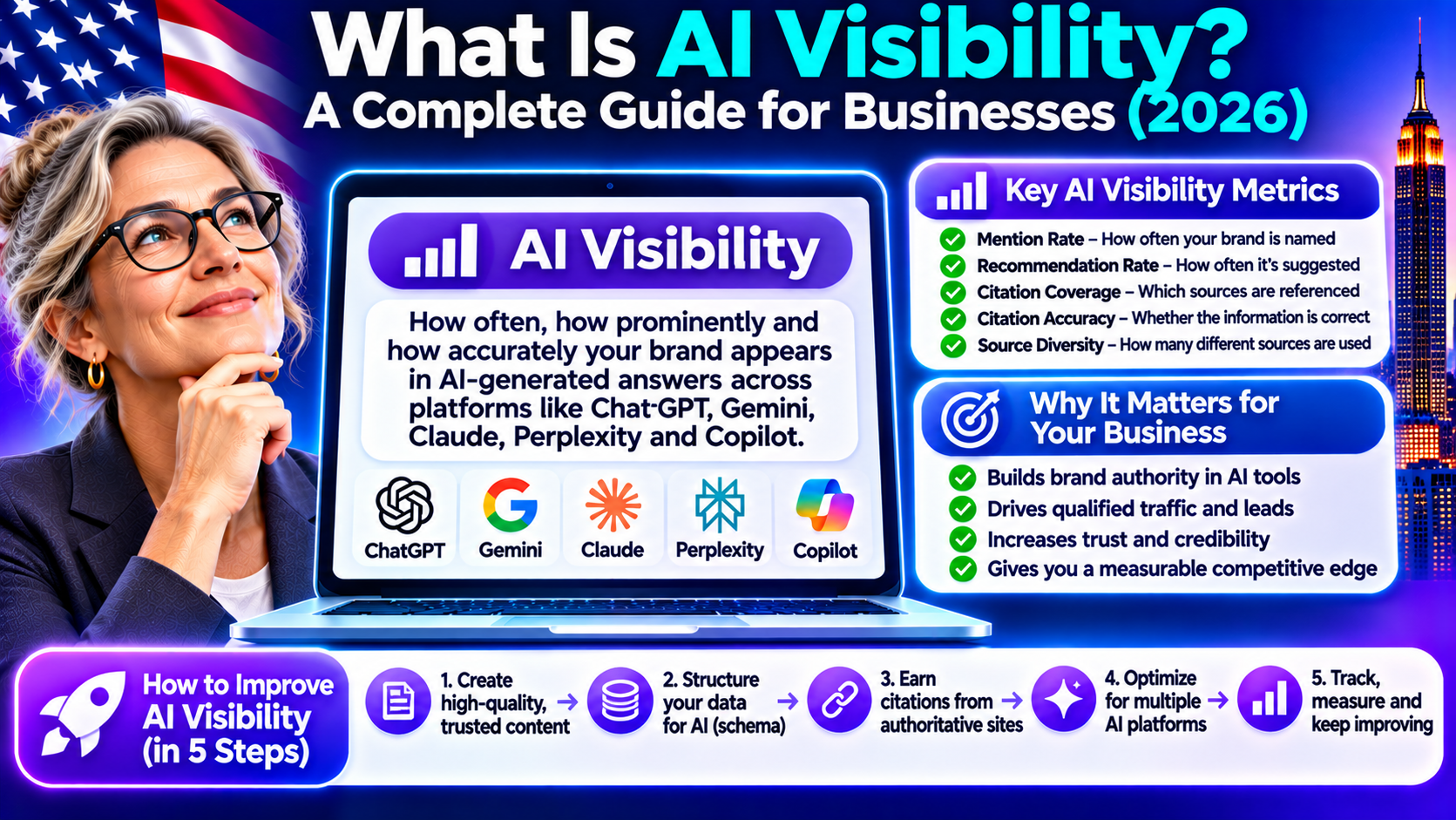
What Is AI Visibility? A Complete Guide for Businesses (2026)
When someone asks ChatGPT, Gemini, Perplexity, or another AI assistant to recommend a solution in your industry, does your company appear? If it does, is the recommendation accurate? Does the answer link to your website, a review, or a third-party publication?
Those questions define a growing business discipline: AI visibility. This guide explains what the term means, how to measure it responsibly, and which practical steps businesses can take without assuming that an AI system can be manipulated into recommending them.
Quick definition: AI visibility is the extent to which a brand, product, person, or website is mentioned, described, cited, or recommended in AI-generated answers relevant to a target audience. A credible measurement program defines the questions being tested, the AI systems involved, the locations and dates of testing, and the evidence supporting each observation.
Why AI visibility matters in 2026
Potential buyers increasingly use conversational AI to explore categories, compare vendors, summarize options, and ask follow-up questions. A buyer might ask: Which expense-management platform works for a 50-person company? or Which GEO agencies specialize in B2B SaaS?
An answer may include your brand, your competitors, a third-party review, or no specific vendor at all. Unlike a conventional search results page, the system may synthesize information into a direct recommendation, sometimes with source links and sometimes without them.
AI visibility matters because a business can be present in traditional search yet absent from answers to commercially relevant AI questions. The reverse is also possible: a brand may appear in a conversational answer even when its own website is not linked. Both cases are important to understand.
This does not mean conventional SEO has become obsolete. Google's guidance on AI features says foundational SEO practices remain relevant and that there are no special technical requirements beyond normal Search eligibility to appear in AI Overviews or AI Mode. AI visibility should therefore complement—not replace—useful content, technical accessibility, and trustworthy public information.
How AI-powered discovery differs from traditional search
| Dimension | Traditional organic search | AI-generated answers |
|---|---|---|
| Common output | Ranked links and search features | Synthesized text, recommendations and sometimes citations |
| Main unit of analysis | Query, ranking, impression, click | Prompt, answer, mention, citation, recommendation |
| Variation | Rankings vary by time, location and device | Answers can also vary between runs and conversation context |
| Website recognition | A page can rank without the brand being recommended | A brand can be mentioned without a link to its website |
| Measurement | Search Console, web analytics and rank tracking | Dated answer samples, source citations and analytics |
| Business impact | Visits, conversions, brand exposure | Awareness, research influence, referrals and potentially conversions |
Important distinction: a cited website is not necessarily the same company that the answer recommends. Count brand mentions and website citations separately.
The six building blocks of an AI visibility program
1. Brand mentions
A brand mention occurs when an AI answer explicitly references your company, product, or accepted brand alias. For reliable reporting, document the naming rules: a parent company, a subsidiary, and a product name may require separate counts. A mention is not automatically an endorsement.
Example: in a set of 40 sampled answers to relevant buyer prompts, your brand appears in 12. The observed mention rate is 12 ÷ 40 = 30%. This describes only that prompt set and measurement period; it does not prove that 30% of all AI users see the brand.
2. Recommendations and position
A recommendation is more specific than a mention. The answer presents the company as a viable or preferred solution for the buyer's request. Some teams track whether the brand was first-mentioned, included in a shortlist, or positively recommended. Because generated answers do not have a consistent ranking structure, treat any AI rank as a measurement convention, not an official universal ranking.
3. Citations and source coverage
An AI answer may cite a manufacturer's documentation, a review, a news story, a product page, or a comparison guide. Track the actual cited URL, its domain, the prompt, and the answer date. Measure both how often your own pages are cited and how broadly relevant third-party sources represent your brand.
More citations do not automatically mean better results. A frequently cited page could still be outdated or irrelevant to the commercial question.
4. Brand accuracy
AI systems may confuse product versions, headquarters, pricing, ownership, capabilities, or the difference between two similarly named companies. Build an approved fact sheet and compare important claims in sampled answers against current primary sources.
Categorize issues such as correct, outdated, unsupported, wrong entity, or needs review. Save the original answer and citation evidence so a human can validate the finding.
5. Competitive visibility
A meaningful competitor comparison uses the same prompts, platforms, dates, countries, and classification rules. Track the competing brands that appear and report the denominator. A branded prompt such as “Tell me about Acme” should not be mixed with an unbranded buying prompt such as “Best scheduling software for dental practices” when calculating competitive share.
6. Referral traffic and business outcomes
Website analytics may capture visits referred from some AI experiences. CRM data can then show whether those sessions resulted in qualified leads or revenue. However, not every AI-influenced journey produces a recognizable referral: buyers may research with AI and later visit directly or through another channel.
For that reason, use AI visibility data as an intermediate indicator, not a substitute for revenue and customer research.
A practical AI visibility scorecard
The table below is an illustrative reporting framework, not a proprietary or industry-standard scoring model.
| Metric | Example definition | What it tells you | Caution |
|---|---|---|---|
| Mention rate | Answers mentioning brand ÷ eligible sampled answers | Brand presence | Depends on your prompt sample |
| Recommendation rate | Answers recommending brand ÷ eligible answers | Commercial inclusion | Requires clear human-reviewed rules |
| Citation rate | Answers citing a brand-owned URL ÷ eligible answers | Owned-site citation frequency | Does not measure all brand exposure |
| Source diversity | Distinct relevant domains cited | Breadth of referenced evidence | Quality matters more than raw volume |
| Accuracy rate | Verified correct claims ÷ evaluated factual claims | Reliability of representation | Requires approved facts and review |
| Competitive share | Brand appearances ÷ all tracked brand appearances | Relative exposure in sample | Multi-brand answers complicate totals |
| AI referral conversions | Qualified conversions from identifiable AI referrals | Directly attributable outcomes | Underestimates untracked influence |
Example: A B2B firm tests 30 unbranded prompts on two platforms, repeating each prompt twice. This produces 120 answers. If the brand appears in 24 answers, its observed mention rate is 20% across that specific sample. If 8 answers cite its own website, its observed owned-site citation rate is approximately 6.7%. Neither percentage describes every possible user session; both describe a reproducible baseline for future comparisons.
How to establish your first AI visibility baseline
You can begin manually before purchasing specialized software.
Step 1: Choose a business objective
Decide whether you want to improve category awareness, capture qualified buyers, correct inaccurate descriptions, grow citations to a particular product, or compare your brand with competitors. Different objectives require different prompts and measurements.
Step 2: Build a representative prompt list
Start with 20–30 questions representing the customer journey:
- Discovery: “What types of software help automate contract renewals?”
- Shortlisting: “Which contract renewal systems suit a mid-sized business?”
- Comparison: “How do platforms A and B differ for approval workflows?”
- Technical evaluation: “Which tools support SSO and API integrations?”
- Buying decision: “What should I check before selecting a vendor?”
Include unbranded prompts and a smaller number of branded diagnostic prompts. Avoid selecting only questions where your company is already likely to appear.
Step 3: Define the test conditions
Record the AI platform, date, region, language, prompt wording, conversation state, response text and citations. Repeat each prompt where practical because the output can vary. Do not compare a US English prompt on one day with a differently worded international prompt on another and treat the result as a controlled change.
Step 4: Classify each answer
Use a consistent set of labels: mentioned, recommended, not present, own-site cited, competitor cited, accurate, inaccurate, and uncertain. Have a human review ambiguous cases and document changes to the rules.
Step 5: Create a baseline report
Summarize the results by platform, topic, intent and competitor. Keep links or saved evidence for the underlying responses, rather than publishing just an unexplained aggregate score.
Step 6: Recheck after meaningful changes
Repeat the same core prompts on a defined cadence, such as every two to four weeks. Separate ordinary answer variation from persistent changes. Track when content was updated, when earned-media coverage appeared, and when technical changes went live, but do not claim causation merely because a visibility metric changed afterward.
Can businesses improve AI visibility?
Businesses can improve the quality, accessibility, consistency and discoverability of the information that AI systems may use. They cannot guarantee inclusion in generated answers. The safest starting point is to improve real customer value and the underlying source material.
Publish original answers to real buying questions
Explain use cases, limitations, implementation requirements, pricing models, comparisons and product differences with firsthand evidence. Include examples, documentation and clear authorship where appropriate. Avoid producing dozens of near-identical pages solely to target slightly different AI prompts.
Keep company facts consistent
Make headquarters, product names, ownership, contact information, and key capabilities easy to verify on official pages. Update old claims, and correct inconsistent descriptions across major public profiles under your control.
Make important content accessible
Check that key pages are crawlable, indexable where intended, accessible without unnecessary barriers, and understandable in rendered HTML. Use descriptive headings, intuitive internal links and accurate structured data where appropriate. Structured data helps describe supported facts but does not guarantee AI citations.
For websites targeting ChatGPT search, OpenAI documents a distinction between OAI-SearchBot, which supports search discovery, and GPTBot, which relates to model-training crawling. Administrators can control these separately through robots.txt. Allowing one crawler does not guarantee inclusion in answers.
Strengthen legitimate third-party references
Independent industry publications, professional associations, relevant directories, genuine reviews and expert interviews can help prospective buyers find corroborating information. Seek accurate coverage and avoid artificial reviews, paid undisclosed endorsements, or fabricated citations.
Improve outdated or inaccurate source information
If a wrong product fact repeatedly appears, investigate the underlying source. Update the authoritative page, clarify ambiguous naming, and request correction where an external publisher is responsible. Recheck the answer after an appropriate interval; a correction may not propagate immediately.
Measure downstream buyer behavior
Use website analytics, CRM qualification data, feedback from sales teams and customer interviews. Ask incoming leads how they discovered you, but do not treat self-reported discovery alone as precise attribution.
SEO vs AEO vs GEO: what is the difference?
These terms overlap, and vendors do not always define them identically.
SEO — Search Engine Optimization: improving website accessibility, usefulness, relevance and performance in conventional search engines.
AEO — Answer Engine Optimization: commonly used to describe making information useful and discoverable for systems that provide direct answers, including AI-assisted search experiences.
GEO — Generative Engine Optimization: commonly used to describe improving the chance that relevant information about a brand is discovered, represented and cited in generative responses.
The practical distinction is one of emphasis, not mutually exclusive technical methods. For Google's generative search features, Google explicitly recommends foundational SEO and valuable original content instead of gimmicks marketed as GEO-specific shortcuts. See Google's optimization guidance.
A good AI visibility plan usually includes SEO fundamentals, clear business facts, helpful content, authoritative references, and reliable measurement.
When to choose software versus an agency
The right operating model depends on your team's resources and the work required.
| Situation | A sensible starting point |
|---|---|
| Marketing analysts need repeatable prompt and citation data | AI visibility monitoring platform |
| Complex website needs technical audits and implementation | Technical SEO/GEO agency |
| Brand is inaccurately described in AI answers | Monitoring plus content and source correction |
| Business lacks an internal content or outreach team | Managed agency service |
| Large enterprise needs integrations, governance and reporting | Enterprise software and possibly specialist consultancy |
US-based AI visibility software in this directory
Explore Profound, Evertune, Scrunch AI, Brandlight, Conductor, and seoClarity. These platforms emphasize different combinations of AI visibility measurement, content workflows, citation analytics, brand intelligence and technical search insights.
For a more detailed buyer framework, find AI Visibility Software: How to Choose the Right Platform (2026) in this directory’s Articles section.
US-based agencies and consultants in this directory
Compare WebFX, Omniscient Digital, iPullRank, and First Page Sage. Their positioning ranges from managed GEO/AEO programs to technical AI search and B2B content strategy.
Browse the GEO & AEO Agencies category and read our article Best Generative Engine Optimization (GEO) Agencies in the USA (2026). As with any procurement decision, verify current service offerings directly with providers.
Editorial note: Directory inclusion is not a ranking, endorsement, or confirmation that products have been independently tested. Features and commercial terms should be verified with each provider.
Common AI visibility mistakes
- Assuming a single response is a ranking. Generative answers vary; save evidence and repeat your tests.
- Counting all mentions as recommendations. A neutral mention, a negative discussion and a positive shortlist entry are different outcomes.
- Ignoring the prompt denominator. A 40% mention rate is meaningless without explaining which questions produced it.
- Optimizing only for bots. Content still needs to help actual customers.
- Treating source citations as guaranteed endorsements. A citation may point to a third-party page or appear in a different context.
- Buying tools before defining decisions. Decide who will act on insights and what changes are feasible.
- Using fabricated reviews or paid undisclosed placements. These undermine trust and may create regulatory or platform-policy risks.
Frequently asked questions
Is AI visibility the same as appearing on Google?
No. Organic Google search visibility usually concerns search results and traffic. AI visibility concerns appearances, citations, descriptions and recommendations within generated answers. There is overlap, especially with Google's AI search features.
Can I force ChatGPT or Gemini to recommend my business?
No. Publishing content, allowing crawlers, or paying for software does not guarantee recommendations. Focus on accurate, relevant information and measure results transparently.
Does an AI citation mean the system recommends my company?
Not necessarily. A citation identifies a referenced source, while a recommendation expresses an answer's selection or preference. They should be measured separately.
How many prompts do I need to track?
There is no universal number. A small business can start with 20–30 carefully selected questions and expand after learning which prompts represent real buyer intent. Sampling quality and consistency matter more than the largest possible count.
How often should I check AI visibility?
A monthly or biweekly check is a practical starting point for many small teams. More frequent monitoring may help fast-moving brands, but results must be interpreted in light of answer variability and cost.
Do AI visibility services replace SEO?
No. Technical accessibility, helpful content and credible information remain foundational. For Google AI Overviews and AI Mode, Google states that the same fundamental SEO practices apply.
Should a small company hire an agency or buy a platform?
Start by identifying whether your main gap is measurement or execution. Software helps quantify and investigate visibility; agencies can implement content, technical changes and outreach. Some businesses need both, but a manual baseline is a reasonable first step.
Your next five actions
- Write down the five customer questions most likely to precede a purchase.
- Test those questions on the AI systems your buyers actually use, and record the responses.
- Verify whether mentions, citations and factual claims are correct.
- Identify one useful content, technical or public-information improvement to implement.
- Repeat the measurement with the same prompts and document what changed.
Bottom line: AI visibility is not about obtaining an artificial number or promising a top spot in ChatGPT. It is about ensuring that credible business information can be discovered, understanding how a brand is represented in AI-generated answers, and using evidence to improve the experience of real customers.
To find assistance, explore the AI Visibility Platforms and AI Visibility Consulting categories in the AI Visibility Directory.
Sources and methodology
- Google Search Central — AI features and your website
- Google Search Central — Optimizing for generative AI features
- Google Search Central — Creating helpful, reliable, people-first content
- OpenAI — Overview of OpenAI crawlers
This educational article was prepared with AI assistance and editorially structured from the linked official documentation and a practical measurement framework. Illustrative calculations are examples, not performance claims. It does not constitute a guarantee of AI search outcomes or a product endorsement. Last reviewed: November 15, 2026.